Owaisi Flags Privacy Violation, Cites Puttaswamy Ruling

Synopsis
AIMIM president Asaduddin Owaisi on June 20, 2026, invoked the Supreme Court's landmark 2017 Puttaswamy ruling to condemn a new government measure as a 'blatant violation' of the fundamental right to privacy, warning it would enable further abuse of citizens' rights by law enforcement.
Key Takeaways
Asaduddin Owaisi , AIMIM president and Hyderabad MP, called a new government measure a 'blatant violation' of the Puttaswamy privacy judgement on June 20, 2026 .
The 2017 Supreme Court ruling in Justice K.S.
Puttaswamy (Retd.) v.
Union of India recognised the right to privacy as a fundamental right under Article 21 .
The judgement requires any state intrusion into personal data to meet tests of legality, necessity, and proportionality.
Owaisi warned the measure would enable arbitrary police action against ordinary citizens, citing the risk of vague enforcement powers.
The Digital Personal Data Protection Act and related surveillance rules remain under ongoing parliamentary and judicial scrutiny.
Constitutional challenges before the Supreme Court are the expected next step for those contesting the measure's validity.
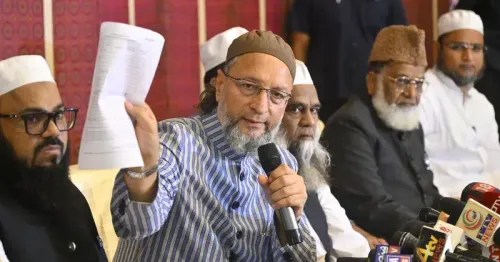
AIMIM president Asaduddin Owaisi on Saturday, June 20, 2026, sharply criticised a new policing or data-gathering measure, calling it a 'blatant violation' of the landmark Puttaswamy privacy judgement and warning it would enable further abuse of citizens' rights.
Context
In his post on X, Owaisi wrote: 'This is a blatant violation of the Puttaswamy judgement, which recognised right to privacy as a fundamental right. In a country where cops can arrest you for drinking tea suspiciously, this will just enable more abuse of citizens' rights.' The statement was directed at what appears to be a fresh government measure touching on surveillance, biometrics, or law-enforcement data collection — the precise policy instrument has not yet been formally identified in public record.
The Hyderabad MP invoked the Supreme Court's 2017 nine-judge bench ruling in Justice K.S. Puttaswamy (Retd.) v. Union of India, one of the most consequential constitutional judgements in recent Indian history, to anchor his objection in established law rather than political opinion.
Policy Backdrop
The 2017 Puttaswamy judgement unanimously held that informational privacy is a fundamental right protected under Article 21 of the Constitution. It set a three-part test — legality, necessity, and proportionality — that any state intrusion into personal data or bodily autonomy must satisfy.
Since that ruling, successive statutes and executive rules on biometrics, CCTV mandates, criminal-procedure reforms, and digital data collection have drawn repeated legal challenges from opposition lawmakers and civil liberties groups. The Digital Personal Data Protection Act and rules framed under it remain under parliamentary and judicial scrutiny for how well they honour the proportionality standard the Supreme Court established.
Owaisi's reference to police arresting citizens for drinking tea 'suspiciously' alludes to a pattern of discretionary and vaguely worded powers that critics say leave ordinary citizens — particularly from marginalised communities — exposed to arbitrary enforcement when new surveillance tools are introduced without robust safeguards.
Stakeholders and Impact
Civil liberties advocates and digital-rights organisations have long argued that India's law-enforcement architecture lacks the independent oversight mechanisms needed to prevent misuse of expanded surveillance capabilities. Owaisi, who frequently raises minority-rights and civil-liberties concerns in Parliament, has positioned this objection as one that cuts across community lines — framing it as a threat to every citizen's constitutional guarantees.
Citizens subject to any new data-collection or policing measure would be the most directly affected, with marginalised communities historically bearing a disproportionate share of discretionary police action. Legal challenges before the Supreme Court or High Courts are a likely avenue for those contesting the measure's constitutional validity.
What's Next
Opposition parties and civil-society groups are expected to demand a detailed parliamentary debate on the measure's legal basis and compliance with the Puttaswamy proportionality test. Any constitutional challenge would likely be heard against the backdrop of pending cases under the Digital Personal Data Protection Act, making the Supreme Court's evolving privacy jurisprudence the decisive battleground. Owaisi's intervention signals that the issue will be pressed both inside Parliament and in public discourse in the weeks ahead.
Point of View
Forcing the government to justify the measure against the Supreme Court's own proportionality standard. It fits a broader post-2017 pattern in which opposition leaders and rights groups use the privacy ruling as a constitutional lever against successive surveillance and data-collection initiatives. The 'drinking tea suspiciously' framing is rhetorically deliberate — it grounds an abstract legal argument in the lived experience of discretionary policing that resonates with a wide cross-section of citizens. How the government responds, and whether a formal legal challenge follows, will test how robustly the Puttaswamy framework is being applied in practice.
NationPress
21 Jun 2026
Frequently Asked Questions
What is the Puttaswamy judgement that Owaisi cited?
The Puttaswamy judgement refers to the Supreme Court's unanimous 2017 ruling in Justice K.S. Puttaswamy (Retd.) v. Union of India, which recognised the right to privacy as a fundamental right under Article 21 of the Constitution and set tests of legality, necessity, and proportionality for any state intrusion.
Why is Owaisi criticising the new government measure?
Owaisi argues the measure violates the constitutionally protected right to privacy established in the Puttaswamy judgement and will give law enforcement vaguely worded powers that can be misused against ordinary citizens.
What does 'proportionality' mean under the Puttaswamy ruling?
Under the Puttaswamy framework, any government action that restricts privacy must be proportionate — meaning the intrusion must not be excessive relative to the legitimate aim it pursues, and less restrictive alternatives must have been considered.
What is the Digital Personal Data Protection Act and how is it related?
The Digital Personal Data Protection Act is India's framework law for regulating how personal data is collected and processed; rules framed under it are already under scrutiny for compliance with the proportionality standards the Supreme Court set in Puttaswamy.
Can citizens legally challenge surveillance measures that violate Puttaswamy?
Yes. Citizens and civil-society organisations can file writ petitions before the Supreme Court or High Courts challenging any law or executive action that fails the legality, necessity, and proportionality tests established in the Puttaswamy judgement.