Jal Shakti Minister Paatil asserts India's claim on Indus waters
Synopsis
Union Jal Shakti Minister C. R. Paatil on June 9, 2026 posted a sharp assertion on X declaring India's sovereign right over its share of the Indus River, saying the water belongs to India's people. The statement renews focus on India's push to fully utilise its treaty entitlements and signals continued pressure on the 1960 Indus Waters Treaty framework.
Key Takeaways
Union Jal Shakti Minister C.
Paatil posted on June 9, 2026 asserting India's right over its share of the Indus River .
The Indus Waters Treaty of 1960 grants India full rights over the eastern rivers and limited but significant rights on the western rivers.
India has formally sought modifications to the treaty, citing changed circumstances and climate-related hydrological changes.
Key beneficiaries of fuller water utilisation include farmers in Jammu and Kashmir, Punjab, and Haryana .
The Permanent Indus Commission , the bilateral oversight body, has held irregular meetings amid India-Pakistan diplomatic strains.
The statement is expected to be watched alongside any new hydropower project clearances or infrastructure announcements on western rivers.
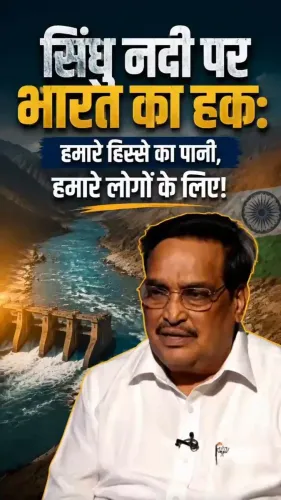
Union Jal Shakti Minister C. R. Paatil on Tuesday, June 9, 2026 staked a firm assertion of India's sovereign claim over its share of the Indus River system, declaring in a post on X that the water flowing through the river belongs to India's own people.
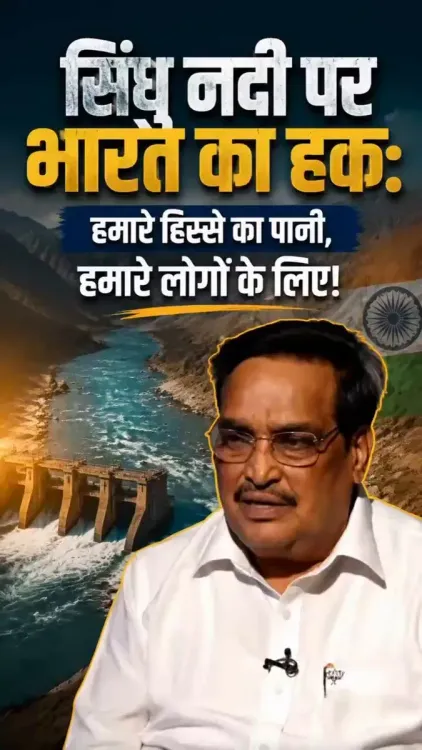
Paatil's post, written in Hindi, read: 'Sindhu nadi par Bharat ka haq: hamare hisse ka paani, hamare logon ke liye!' — translated as 'India's right over the Indus River: our share of the water, for our people!' The statement is a pointed articulation of a position that has grown louder among Indian policymakers in recent years.
Context
The Indus Waters Treaty of 1960, brokered by the World Bank, divided the six rivers of the Indus system between India and Pakistan. Under its terms, India received full rights over the three eastern rivers — the Ravi, Beas, and Sutlej — while the three western rivers — the Indus, Jhelum, and Chenab — were allocated primarily to Pakistan, with limited use rights for India.
India has long maintained that it has not fully utilised even the water it is entitled to under the treaty, particularly on the western rivers where it holds rights to run-of-river hydropower projects and limited irrigation. The minister's statement squarely addresses that gap between entitlement and utilisation.
Policy Backdrop
Indian ministers and officials have periodically issued statements affirming India's treaty rights, often in the context of planned hydropower projects in Jammu and Kashmir or in response to tensions with Pakistan. The Jal Shakti Ministry, which Paatil heads, oversees national water resource planning, river development, and the Namami Gange programme.
India has in recent years pushed ahead with infrastructure on permitted western-river projects, including hydropower stations in Jammu and Kashmir. The government has also formally communicated to Pakistan its intent to seek modifications to the treaty, citing changed circumstances and the need to account for climate-related hydrological shifts.
The Permanent Indus Commission, the bilateral body that oversees treaty implementation, has seen irregular meetings in recent years amid broader diplomatic strains between the two countries.
Stakeholders and Impact
The most direct beneficiaries of fuller utilisation of India's Indus entitlement would be farmers and communities in Jammu and Kashmir, as well as cultivators in Punjab and Haryana who depend on the river system for irrigation. Hydropower generation in the Himalayan foothills would also expand, potentially easing power deficits in northern states.
For Pakistan, as the lower riparian state, any significant increase in India's upstream water use — within or beyond treaty limits — carries implications for agricultural output in its Punjab and Sindh provinces, which are heavily dependent on Indus flows.
What's Next
Observers will watch for whether Paatil's statement is followed by concrete policy announcements — such as accelerated clearances for pending hydropower projects or a formal update on India's treaty-modification notice to Pakistan. The next scheduled meeting of the Permanent Indus Commission and any new infrastructure announcements on western rivers will be key signals of how far this assertion translates into action.
With water security increasingly framed as a national-interest issue, the minister's post signals that the Indus question is unlikely to recede from India's political and diplomatic agenda.
Point of View
Fitting a pattern where BJP ministers use water rights language to signal both domestic resolve and diplomatic posture toward Pakistan. It arrives at a moment when India's formal notice seeking treaty modifications remains unresolved, giving the statement a policy dimension beyond rhetoric. The framing — 'our water, for our people' — is designed to resonate with constituencies in water-stressed northern states while reinforcing the government's broader narrative of assertive resource nationalism. Whether it precedes a concrete policy move or remains a statement of principle will determine its lasting significance.
NationPress
26 Oct 2026
Frequently Asked Questions
What is India's right over the Indus River?
Under the Indus Waters Treaty of 1960 , India has full rights over the eastern rivers of the Indus system — the Ravi, Beas, and Sutlej — and limited but defined rights on the western rivers, including the right to build run-of-river hydropower projects.
What did Jal Shakti Minister C. R. Paatil say about the Indus River?
On June 9, 2026 , Paatil posted in Hindi declaring 'India's right over the Indus River: our share of the water, for our people,' asserting that India must fully utilise its treaty entitlement for its own citizens.
Is India trying to change the Indus Waters Treaty?
India has formally communicated to Pakistan its intent to seek modifications to the 1960 treaty , citing changed circumstances including climate-related hydrological shifts and the need to update provisions after more than six decades.
Who benefits if India uses more of its Indus water share?
Farmers and communities in Jammu and Kashmir, Punjab, and Haryana stand to benefit most, along with expanded hydropower generation in the Himalayan foothills that could ease power deficits in northern India.
What is the Permanent Indus Commission?
The Permanent Indus Commission is a bilateral body comprising commissioners from India and Pakistan, established under the 1960 treaty to oversee its implementation and resolve technical disputes; it has met irregularly in recent years amid diplomatic tensions.