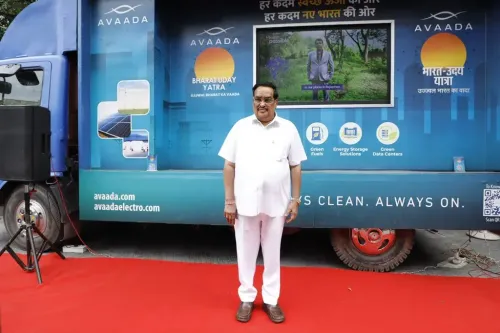
Jal Shakti Minister Paatil Hails India's First Hydrogen Train

Synopsis
Union Jal Shakti Minister C. R. Paatil on 16 July 2026 hailed India's first hydrogen fuel cell train as a historic green-technology milestone, linking it to PM Modi's Viksit Bharat 2047 vision and the National Green Hydrogen Mission's push for clean, self-reliant transportation.
Key Takeaways
Paatil publicly endorsed India's first hydrogen fuel cell train on 16 July 2026 , framing it as a landmark in green mobility.
The train was described as a symbol of clean energy, innovation, and sustainable development under PM Modi's leadership.
Indian Railways has been developing hydrogen traction since 2020 to reduce diesel dependence on non-electrified routes.
The National Green Hydrogen Mission (2023) provides the policy framework supporting hydrogen adoption across transport and industry.
The initiative is tied to India's Viksit Bharat 2047 vision and the country's net-zero emissions pledge by 2070 .
Commercial scale-up of hydrogen trains and budget provisions for refuelling infrastructure remain the key milestones to watch.
Union Jal Shakti Minister C. R. Paatil on Thursday, 16 July 2026 praised the rollout of India's first hydrogen fuel cell train, calling it a historic step toward green and self-reliant transportation under Prime Minister Narendra Modi's leadership.
Posting on X, Paatil wrote: 'हरित प्रौद्योगिकी की दिशा में भारत का एक और ऐतिहासिक कदम!' ['Another historic step for India in the direction of green technology!'], adding that the achievement powerfully expresses the nation's commitment to clean energy, innovation, and sustainable development. He concluded with the phrase 'प्रगति भी… प्रकृति भी' — 'Progress too… and Nature too' — framing the train as proof that economic advancement and environmental responsibility can coexist.
Context
Indian Railways, the world's fourth-largest rail network, has been pursuing aggressive fleet modernisation as part of its stated goal to achieve net-zero carbon emissions. A hydrogen fuel cell train emits only water vapour, making it a zero-direct-emission alternative to diesel-powered locomotives that still operate on non-electrified routes across the country. Paatil linked the development explicitly to the Viksit Bharat 2047 vision — the government's blueprint for transforming India into a fully developed nation by the centenary of independence.
Policy Backdrop
Indian Railways announced plans to develop hydrogen-powered trains as early as 2020, positioning the technology as a route to cutting diesel dependence on branch lines where overhead electrification is not economically viable. The National Green Hydrogen Mission, approved in 2023, provided further institutional backing by earmarking support for green hydrogen production and its application across transport and industry. Successive Union Budgets have reinforced the linkage between rail modernisation and the Atmanirbhar Bharat ('self-reliant India') framework, with an emphasis on indigenously developed technology.
The hydrogen train initiative sits within a broader pattern of decarbonising heavy transport — a sector that is difficult to electrify directly — alongside India's internationally stated commitment to reach net-zero emissions by 2070. Green hydrogen is seen as a bridging fuel that can be produced domestically, reducing dependence on imported fossil fuels and supporting domestic manufacturing under Atmanirbhar Bharat.
Stakeholders and Impact
For railway passengers, particularly those on non-electrified rural and semi-urban routes, a successful hydrogen train programme could mean cleaner, quieter journeys without the diesel fumes associated with current traction. For the clean energy sector, the deployment signals a commercially credible demand anchor for green hydrogen, which has struggled to find large-scale off-takers despite significant policy support. Domestic component manufacturers and research institutions working on fuel cell technology stand to benefit if the programme scales.
Paatil's intervention, as a senior Cabinet minister whose portfolio covers water resources rather than railways, underscores the cross-sectoral political significance the ruling BJP attaches to the milestone. Senior party leaders routinely amplify infrastructure achievements to reinforce the government's development narrative ahead of electoral cycles.
What's Next
Attention will now turn to the commercial rollout of additional hydrogen trains on designated routes and whether the next Union Budget includes fresh provisions for scaling green hydrogen infrastructure — including refuelling stations along rail corridors. The pace of indigenisation of fuel cell components will also be closely watched, as imported technology would undercut the Atmanirbhar Bharat narrative the government has attached to the project. A broader question remains whether the hydrogen train programme can be replicated at scale across the tens of thousands of kilometres of non-electrified track that still rely on diesel traction.
Point of View
Making individual projects feel like chapters in a larger story. The 'Progress too… Nature too' sign-off is also politically significant: it is a direct rebuttal to critics who argue that rapid infrastructure expansion comes at an environmental cost. Whether the hydrogen train programme delivers at scale will ultimately determine whether this narrative holds.
NationPress
15 Oct 2026
Frequently Asked Questions
What is India's first hydrogen fuel cell train?
India's first hydrogen fuel cell train is a zero-direct-emission locomotive that runs on hydrogen, producing only water vapour, developed under Indian Railways' plan to cut diesel dependence on non-electrified routes.
What did C. R. Paatil say about the hydrogen train?
Union Jal Shakti Minister C. R. Paatil called it 'another historic step in the direction of green technology' and said it expresses India's commitment to clean energy, innovation, and sustainable development under PM Modi's leadership.
What is the National Green Hydrogen Mission?
The National Green Hydrogen Mission, approved in 2023, is a government policy that supports the production and use of green hydrogen across transport and industry in India, including its application in railways.
How does the hydrogen train connect to Viksit Bharat 2047?
Viksit Bharat 2047 is the government's vision to make India a fully developed nation by its centenary of independence; the hydrogen train is being presented as evidence of the clean-technology progress required to achieve that goal.
When did Indian Railways start working on hydrogen trains?
Indian Railways announced plans to develop hydrogen fuel cell trains in 2020 as part of its broader strategy to modernise its fleet and reduce emissions on routes where overhead electrification is not feasible.