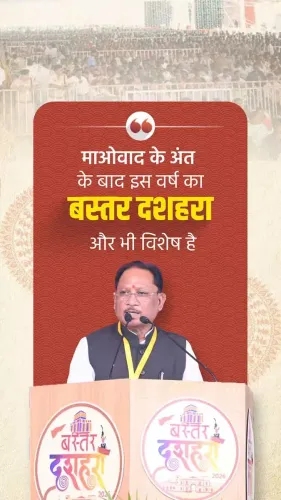
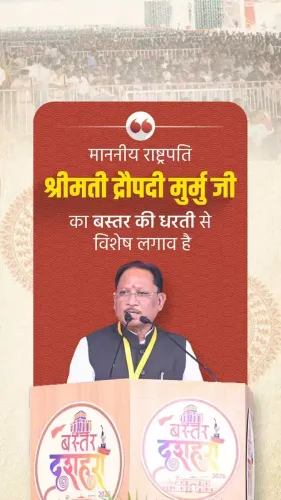
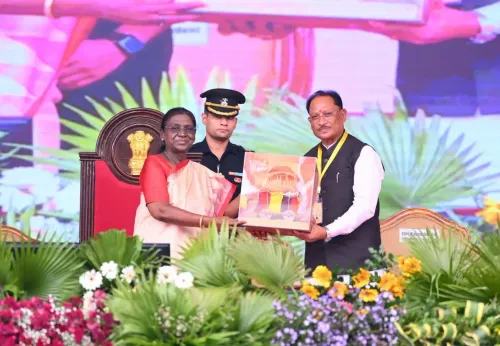
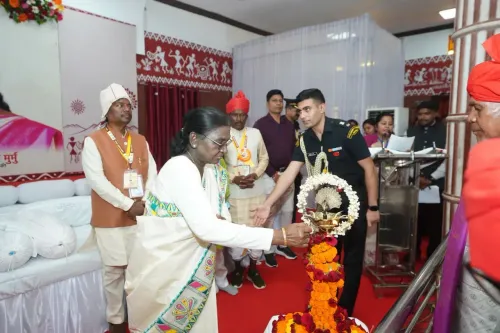
President Murmu graces Bastar Dussehra feast in Jagdalpur
Synopsis
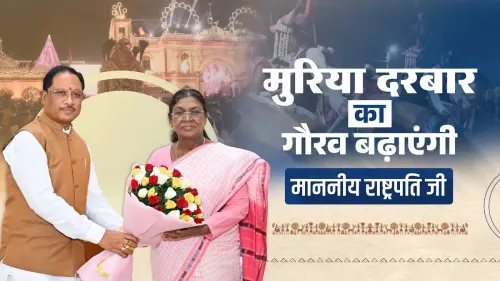
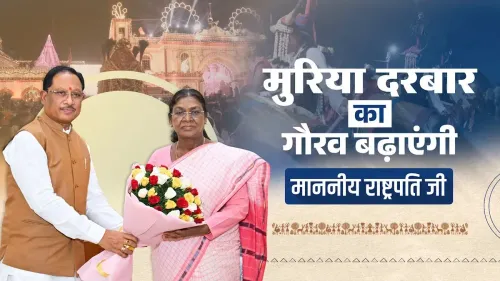
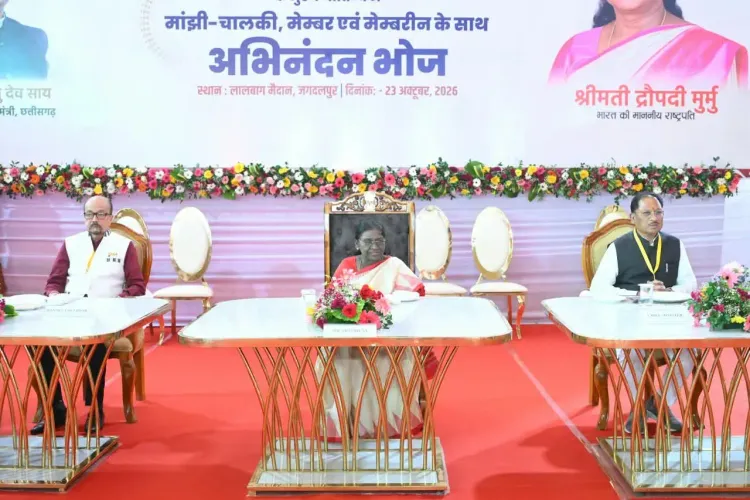
President Droupadi Murmu, India's first tribal woman President, presided as chief guest at the Bastar Dussehra Abhinandan Bhoj on 23 October 2026 at Lalbagh Maidan, Jagdalpur, alongside Governor Ramen Deka and Chief Minister Vishnu Deo Sai, honouring the region's centuries-old tribal custodians.
Key Takeaways
President Droupadi Murmu served as chief guest at the Bastar Dussehra 2026 Abhinandan Bhoj at Lalbagh Maidan, Jagdalpur on 23 October 2026 .
Governor Ramen Deka and Chief Minister Vishnu Deo Sai were present at the ceremonial feast.
The banquet honoured Manzhi-Chalki — traditional tribal headmen — along with community representatives called Members and Memberins .
Bastar Dussehra is a 75-day tribal festival focused on Goddess Danteshwari , distinct from the mainstream Ramayana-themed Dussehra celebrated elsewhere in India.
President Murmu is India's first tribal woman President , making her participation a moment of deep symbolic resonance for the tribal communities of Bastar.
The event was branded under #JanJatiyaGaurav and #ViksitChhattisgarh , reflecting the state government's alignment of tribal heritage with its development agenda.
At Lalbagh Maidan, Jagdalpur, on 23 October 2026, the oldest and most distinctive tribal festival in India pulled in its highest-ranking guest yet — President Droupadi Murmu, the first tribal woman to hold India's highest constitutional office, presided as chief guest at the grand Abhinandan Bhoj, the ceremonial welcome banquet of Bastar Dussehra 2026. Alongside her sat Governor Ramen Deka and Chief Minister Vishnu Deo Sai, lending the occasion a rare confluence of constitutional dignity and local tribal pride.
The Mânzhi-Chalki, Members and Memberins at the table
The Abhinandan Bhoj was no ordinary state dinner. Seated at the feast were the Mânzhi-Chalki — the traditional village headmen and functionaries who form the living backbone of Bastar's tribal governance — along with Members and Memberins, the male and female community representatives whose roles in the Dussehra rituals stretch back centuries. Their presence at the same table as the President is itself a statement: that the custodians of tribal tradition are honoured guests, not ceremonial props.
Why Bastar Dussehra stands apart from every other Dussehra in India
Bastar Dussehra is not a retelling of Rama's victory over Ravana. It is a 75-day festival — the longest in India — centred on the worship of Goddess Danteshwari, the presiding deity of the Bastar region, and it is governed entirely by tribal custom and the consent of the local Gond and Halba communities. The rituals — from the 'Rath Parikrama' chariot procession to the 'Jogi Bithai' — have no parallel anywhere in the country. Jagdalpur, the administrative headquarters of Bastar district in Chhattisgarh, transforms into the festival's living stage.
President Murmu's presence: recognition written in attendance
President Murmu, herself from the Santali tribal community of Odisha, attending Bastar Dussehra as chief guest carries an unmistakable symbolic weight. Indian state governments have routinely sought the participation of constitutional heads in regional tribal festivals — but having the President, who embodies India's constitutional commitment to its Scheduled Tribe communities, centre-stage in Bastar sends a signal that travels well beyond the maidan. It sits squarely within the national push for Jan Jatiya Gaurav — tribal pride — that both the Centre and the Chhattisgarh government have amplified since CM Vishnu Deo Sai took office in December 2023, making him the state's first tribal Chief Minister.
The Chief Minister's Office of Chhattisgarh shared images of the banquet on X, tagging the Rashtrapati Bhavan account and carrying the hashtags #BastarDussehra, #TribalPride, #JanJatiyaGaurav, and #ViksitChhattisgarh — the state government's development branding — underlining how tradition and governance aspiration are being woven into a single narrative.
When India's first tribal President breaks bread with Bastar's traditional headmen on the maidan in Jagdalpur, the message is clear: this heritage is not folklore to be archived — it is a living tradition the Indian state is choosing to stand behind.
Point of View
It reinforces the 'Jan Jatiya Gaurav' political narrative that elevated Vishnu Deo Sai, the state's first tribal CM, to power in December 2023. Placing India's first tribal President at the same table as Bastar's traditional headmen fuses identity politics with genuine cultural recognition, a combination that resonates deeply in a state where Scheduled Tribes form nearly one-third of the population. The optics are deliberate — and the political dividends, in a tribal-majority region, are real.
NationPress
23 Oct 2026
Frequently Asked Questions
What is Bastar Dussehra and how is it different from regular Dussehra?
Bastar Dussehra is a 75-day tribal festival held in Jagdalpur, Chhattisgarh, centred on the worship of Goddess Danteshwari rather than the Ramayana narrative. Its rituals — governed by the Gond and Halba tribal communities — are unique to the region and have no parallel elsewhere in India.
Why did President Droupadi Murmu attend Bastar Dussehra 2026?
President Droupadi Murmu attended Bastar Dussehra 2026 as chief guest for the Abhinandan Bhoj at Lalbagh Maidan, Jagdalpur on 23 October 2026. As India's first tribal woman President, her participation signals constitutional recognition of tribal heritage and aligns with the Jan Jatiya Gaurav initiative.
Who are the Manzhi-Chalki in Bastar Dussehra?
The Manzhi-Chalki are traditional village headmen and functionaries who play a central ceremonial and governance role in Bastar's tribal community. They are key participants in the Dussehra rituals and were honoured at the Abhinandan Bhoj alongside the President.
Who is Vishnu Deo Sai and why is his presence significant?
Vishnu Deo Sai has been Chief Minister of Chhattisgarh since December 2023 and is the state's first tribal Chief Minister. His co-hosting of the event alongside President Murmu underscores the state government's focus on tribal identity and heritage.
Where is Jagdalpur and what is its connection to Bastar Dussehra?
Jagdalpur is the administrative headquarters of Bastar district in Chhattisgarh, central India. It is the primary venue for Bastar Dussehra, and Lalbagh Maidan in the city serves as the main stage for key festival events.