Rajnath Singh hails Operation Sindoor as proof of indigenous defence might
Synopsis
Union Defence Minister Rajnath Singh has hailed Operation Sindoor as proof of the Indian Armed Forces' valour, preparedness, and the effectiveness of indigenous defence systems, reinforcing the government's Atmanirbhar Bharat push in defence manufacturing.
Key Takeaways
Rajnath Singh praised Operation Sindoor on 18 July 2026 as evidence of Indian military valour, modern technology, and indigenous defence capability.
The minister stated that the operation proved India's forces are 'Up to Date and Up to Mark' for every challenge.
The remarks align with the Atmanirbhar Bharat self-reliance programme launched in 2020 , which targets domestic defence manufacturing.
India's Make in India defence push since 2014 has produced successive negative import lists and raised FDI caps to boost local production.
Indigenous defence manufacturers and DRDO -industry partnerships stand to benefit from high-level operational endorsement of domestically produced systems.
Upcoming defence budget allocations and negative import list revisions will be closely watched as indicators of continued indigenisation momentum.
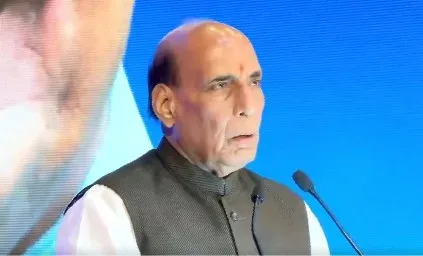
Union Defence Minister Rajnath Singh on Saturday, 18 July 2026, praised Operation Sindoor as a landmark demonstration of the Indian Armed Forces' indomitable courage, modern technology, and the growing strength of indigenous defence systems, asserting that the operation proved the forces are fully prepared to meet every challenge.
Context
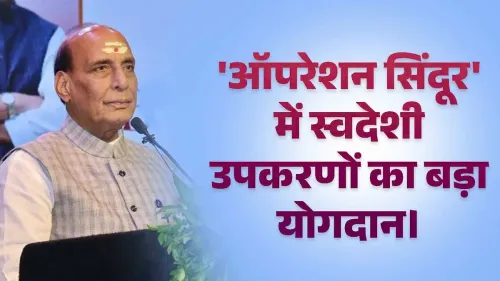
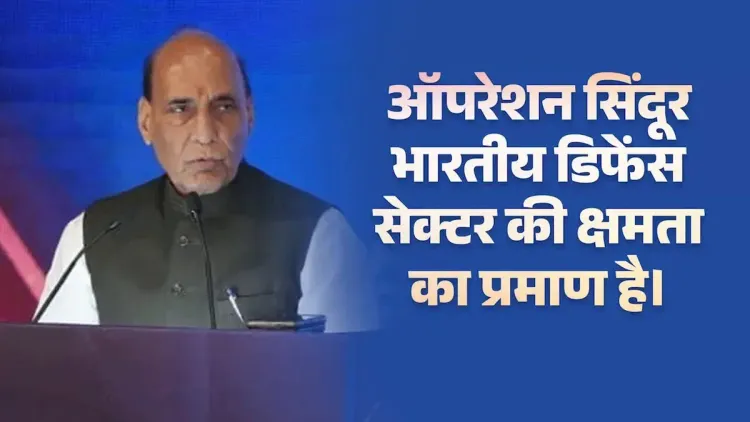
Posting on X, Rajnath Singh wrote that 'ऑपरेशन सिंदूर' ('Operation Sindoor') is proof not only of the 'indomitable valour of the Indian Armed Forces' but also of 'excellent preparation, modern technology, and the strength of indigenous defence systems.' He added that the operation established that India's forces are 'Up to Date and Up to Mark' in facing every challenge — a phrase he used in English within his otherwise Hindi post, underscoring the point emphatically.
The statement, shared with a video, comes from one of India's most senior security policymakers, who has overseen a significant period of defence modernisation and indigenisation as Union Defence Minister.
Policy Backdrop
The endorsement of indigenous systems fits squarely within the Atmanirbhar Bharat (Self-Reliant India) framework launched in 2020, which set ambitious targets for domestic defence manufacturing and reduced reliance on imports. The broader Make in India defence push, initiated in 2014, introduced successive negative import lists and raised foreign direct investment caps to spur local production.
India's defence sector has seen DRDO-industry partnerships yield platforms ranging from light combat aircraft to missile systems and surveillance drones. Budget allocations in recent years have consistently earmarked a growing share of the capital outlay for domestically produced equipment, reflecting a deliberate policy shift away from imported weapons platforms and avionics.
Past operations — including the 2016 surgical strikes across the Line of Control and the 2019 Balakot airstrike — were similarly cited by the government as evidence of the forces' readiness and the effectiveness of modernised, increasingly indigenous equipment.
Stakeholders and Impact
The minister's remarks carry significance for India's indigenous defence manufacturers, including public-sector undertakings and a growing private-sector ecosystem, who have invested heavily in developing platforms aligned with the government's self-reliance goals. A high-profile operational endorsement from the Defence Minister strengthens the political and institutional case for continued domestic procurement.
For the Indian Army, Navy, and Air Force, the statement reinforces the government's public confidence in their operational readiness. It also signals to strategic partners and adversaries that India views its current defence posture — backed by indigenous technology — as credible and battle-tested.
What's Next
Attention will now turn to forthcoming defence budget allocations and any additions to the negative import list, which would further restrict procurement of foreign systems and channel spending toward domestic industry. Parliamentary discussions are also expected to probe the specific indigenous systems deployed or validated during Operation Sindoor.
The minister's framing of the operation as proof of technological self-reliance suggests that Atmanirbhar Bharat in defence will remain a central pillar of government messaging — and policymaking — in the months ahead.
Point of View
He frames Operation Sindoor as a vindication of a decade-long policy architecture — not merely a military event. This fits a consistent pattern in which high-stakes operations are leveraged to build public and institutional confidence in domestic defence manufacturing. The political subtext is equally clear: as defence budget debates loom, such statements preemptively justify continued and expanded spending on indigenous platforms over foreign procurement.
NationPress
16 Oct 2026
Frequently Asked Questions
What is Operation Sindoor?
Operation Sindoor is a military operation referenced by Union Defence Minister Rajnath Singh in a post dated 18 July 2026 . He described it as proof of the Indian Armed Forces' valour, modern technology, and the strength of indigenous defence systems. Specific operational details have not been officially disclosed beyond the minister's statement.
What did Rajnath Singh say about Operation Sindoor?
Rajnath Singh said Operation Sindoor is proof not only of the 'indomitable valour' of the Indian Armed Forces but also of 'excellent preparation, modern technology, and the strength of indigenous defence systems,' adding that the forces are 'Up to Date and Up to Mark' for every challenge.
What is Atmanirbhar Bharat in defence?
Atmanirbhar Bharat (Self-Reliant India) is a national programme launched in 2020 that includes major targets for indigenous defence manufacturing, reducing India's dependence on imported weapons platforms, avionics, and munitions through domestic production and DRDO -industry partnerships.
How has India promoted indigenous defence manufacturing?
Since 2014 , India has introduced successive negative import lists barring procurement of specified foreign defence items, raised foreign direct investment caps to attract technology partners, and channelled budget allocations toward domestically produced platforms under the Make in India initiative.
Why is Rajnath Singh's statement on indigenous defence systems significant?
As Union Defence Minister , Rajnath Singh's explicit crediting of indigenous systems in an active operation provides strong institutional validation for India's domestic defence industry, signalling continued policy and budgetary support for the Atmanirbhar Bharat defence manufacturing agenda.