Rajnath Singh highlights Modi govt's farm welfare push
Synopsis
Union Defence Minister Rajnath Singh on 8 July 2026 outlined the Modi government's agricultural support framework, citing historic MSP hikes, PM-KISAN transfers, PM Fasal Bima Yojana coverage, record farm credit, and fertiliser subsidies exceeding Rs 13 lakh crore as part of a continuous campaign to empower farmers.
Key Takeaways
Rajnath Singh posted on 8 July 2026 summarising the Modi government's agricultural welfare measures.
The government claims 'historic' increases in Minimum Support Price (MSP) for crops under PM Modi's tenure.
PM-KISAN provides Rs 6,000 annually in direct income support to eligible landholding farmer families.
PM Fasal Bima Yojana , launched in 2016 , offers crop insurance cover against natural calamities and pests.
Fertiliser subsidies cited in the post exceed Rs 13 lakh crore cumulatively, aimed at reducing input costs.
The post signals the government views farm empowerment as an ongoing campaign ahead of the next cropping season.
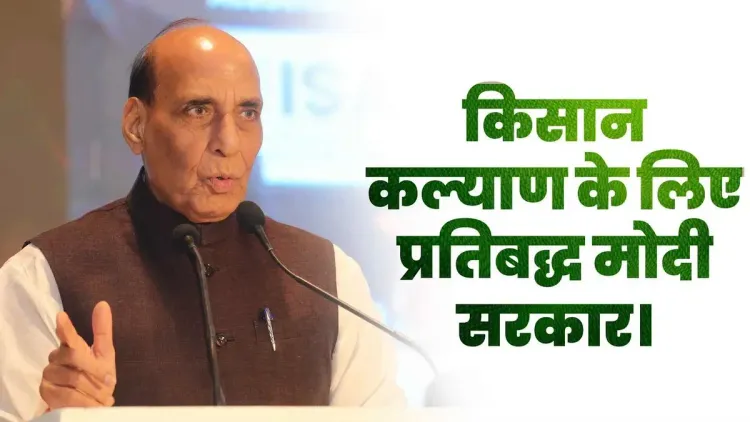
Union Defence Minister Rajnath Singh on Wednesday, 8 July 2026, took to X to outline the central government's ongoing efforts to strengthen the agricultural sector, citing a range of schemes and financial interventions under Prime Minister Narendra Modi's leadership aimed at raising farmer incomes, reducing input costs, and making agriculture self-reliant.
Context
In his post, Singh listed several pillars of the government's farm support framework. He wrote — 'MSP mein aitihasik vriddhi, PM-KISAN ke tahat aarthik sahayata, PM Fasal Bima Yojana ke madhyam se suraksha kavach' — describing 'a historic increase in MSP, financial assistance under PM-KISAN, a security cover through PM Fasal Bima Yojana.' He further cited record agricultural credit and fertiliser subsidies exceeding Rs 13 lakh crore as instruments of this campaign.
The post frames these measures collectively as a continuous effort — 'abhiyan nirantar jaari hai' ('the campaign is ongoing') — signalling that the government considers this an active, evolving agenda rather than a completed milestone.
Policy Backdrop
PM-KISAN, launched in the 2019-20 Union Budget, provides direct income support of Rs 6,000 annually to eligible landholding farmer families through direct benefit transfers. The scheme was designed to reduce distress and supplement household income without intermediaries.
PM Fasal Bima Yojana, introduced in 2016, replaced earlier national crop insurance programmes and extended coverage against losses from natural calamities, pests, and diseases. Minimum Support Price revisions for both kharif and rabi crops have been announced annually since 2014, with the government framing each round of hikes as a remunerative return to cultivators. Fertiliser subsidies have featured as a significant line item in successive Union Budgets to keep input costs manageable for farmers.
Stakeholders and Impact
The primary beneficiaries of the schemes cited are India's farming households, who depend on a combination of price support, insurance cover, credit access, and subsidised inputs to sustain agricultural livelihoods. Cross-portfolio messaging on welfare schemes by senior ministers — including those outside the agriculture ministry — has become a recurring feature of government communication, reflecting a whole-of-government approach to rural outreach.
The cumulative fertiliser subsidy figure of over Rs 13 lakh crore cited by Singh underscores the scale of fiscal commitment the government attributes to keeping agricultural input costs in check, though independent verification of the cumulative figure remains ongoing.
What's Next
Attention will now turn to forthcoming Union Budget allocations for agriculture and any fresh MSP announcements ahead of the upcoming cropping seasons, which will test whether the government's stated commitment to farmer income support translates into enhanced outlays. Observers will also watch for updates on PM-KISAN instalment disbursements and the pace of PM Fasal Bima Yojana claim settlements as indicators of on-ground delivery.
Point of View
Not merely an agriculture ministry brief. The enumeration of four distinct policy instruments — MSP, PM-KISAN, crop insurance, and fertiliser subsidy — suggests the BJP is consolidating its rural outreach narrative ahead of what could be a politically sensitive budget cycle. The Rs 13 lakh crore subsidy figure, if substantiated, would represent one of the largest cumulative agricultural input interventions in India's post-liberalisation history. The framing of the campaign as 'ongoing' rather than concluded is also notable, leaving room for fresh announcements.
NationPress
9 Jul 2026
Frequently Asked Questions
What did Rajnath Singh say about farmers on 8 July 2026?
Rajnath Singh posted on X outlining the Modi government's farm welfare measures, including historic MSP hikes, PM-KISAN income support, PM Fasal Bima Yojana crop insurance, record agricultural credit, and fertiliser subsidies of over Rs 13 lakh crore.
What is PM-KISAN and who benefits from it?
PM-KISAN is a central government scheme launched in 2019 that provides Rs 6,000 annually in direct cash transfers to eligible landholding farmer families across India to supplement their income.
What is PM Fasal Bima Yojana?
PM Fasal Bima Yojana is a crop insurance scheme introduced in 2016 that covers farmers against losses caused by natural calamities, pests, and diseases, replacing older national agricultural insurance programmes.
How much has India spent on fertiliser subsidies for farmers?
According to Rajnath Singh's post, the government has provided fertiliser subsidies exceeding Rs 13 lakh crore to help reduce input costs for farmers, though this is a cumulative figure cited by the minister.
Why is the Defence Minister talking about farmer welfare?
Senior ministers across portfolios routinely amplify government welfare messaging on agriculture as part of a whole-of-government communication strategy, particularly around politically significant rural issues.