Rajnath Singh: Maritime Security Now Covers Cables, Ports, Energy
Synopsis
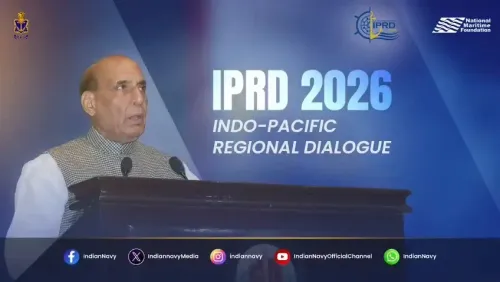
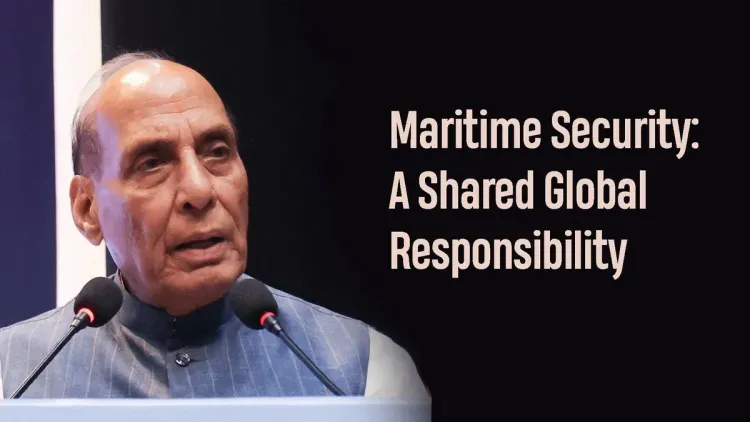
Union Defence Minister Rajnath Singh on 4 November 2026 called for international cooperation, domain awareness, and resilient infrastructure to protect shipping lanes, undersea cables, ports, and offshore energy assets — framing maritime security as an economic and strategic imperative beyond traditional naval defence.
Key Takeaways
Rajnath Singh declared on 4 November 2026 that maritime security now encompasses shipping lanes, ports, undersea cables, and offshore energy infrastructure.
He outlined three pillars: stronger international cooperation, better awareness mechanisms, and resilient maritime infrastructure.
India's expanded maritime doctrine traces back to its 2015 Maritime Security Strategy and PM Modi's SAGAR doctrine .
Undersea cables carry an estimated 95 per cent of global international data traffic, making them a critical strategic vulnerability.
India sits at a major junction on undersea cable routes linking Southeast Asia, the Middle East, and Europe .
The statement aligns with India's ongoing Indo-Pacific engagement with partners including the US, Japan, Australia, and France .
Shipping lanes and naval fleets are only the beginning. Union Defence Minister Rajnath Singh widened the frame on Wednesday, 4 November 2026, arguing that maritime security today must extend to undersea cables, ports, and offshore energy infrastructure — and that India sees stronger international cooperation as the only credible answer to these emerging threats.
From naval patrol to critical infrastructure: the expanded doctrine
Singh's statement captures a shift that has been building in Indian strategic thinking since at least 2015, when India released its Maritime Security Strategy and Prime Minister Modi articulated the SAGAR doctrine — 'Security and Growth for All in the Region' — signalling that New Delhi's maritime ambitions stretched well beyond the traditional navy-versus-navy paradigm. What was once framed as gunboat deterrence is now inseparable from protecting the undersea fibre-optic cables that carry global internet traffic, the port terminals that keep supply chains moving, and the offshore platforms that power coastal economies.
The minister identified three pillars India believes are necessary: 'stronger international cooperation, better awareness and resilient maritime infrastructure.' Each word is deliberate. 'Awareness' points to the intelligence-sharing and domain-awareness mechanisms — maritime surveillance grids, information-fusion centres — that India has been building with partners across the Indo-Pacific. 'Resilient infrastructure' signals investment in hardening assets, not merely patrolling around them.
Why undersea cables and offshore energy are the new front line
The specificity is striking. Undersea cables carry an estimated 95 per cent of the world's international data traffic; a severed cable can black out financial markets and military communications simultaneously. Offshore energy platforms — oil rigs, liquefied-natural-gas terminals, wind-farm arrays — represent trillions of dollars in infrastructure with long coastline exposure. Both categories sit outside the traditional laws-of-war frameworks that governed naval combat, making them harder to defend legally and practically.
India's interest is far from academic. The country is a major node on multiple undersea cable routes connecting Southeast Asia, the Middle East, and Europe, and its western and eastern seaboards host growing offshore energy fields. Any disruption — whether by state actors, non-state groups, or simple sabotage — lands directly on India's economic security.
India's Indo-Pacific posture and what comes next
Singh's framing aligns with India's broader Indo-Pacific engagement, where New Delhi has deepened naval exercises, information-sharing arrangements, and port-access agreements with partners including the United States, Japan, Australia, and France. The focus on multilateral cooperation — rather than purely bilateral defence pacts — reflects India's traditional preference for strategic autonomy: building a wide coalition without being locked into a single alliance architecture.
The minister's post does not announce a specific initiative, but the emphasis on 'emerging threats' and 'resilient maritime infrastructure' points squarely at the conversations happening inside upcoming maritime-security dialogues and within multilateral forums where undersea cable protection is rising fast on the agenda.
The sea has never been just a battlefield. For India — and for the world — it is now the nervous system of the global economy. Rajnath Singh is making the case that defending it demands an entirely new level of collective seriousness.
Point of View
He is signalling to multilateral partners that India is ready to co-lead frameworks that go beyond traditional naval-to-naval cooperation. The timing, ahead of anticipated maritime-security dialogues, looks designed to position New Delhi as an agenda-setter in Indo-Pacific governance rather than a rule-taker. It also quietly acknowledges that the threats India faces at sea are as likely to be grey-zone economic coercion as open military confrontation.
NationPress
4 Nov 2026
Frequently Asked Questions
What did Rajnath Singh say about maritime security?
On 4 November 2026, Rajnath Singh stated that maritime security now extends beyond naval defence to cover shipping lanes, ports, undersea cables, and offshore energy infrastructure, calling for stronger international cooperation, better awareness, and resilient maritime infrastructure.
What is India's maritime security strategy?
India released a formal Maritime Security Strategy in 2015, expanding the focus from traditional naval threats to critical infrastructure protection. PM Modi's SAGAR doctrine, also from 2015, underpins India's cooperative approach across the Indian Ocean Region.
Why are undersea cables important for national security?
Undersea cables carry an estimated 95 per cent of the world's international data traffic, including financial and military communications. Damage to them can disrupt economies and defence systems simultaneously, making them a high-value target.
What is India's role in Indo-Pacific maritime security?
India has deepened naval exercises, information-sharing arrangements, and port-access agreements with partners including the United States, Japan, Australia, and France, positioning itself as a key stakeholder in Indo-Pacific maritime governance.
What is the SAGAR doctrine?
SAGAR stands for 'Security and Growth for All in the Region.' Prime Minister Modi articulated it in 2015 to emphasise maritime security cooperation and collective prosperity across the Indian Ocean Region, moving beyond a purely military framework.