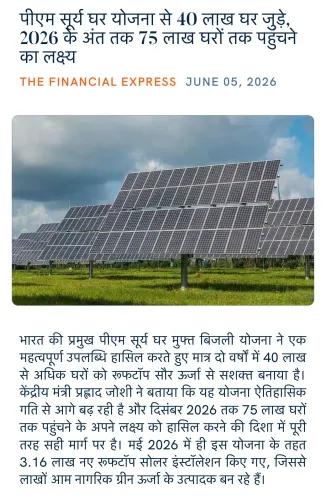
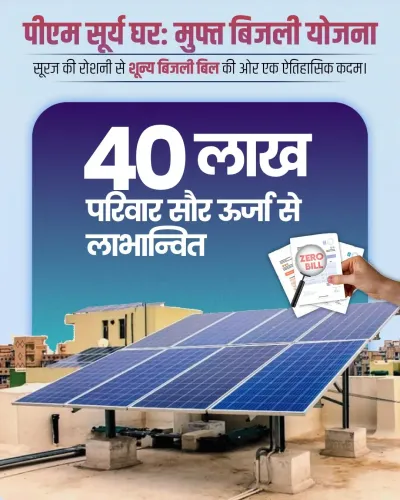
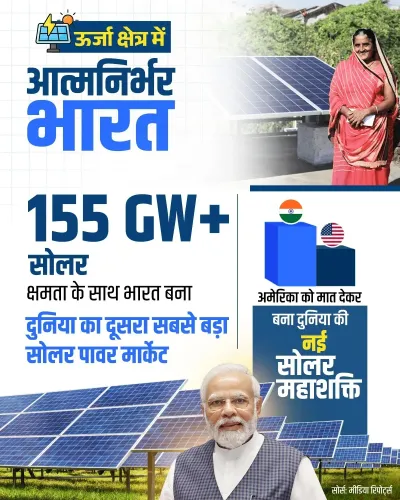
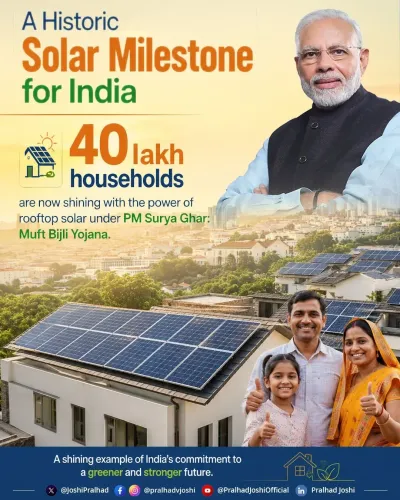
Shekhawat promotes PM Surya Ghar rooftop solar scheme

Synopsis
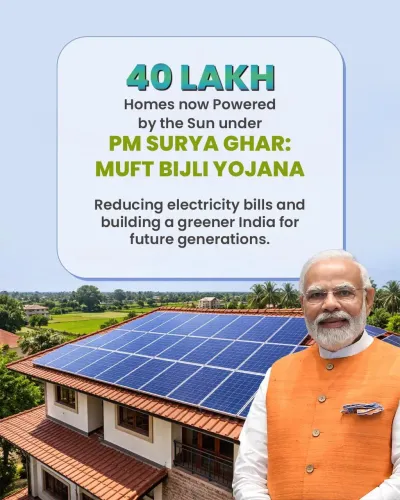
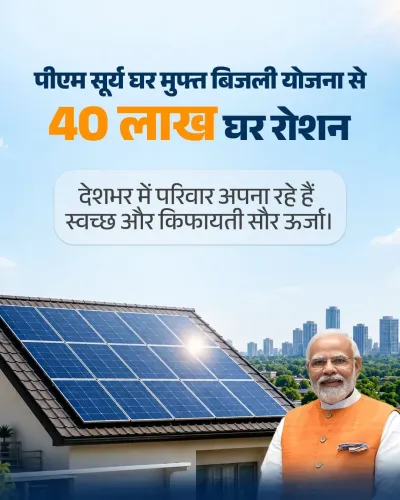
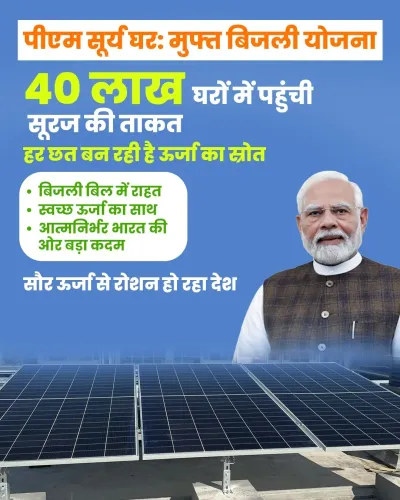
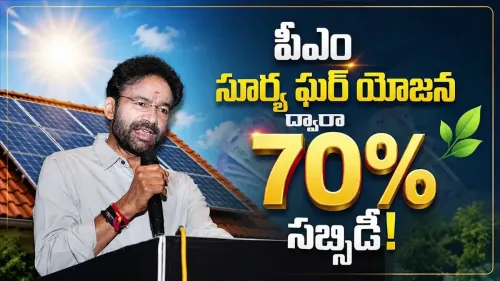
Union Minister Gajendra Singh Shekhawat on 24 June 2026 promoted PM Surya Ghar: Muft Bijli Yojana on X, urging households to install rooftop solar panels for up to 300 units of free monthly electricity and additional income by selling surplus power to the grid.
Key Takeaways
Gajendra Singh Shekhawat , Union Culture and Tourism Minister, publicly promoted the PM Surya Ghar: Muft Bijli Yojana on 24 June 2026 .
The scheme, launched in 2024 , offers subsidies for rooftop solar installations and promises up to 300 units of free electricity per month to beneficiary households.
Households can sell surplus solar power back to the grid, generating additional income — the key appeal Shekhawat highlighted.
The initiative is part of India's broader goal to reach 500 GW of non-fossil fuel capacity by 2030 and net-zero emissions by 2070 .
The scheme builds on the Jawaharlal Nehru National Solar Mission of 2010 , extending India's decentralised solar strategy to residential rooftops.
Union Culture and Tourism Minister Gajendra Singh Shekhawat on Wednesday, 24 June 2026, took to X to champion the PM Surya Ghar: Muft Bijli Yojana, urging Indian households to turn their rooftops into sources of clean energy, lower electricity bills, and additional income.
Context
Shekhawat's post, written in Hindi, carries a direct appeal to homeowners: 'Apni chhat ko kaam par lagaiye, bijli banaiye aur bachat ke saath kamai bhi badhaiye!' ('Put your roof to work, generate electricity, and grow your savings along with your income!'). He frames the rooftop not as empty space but as a gateway to clean energy, reduced power bills, and supplementary earnings.
The minister invoked Prime Minister Narendra Modi by name, describing the scheme as a vehicle through which 'millions of families are moving from being mere consumers of electricity to becoming energy producers.'
Policy Backdrop
The PM Surya Ghar: Muft Bijli Yojana was launched in 2024 as a central government initiative offering subsidies to households for installing rooftop solar systems, with the stated aim of providing up to 300 units of free electricity per month to beneficiary families. Surplus electricity generated by households can be fed back into the grid, creating an additional revenue stream — the core proposition Shekhawat highlighted.
The scheme builds on a longer arc of solar policy that traces back to the Jawaharlal Nehru National Solar Mission of 2010, which first set national targets for grid-connected and rooftop solar capacity. Rooftop solar has since emerged as a critical decentralised pillar of India's renewable energy strategy, complementing large-scale solar parks.
India has committed under the Paris Agreement to achieving 500 GW of non-fossil fuel power capacity by 2030 and net-zero emissions by 2070. Distributed rooftop installations are seen as essential to meeting those targets at the household level.
Stakeholders and Impact
The primary beneficiaries are residential households, particularly those in states with high solar irradiance, who stand to reduce their monthly electricity expenditure significantly while earning from grid export. The broader renewable energy sector — including solar panel manufacturers, installers, and financiers — also benefits from expanded demand driven by government subsidy support.
For a senior BJP leader and Lok Sabha MP from Jodhpur, Rajasthan — a sun-rich desert constituency — amplifying a rooftop solar scheme carries both policy and political resonance, connecting the national programme to a region with strong solar potential.
What's Next
Attention will now turn to rollout metrics: the number of household installations completed, subsidy amounts disbursed across states, and any parliamentary updates on the scheme's funding allocation. Sustained ministerial outreach of this kind signals that the Centre is pushing awareness and adoption as key near-term priorities for the programme.
Point of View
The endorsement also serves local political optics. The post underscores how rooftop solar has moved from a niche energy-sector talking point to mainstream political messaging as India races toward its 2030 renewable targets.
NationPress
24 Jun 2026
Frequently Asked Questions
What is PM Surya Ghar Muft Bijli Yojana?
PM Surya Ghar: Muft Bijli Yojana is a central government scheme launched in 2024 that provides subsidies to households for installing rooftop solar panels, with the aim of supplying up to 300 units of free electricity per month and enabling families to earn income by selling surplus power to the grid.
Who launched the PM Surya Ghar scheme?
The scheme was launched by Prime Minister Narendra Modi's government in 2024 as part of India's push to expand rooftop solar adoption and meet its renewable energy targets.
What did Gajendra Singh Shekhawat say about PM Surya Ghar?
On 24 June 2026, Shekhawat posted on X urging households to put their rooftops to work, generate electricity, reduce bills, and earn additional income through the PM Surya Ghar: Muft Bijli Yojana, calling it a path from being electricity consumers to energy producers.
How much free electricity does PM Surya Ghar scheme provide?
The scheme is designed to provide up to 300 units of free electricity per month to eligible households that install rooftop solar systems under its subsidy framework.
How does rooftop solar help India meet its climate targets?
India has committed to 500 GW of non-fossil fuel power capacity by 2030 and net-zero emissions by 2070 under the Paris Agreement; rooftop solar programmes like PM Surya Ghar form a key decentralised component of that strategy alongside large utility-scale solar parks.