Terror-drug nexus: Syndicates merge arms and narcotics to outpace Indian agencies
Synopsis
India's security agencies are confronting a new threat architecture: terror and drug networks have merged, bundling arms and narcotics into single cross-border consignments. Satellite-linked drones over Punjab and a rotating-handler model directed by the ISI are making traditional countermeasures obsolete — and a nationwide anti-drug pledge on 18 August underscores how high the political stakes have become.
Key Takeaways
Terror and drug smuggling networks have merged operations , with nearly every recent seizure containing both arms and narcotics in a single consignment.
On 7 August , the NIA charged two individuals with smuggling a firearm, an IED , and heroin, with planned attacks in Delhi , Punjab , and on a passenger train.
Punjab is the primary flashpoint, with satellite-linked drones used for delivery; officials say this points to direct Pakistan state involvement .
The ISI is reportedly rotating handlers and rewriting operational playbooks to stay ahead of Indian countermeasures.
The NIA , ED , IB , and BSF are jointly tracking handlers and money trails, with securing local contacts identified as the key to breaking supply chains.
The Modi government targets a drug-free India by 2047 ; a nationwide pledge is scheduled for 18 August .
Terror networks and drug-smuggling syndicates operating against India have converged into a single, harder-to-track threat, with security officials warning that the merger of arms and narcotics trafficking is stretching the capacity of Indian agencies in ways not seen before. The shift, described by multiple officials as a deliberate tactical evolution, is being tracked by the National Investigation Agency (NIA), the Enforcement Directorate (ED), the Intelligence Bureau (IB), and the Border Security Force (BSF).
How the Convergence Works
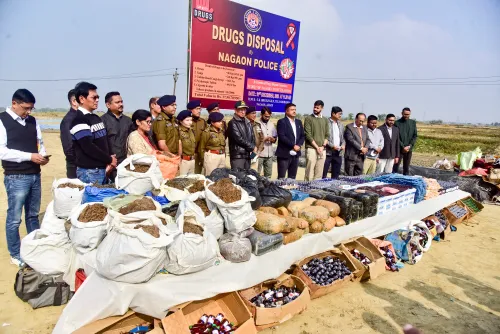
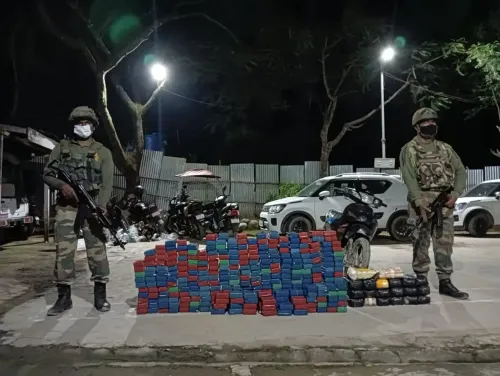
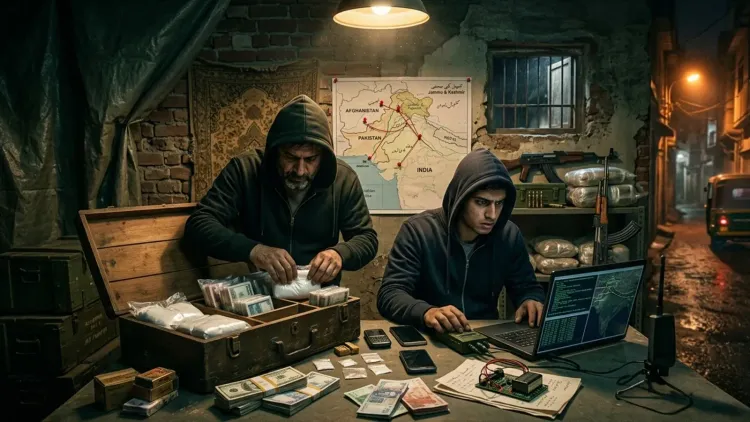
For years, arms smugglers and drug traffickers operated as distinct networks with separate handlers, supply chains, and delivery modules. Indian agencies had developed targeted countermeasures for each. That structural separation has now collapsed. According to officials, nearly every major seizure in recent months has contained both drugs and firearms in the same consignment — a pattern that signals coordinated logistics rather than coincidence.
Officials explain that combining contraband into a single operation is more cost-effective for syndicates: one crossing, one handler, one risk. It also complicates agency response, since the intelligence picture for a drug bust and a weapons interception now overlap in ways that demand simultaneous coordination across multiple departments.
NIA Chargesheet Illustrates the Threat
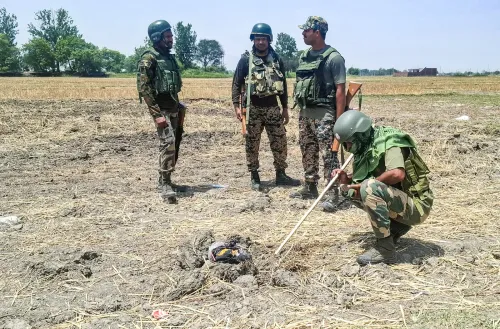
On 7 August, the NIA filed charges against two individuals accused of smuggling a firearm, an improvised explosive device (IED), and heroin — all in a single operation. According to the agency, the accused had planned attacks in Delhi and Punjab, and had also targeted a passenger train. Officials said the case is a textbook example of how the two mafias now operate in concert to confuse Indian security agencies.
Punjab and Rajasthan: The Two Flashpoints
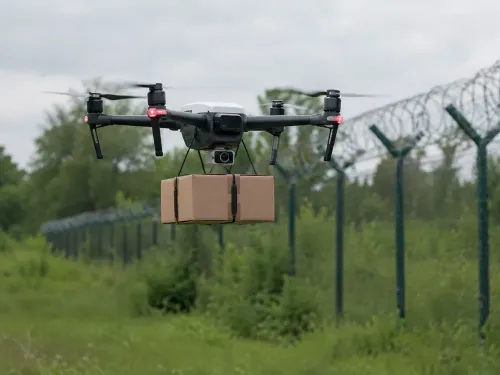
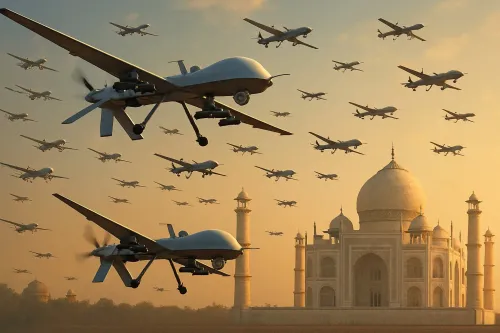
An Intelligence Bureau official identified Punjab and Rajasthan as the primary pressure points. In Punjab, satellite-linked drones are the preferred delivery mechanism — a level of technological sophistication that officials say points directly to Pakistan state involvement. Each time border agencies develop countermeasures, the drones are upgraded to more advanced models, some now connected to satellite navigation systems.
In Rajasthan, the smuggling model remains more conventional, with traffickers attempting to slip through border crossings on foot or by vehicle. Seizure quantities also differ: larger hauls are intercepted in Punjab, while Rajasthan sees smaller but more frequent consignments. Officials attribute this to Punjab's near-total reliance on drone delivery, which minimises human exposure on the Pakistani side.
ISI's Role and Evolving Tradecraft
According to officials, Pakistan's Inter-Services Intelligence (ISI) has instructed syndicates to rotate handlers and operatives continuously, preventing Indian agencies from building reliable profiles of key individuals. The ISI is also described as actively rewriting operational playbooks each time Indian agencies gain the upper hand — a cat-and-mouse dynamic that officials say shows no sign of abating.
The Modi government has set a national target of a drug-free India by 2047. As part of this push, a nationwide mass pledge against drug abuse is scheduled for 18 August, marking the first anniversary of the initiative. Officials acknowledge that while agencies have recorded significant successes over the past year and a half, the adaptive capacity of these syndicates means the gains are constantly under pressure.
The Road Ahead for Indian Agencies
The NIA, ED, IB, and BSF are jointly tracking financial flows and handler networks based in Pakistan. Officials noted that securing local contacts — the ground-level facilitators within India — remains the single most critical factor in dismantling these operations. Without cracking the domestic network, even successful border interdictions are unlikely to break the supply chain permanently.
Point of View
State-backed pressure campaign, not opportunistic crime. Indian agencies are playing catch-up in a technology race they did not choose. The 2047 drug-free target is a worthy political aspiration, but the more urgent question is whether India's inter-agency coordination architecture — NIA, ED, IB, BSF — is structured for the speed and cross-domain complexity this convergence now demands. The emphasis on local contacts as the decisive variable is telling: it implies that border interdiction alone, however successful, cannot break a network whose roots are domestic.
NationPress
10 Aug 2026
Frequently Asked Questions
How have terror and drug networks in India merged?
Terror and drug syndicates that previously operated independently now share logistics, bundling firearms and narcotics into the same cross-border consignments. Officials say this makes the combined network larger and harder to track, since agencies can no longer treat arms and drug intelligence as separate streams.
What did the NIA chargesheet on 7 August reveal?
On 7 August, the NIA charged two individuals with smuggling a firearm, an IED, and heroin in a single operation. The accused had reportedly planned attacks in Delhi and Punjab and had also targeted a passenger train, illustrating how terror and narcotics networks now operate together.
Why is Punjab considered a more complex smuggling challenge than Rajasthan?
Punjab's smuggling model relies almost entirely on technologically advanced drones, some connected to satellite systems, with minimal human exposure on the Pakistani side. Each time border agencies develop countermeasures, the drones are upgraded. Rajasthan sees more conventional border crossings with smaller quantities.
What is the ISI's alleged role in these smuggling operations?
According to officials, Pakistan's Inter-Services Intelligence (ISI) is directing syndicates to rotate handlers and operatives continuously and is actively updating operational methods each time Indian agencies gain an advantage. The use of satellite-linked drones is cited as evidence of direct Pakistan state involvement.
What is India's drug-free 2047 initiative?
The Modi government has set a national goal of achieving a drug-free India by 2047. A nationwide mass pledge against drug abuse is scheduled for 18 August, marking the first anniversary of the initiative, as agencies continue operations against drug and terror syndicates.