Tharoor Calls for 'West Asia' to Replace 'Middle East'
Synopsis
Congress MP Dr. Shashi Tharoor has backed a call to retire the term 'Middle East' in favour of 'West Asia,' aligning with India's official MEA usage since the 1950s and a broader postcolonial push to replace Eurocentric geographic labels in strategic discourse.
Key Takeaways
Shashi Tharoor on June 10, 2026 called for 'West Asia' to replace 'Middle East' in strategic vocabulary.
The term 'Middle East' was coined from a British naval perspective , positioning the region relative to London rather than its own geography.
India's MEA has officially used 'West Asia' in documents and parliamentary replies since the 1950s .
The preference aligns with India's 'Act West' outreach to Gulf states and Iran .
Similar usage exists in Chinese and Japanese official communications, reflecting a broader Asian convergence.
Indian think tanks ORF and IDSA have increasingly standardised 'West Asia' in their publications.
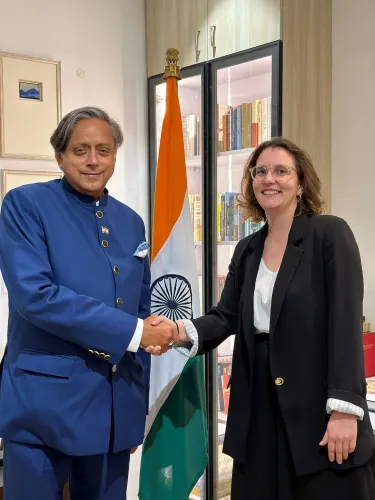
Congress MP Dr. Shashi Tharoor on Wednesday, June 10, 2026, called for a decisive shift in geopolitical vocabulary, endorsing the view that the term 'Middle East' has run its course and urging all strategic thinkers to adopt 'West Asia' in its place.
Context
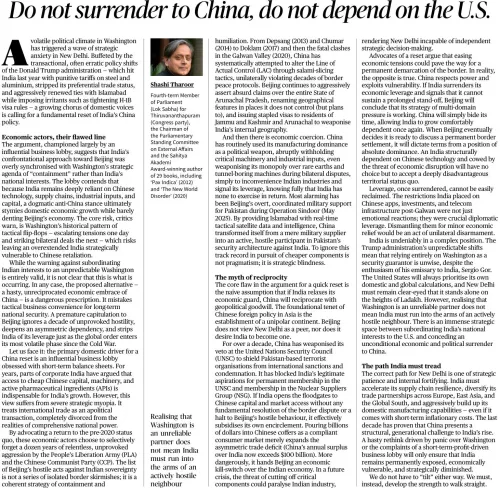
Tharoor shared what he described as a 'terrific piece' that concludes with the assertion that 'the Middle East has expired,' adding his own endorsement: 'Time for West Asia to dawn in the vocabulary of all strategic thinkers!' The post reflects a long-held position of the former UN Under-Secretary-General, who has consistently championed postcolonial corrections to inherited Eurocentric terminology in international affairs.
The label 'Middle East' was coined from a British naval perspective in the early twentieth century, positioning the region relative to London rather than to its own geography or to neighbouring Asian powers. Critics of the term argue it embeds a colonial vantage point into everyday diplomatic and media language.
Policy Backdrop
India's Ministry of External Affairs (MEA) has used 'West Asia' rather than 'Middle East' in official documents, annual reports, and Lok Sabha replies since the 1950s, reflecting an Asia-centric geographic perspective. The MEA maintains a dedicated 'West Asia and North Africa' division, and the term appears consistently in ministerial statements and parliamentary answers.
Similar terminological preferences exist in Chinese and Japanese official usage, suggesting a broader Asian convergence around geography-centred nomenclature. In India's case, the preference also aligns with its 'Act West' diplomatic outreach to Gulf states and Iran, framing the region as a natural western extension of the Indian subcontinent's strategic neighbourhood rather than a distant 'middle' ground between Europe and Asia.
Stakeholders and Impact
The debate over nomenclature is more than semantic: it shapes how diplomats, strategic analysts, and policymakers frame alliances, threat perceptions, and regional identities. Indian think tanks such as the Observer Research Foundation (ORF) and the Institute for Defence Studies and Analyses (IDSA) have increasingly standardised 'West Asia' in their publications, nudging the wider policy community toward the MEA's preferred usage.
For media organisations, the choice of term signals editorial alignment with either a Western or an Asian frame of reference. Tharoor's intervention, given his profile as a parliamentarian and former senior UN official, is likely to renew pressure on Indian commentators and newsrooms to reconsider default usage of 'Middle East.'
What's Next
Observers will watch upcoming MEA annual reports and parliamentary questions on regional policy to gauge whether the government reinforces its longstanding preference for 'West Asia.' Publications from major Indian foreign-policy institutes are also expected to weigh in as the terminology debate gains fresh momentum.
Tharoor's endorsement signals that the push for decolonised geographic language is moving beyond academic circles into mainstream political commentary — and may accelerate the retirement of 'Middle East' from Indian strategic discourse altogether.
Point of View
' he is nudging the broader commentariat — not just government — to align with MEA practice. The timing matters: as India deepens its Gulf and Iran engagement under 'Act West,' consistent nomenclature carries real diplomatic signalling value. The post fits a pattern in which Tharoor uses his platform to accelerate postcolonial corrections to inherited Western frameworks in international relations.
NationPress
28 Oct 2026
Frequently Asked Questions
Why does India use 'West Asia' instead of 'Middle East'?
India's Ministry of External Affairs has used 'West Asia' since the 1950s because the term reflects an Asia-centric geographic perspective, positioning the region as India's western neighbourhood rather than a 'middle' point between Europe and Asia.
Who coined the term 'Middle East' and why is it considered Eurocentric?
The term 'Middle East' was coined from a British naval perspective in the early twentieth century, locating the region relative to London. Critics argue it embeds a colonial vantage point and should be replaced with geographically neutral terms like 'West Asia.'
What did Shashi Tharoor say about 'West Asia' and 'Middle East'?
On June 10, 2026, Dr. Shashi Tharoor endorsed an article concluding that 'the Middle East has expired' and called for 'West Asia' to dawn in the vocabulary of all strategic thinkers.
Do other Asian countries also use 'West Asia' instead of 'Middle East'?
Yes. China and Japan also use geography-centred terminology similar to 'West Asia' in official communications, reflecting a broader Asian preference for non-Eurocentric regional labels.
What is India's 'Act West' policy?
'Act West' is India's diplomatic outreach to Gulf states and Iran, framing the region as a natural extension of India's strategic neighbourhood. Consistent use of 'West Asia' as nomenclature reinforces this Asia-centred framing.