Vaishnaw Marks 12 Years of Healthcare Reform Under Modi Govt
Synopsis
Union Minister Ashwini Vaishnaw marked 12 years of healthcare transformation under PM Modi on 14 June 2026, spotlighting Ayushman Bharat, Jan Aushadhi, and the National Digital Health Mission as pillars of a redesigned public health architecture.
Key Takeaways
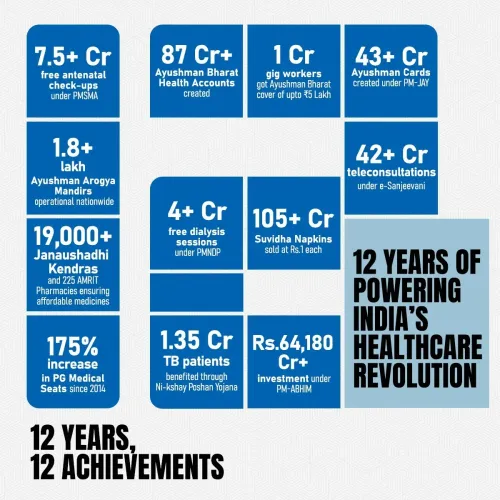
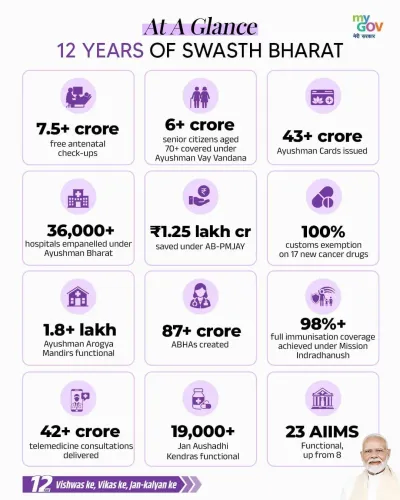
Ashwini Vaishnaw posted on 14 June 2026 marking 12 years of healthcare change under the Modi government with the hashtag #12YearsOfSwasthBharat .
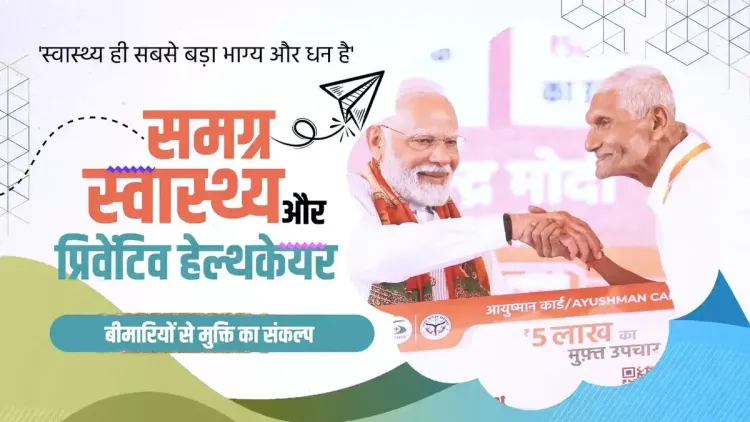
Ayushman Bharat PM-JAY was designed to cover 50 crore economically vulnerable citizens with health insurance of up to Rs 5 lakh per family.
Over 1.5 lakh Health and Wellness Centres were approved for upgrade between 2018 and 2023 to strengthen primary care.
The Pradhan Mantri Jan Aushadhi Yojana provides generic medicines at 50 to 90 percent lower cost than branded drugs.
The National Digital Health Mission (2020) introduced unique health IDs and interoperable records across public and private facilities.
The government's welfare health architecture uses Aadhaar-linked targeting, mirroring its approach in housing, sanitation and nutrition.
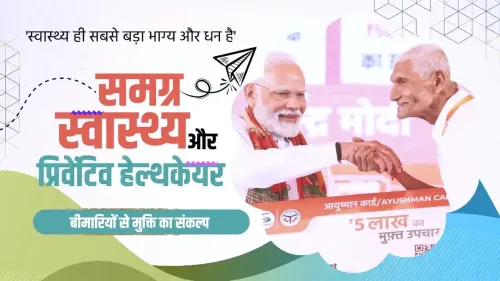
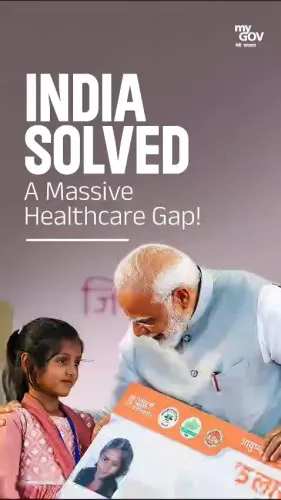
Union Minister Ashwini Vaishnaw on Sunday, 14 June 2026, took to X to highlight the transformation of India's healthcare sector over the past 12 years, marking the occasion with the hashtag #12YearsOfSwasthBharat — broadly translating to '12 Years of a Healthy India.'
Context
The post, shared alongside a video, celebrates what the ruling Bharatiya Janata Party frames as a decade-plus overhaul of public health delivery since 2014. The hashtag #12YearsOfSwasthBharat signals a coordinated government communication effort to document and publicise health-sector milestones under Prime Minister Narendra Modi.
Vaishnaw, a senior BJP leader who holds charge of the Railways, Information and Broadcasting, and Electronics and IT ministries, has increasingly been deployed as a key communicator for the government's welfare narrative on social media.
Policy Backdrop
The 12-year arc referenced in the post spans a series of landmark health initiatives. The Pradhan Mantri Jan Aushadhi Yojana, launched in 2015, established a network of outlets selling quality generic medicines at 50 to 90 percent lower prices than branded alternatives, directly targeting out-of-pocket expenditure for low-income households.
Ayushman Bharat, rolled out in 2018, combined the creation of Health and Wellness Centres for primary care with the PM-JAY insurance scheme, which provides coverage of up to Rs 5 lakh per family and was designed to cover approximately 50 crore economically vulnerable citizens. More than 1.5 lakh Health and Wellness Centres were approved for upgrade between 2018 and 2023.
The National Digital Health Mission, launched in 2020, further extended this architecture by creating unique health IDs and interoperable digital records, integrating public and private facilities into a single data ecosystem. These programmes collectively reflect the National Health Policy 2017 target of raising public health expenditure to 2.5 percent of GDP and achieving universal health coverage.
Stakeholders and Impact
The primary beneficiaries of this policy shift have been rural patients and low-income households, for whom catastrophic health expenditure had historically been a driver of poverty. The generic medicines programme and the PM-JAY insurance cover together address both the affordability of drugs and the cost of hospitalisation.
Analysts note that the centralised, Aadhaar-linked targeting model used in health mirrors parallel welfare architecture built in housing, sanitation and nutrition — suggesting a deliberate design to create a unified delivery platform rather than isolated schemes.
What's Next
Parliamentary deliberations on the next health budget and potential expansions of the PM-JAY beneficiary list — including possible integration of state government schemes — remain key markers to watch. The government's communication push around #12YearsOfSwasthBharat also suggests further announcements or milestone reports may follow as the ruling party builds its welfare record ahead of future electoral cycles.
Point of View
Using social media milestones to anchor policy legacy. The '12 years' framing is significant — it positions health reform not as a single scheme but as a sustained institutional shift, making it harder for critics to dismiss as electoral optics. The bundling of insurance, generic drugs, digital records and primary infrastructure under one hashtag reflects a deliberate effort to present a unified welfare delivery architecture rather than fragmented interventions. Whether the government follows this social media moment with verifiable outcome data — on hospitalisation rates, out-of-pocket expenditure, or PM-JAY claim settlements — will determine how the narrative holds up to scrutiny.
NationPress
25 Sept 2026
Frequently Asked Questions
What is #12YearsOfSwasthBharat?
#12YearsOfSwasthBharat is a hashtag used by BJP leaders and the Indian government to mark 12 years of health policy reforms since 2014, highlighting schemes like Ayushman Bharat, Jan Aushadhi, and the National Digital Health Mission.
What is Ayushman Bharat PM-JAY?
Ayushman Bharat Pradhan Mantri Jan Arogya Yojana, launched in 2018, is India's flagship public health insurance scheme providing coverage of up to Rs 5 lakh per family per year, targeting approximately 50 crore economically vulnerable citizens.
What does Pradhan Mantri Jan Aushadhi Yojana offer?
The Pradhan Mantri Jan Aushadhi Yojana, started in 2015, provides quality generic medicines through dedicated outlets at prices 50 to 90 percent lower than branded drugs, reducing out-of-pocket health spending for low-income families.
What is the National Digital Health Mission?
Launched in 2020, the National Digital Health Mission creates unique digital health IDs for citizens and enables interoperable health records across public and private facilities, forming the data backbone of India's health system.
How many Health and Wellness Centres has India set up?
More than 1.5 lakh Health and Wellness Centres were approved for upgrade between 2018 and 2023 to deliver comprehensive primary healthcare, especially in rural and semi-urban areas.