China scientists make diamond 6x tougher, harder than armour
Synopsis
Chinese researchers have created a diamond composite reinforced with carbon nanotubes that is six times tougher than conventional diamond and harder than tungsten armour-piercing alloys — without sacrificing any hardness — resolving a decades-old trade-off in materials science.
Key Takeaways
Researchers at the Institute of Physics, Chinese Academy of Sciences and Beihang University published the findings in Nature Synthesis on July 9, 2026 .
The new diamond composite is six times tougher than conventional diamond while retaining its full hardness.
The breakthrough uses multi-walled carbon nanotubes (MWCNTs) — roughly one ten-thousandth the width of a human hair — as internal reinforcing structures.
The material is reportedly tougher than tungsten alloys used in armour-piercing ammunition, a key defence-materials benchmark.
Research was conducted at the Synergetic Extreme Condition User Facility in Huairou Science City, Beijing .
Potential applications span aerospace components, precision cutting tools, advanced armour systems , and semiconductor substrates.
Chinese scientists have engineered a form of diamond that is simultaneously harder and six times tougher than conventional diamond — a material that reportedly cannot be shattered even by a direct hammer blow, according to a paper published on July 9 in the peer-reviewed journal Nature Synthesis. The breakthrough, led by researchers at the Institute of Physics at the Chinese Academy of Sciences and Beihang University, resolves a long-standing trade-off in materials science.
The Diamond's Fatal Flaw — Now Fixed
Diamond is the hardest naturally occurring material on Earth, yet it shares a critical weakness with glass: brittleness. A sharp, concentrated blow can shatter it along crystallographic planes, limiting its use in high-stress industrial environments. For decades, researchers have attempted to boost toughness — a material's resistance to fracture — without degrading hardness, but gains in one property have historically come at the cost of the other.
The new research sidesteps this compromise entirely. According to the paper, the team engineered an internal support architecture within the diamond matrix that multiplies fracture resistance by six times while leaving hardness intact.
The Secret: Carbon Nanotube 'Cords'
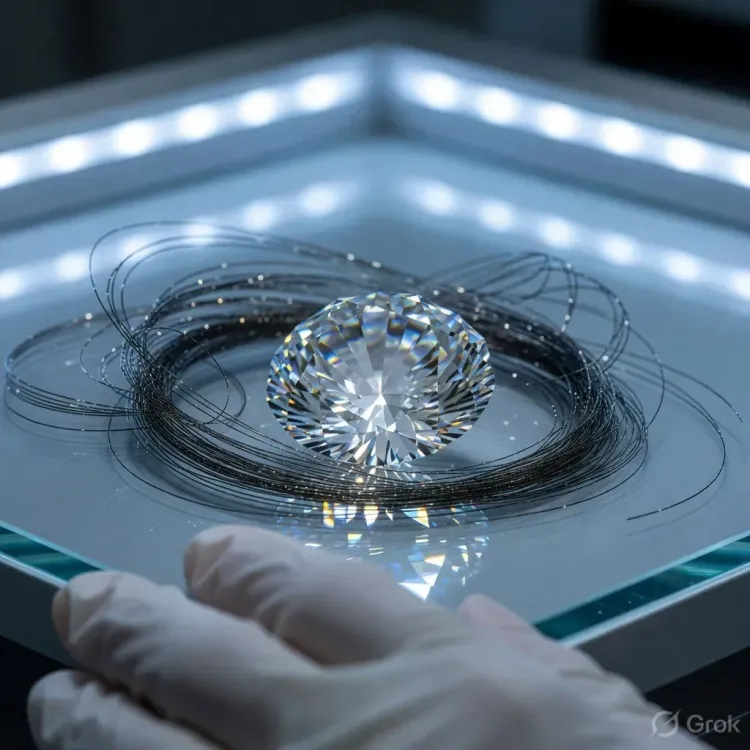
The key innovation lies in the integration of multi-walled carbon nanotubes (MWCNTs) — ultra-fine carbon fibre structures approximately one ten-thousandth the width of a human hair, yet dozens of times stronger than steel, the paper noted. These nanotubes act as internal reinforcing cords, absorbing and redistributing energy from impacts that would ordinarily cause fracture.
The resulting composite material is described as tougher than the tungsten alloys used in armour-piercing ammunition — a benchmark that underscores its potential for extreme-environment applications far beyond conventional gemology or industrial cutting tools.
Who Built It and Where
The research team operated out of facilities including the Synergetic Extreme Condition User Facility at Huairou Science City in Beijing, a national laboratory complex designed for high-pressure and extreme-condition materials research. The involvement of Beihang University — one of China's leading aerospace and defence-oriented engineering institutions — adds significance to the potential downstream applications of the material.
Why It Matters for Industry
Diamonds already underpin a vast industrial ecosystem: cutting, grinding, polishing, drilling, and semiconductor substrate manufacturing all rely on diamond's hardness. A version that resists fracture under shock loading could expand viable use cases into aerospace components, hypersonic vehicle surfaces, and advanced armour systems — sectors where both hardness and impact resistance are non-negotiable.
The tungsten alloy comparison is particularly telling. Tungsten-based materials dominate kinetic penetrator and armour applications precisely because of their toughness; a diamond composite that exceeds that benchmark would represent a step-change in structural materials.
What's Next
The research remains at the laboratory stage, and scaling MWCNT-reinforced diamond synthesis to commercial volumes presents significant engineering and cost challenges. Materials scientists will be watching whether the team can demonstrate reproducibility at larger sample sizes and whether the synthesis process — likely requiring extreme pressures and temperatures — can be made economically viable. If it can, the implications for defence, aerospace, and precision manufacturing could be substantial.
Point of View
A priority that has intensified under export controls on Western high-performance composites. Mainstream coverage tends to frame this as a scientific curiosity; the tungsten-alloy comparison is the tell — tungsten is the benchmark for kinetic energy penetrators and armour, and exceeding it in a diamond composite opens a new frontier in hard-kill protection systems. The harder question, which the paper does not answer, is whether MWCNT-diamond synthesis can escape the lab: scaling high-pressure, high-temperature processes for carbon nanotube integration is a formidable manufacturing challenge, and cost curves will determine whether this stays a defence niche or reshapes industrial tooling at scale.
NationPress
25 Sept 2026
Frequently Asked Questions
What did Chinese scientists discover about diamonds?
Chinese scientists engineered a diamond composite that is six times tougher than conventional diamond without any loss of hardness, according to a paper published in Nature Synthesis on July 9, 2026. The material uses multi-walled carbon nanotubes embedded within the diamond structure to prevent fracture under impact.
Why is ordinary diamond brittle if it is so hard?
Hardness and toughness are distinct properties: hardness measures resistance to scratching, while toughness measures resistance to fracture. Diamond is the hardest natural material but has a crystallographic structure that allows it to cleave cleanly under a sharp blow, making it brittle in the same way glass is.
What are multi-walled carbon nanotubes and why do they matter here?
Multi-walled carbon nanotubes are concentric cylindrical carbon structures roughly one ten-thousandth the width of a human hair, yet dozens of times stronger than steel, according to the research paper. Embedded in diamond, they act as internal reinforcing cords that absorb and redirect impact energy, preventing crack propagation.
What real-world applications could this tougher diamond enable?
The material's toughness exceeding that of tungsten alloys used in armour-piercing ammunition makes it a candidate for defence and aerospace applications, including advanced armour systems and hypersonic vehicle components. Industrial uses such as cutting, drilling, and polishing tools — where diamond already dominates — could also benefit significantly.
Which institutions were behind this diamond research?
The research was conducted by a team from the Institute of Physics at the Chinese Academy of Sciences and Beihang University, using facilities at the Synergetic Extreme Condition User Facility in Huairou Science City, Beijing. The findings were published in the peer-reviewed journal Nature Synthesis.