Bhojshala verdict: Opposition calls it BJP's 'Hindu agenda' push
Synopsis
The Madhya Pradesh High Court's Bhojshala ruling has split political India sharply. While TMC, RJD, and Congress leaders call it a BJP-driven communal move that sidelines real economic concerns, the Samajwadi Party is urging restraint until the Supreme Court speaks — signalling that the legal battle over this contested site is far from over.
Key Takeaways
The Madhya Pradesh High Court declared Bhojshala a Hindu temple and property of King Bhoj , revoking the ASI's 2003 shared-use order .
TMC MP Saugata Roy called the verdict 'unfortunate' and described it as a 'communal step by the BJP government.' RJD MP Manoj Jha invoked the Places of Worship Act, 1991 , arguing such disputes set the nation back.
Congress leader Hussain Dalwai called the decision 'completely wrong' and alleged the Muslim community is being 'intentionally harassed.' Samajwadi Party spokesperson Ashutosh Verma urged no political comment until the Supreme Court delivers a final verdict.
The Muslim side and Jain community's petitions were dismissed; the matter is expected to head to the Supreme Court.
A day after the Madhya Pradesh High Court declared the Bhojshala complex a Hindu temple and property of King Bhoj, opposition leaders on Saturday sharply criticised the ruling, describing it as a step by the Bharatiya Janata Party (BJP) to advance what they called its 'Hindu agenda'. The verdict, which revoked the Archaeological Survey of India (ASI)'s 2003 order, granted the Hindu side exclusive worship rights at the site while dismissing petitions filed by the Muslim side and the Jain community.
Opposition Reactions
Trinamool Congress (TMC) MP Saugata Roy called the judgment 'unfortunate,' saying: 'The BJP governments all over the country are taking steps to fulfil their Hindu agenda. I do not support this. The Madhya Pradesh High Court... the courts have not been fair in this matter.' He further described it as 'a communal step by the BJP government.'
Rashtriya Janata Dal (RJD) MP Manoj Jha argued that religious disputes push the nation backwards. He pointed to the Places of Worship Act, 1991 — enacted to prohibit conversion of any place of worship and preserve its religious character — saying such disputes should not be recurring. 'The country needs an end to such issues,' Jha said, adding that problems of unemployment, income insecurity, and inequality remain sidelined in public discourse.
Congress Leaders Weigh In
Congress MP Imran Masood echoed the concern that contentious religious issues dominate national conversation at the expense of economic matters. 'Discussion on health, exams, unemployment, inflation, etc. won't be held. Only such things will be discussed,' he said.
Congress leader Hussain Dalwai called the decision 'completely wrong,' alleging that the Muslim community is being 'intentionally harassed.' He also alleged that Buddhist stupas and Jain temples have been demolished historically, and argued that the site should be left as it stands. 'Let the place remain as it is and make another temple, how does it make any difference,' he said.
A Dissenting Voice: SP Urges Restraint
Samajwadi Party (SP) spokesperson Ashutosh Verma struck a notably different tone, cautioning against political commentary while avenues to the Supreme Court remain open. 'Many people will try to find a Hindu-Muslim angle in it, but my view is that as long as avenues to the Supreme Court are open, both parties can go there and present their case. Political reaction should be given only after the final verdict,' he said.
Background and Context
The Bhojshala complex in Dhar, Madhya Pradesh, has long been a contested site. The ASI's 2003 order had established a shared arrangement — Hindus were permitted to worship on Tuesdays and Muslims on Fridays. The High Court's ruling overturns that framework entirely, a development that critics argue could set a precedent for similar disputes across the country. This comes amid a broader national conversation about the Places of Worship Act, 1991, whose scope and enforceability have been repeatedly questioned in recent years.
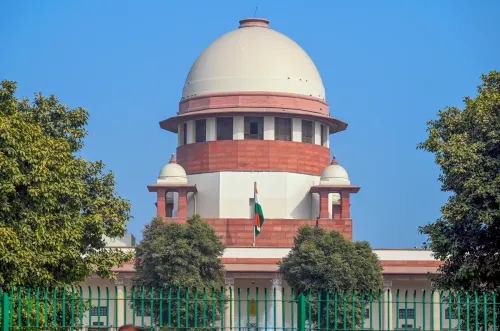
The matter is expected to be taken to the Supreme Court, with the Muslim side yet to announce its next legal steps following the verdict.
Point of View
1991 is already under sustained legal pressure — making the High Court's move to overturn a two-decade-old ASI arrangement particularly consequential. What is striking is the SP's studied restraint: by deferring to the Supreme Court, it signals that even within the opposition, the political calculus on religious-site disputes is not uniform. The deeper pattern mainstream coverage tends to miss is this — each such verdict, regardless of legal merit, resets the Overton window on what disputes are litigable, effectively stress-testing the 1991 Act's protections in ways Parliament has so far avoided addressing directly.
NationPress
20 Sept 2026
Frequently Asked Questions
What did the Madhya Pradesh High Court rule on Bhojshala?
The Madhya Pradesh High Court declared the Bhojshala complex a Hindu temple and the property of King Bhoj, revoking the ASI's 2003 order that had allowed shared use of the site. The Hindu side was granted exclusive worship rights, while petitions from the Muslim side and Jain community were dismissed.
What was the ASI's 2003 order on Bhojshala?
The Archaeological Survey of India's 2003 order established a shared-use arrangement at Bhojshala, permitting Hindus to worship on Tuesdays and Muslims to offer Friday prayers. The Madhya Pradesh High Court's recent ruling overturns this arrangement entirely.
Why are opposition parties criticising the Bhojshala verdict?
Opposition leaders from TMC, RJD, and Congress have called the verdict a step by the BJP to fulfil its 'Hindu agenda,' arguing it is communally divisive and distracts from pressing issues like unemployment and inflation. Congress leader Hussain Dalwai called it 'completely wrong,' while RJD MP Manoj Jha pointed to the Places of Worship Act, 1991 as a framework that should prevent such disputes.
What is the Places of Worship Act, 1991, and why is it relevant?
The Places of Worship Act, 1991 was enacted to prohibit the conversion of any place of worship and to maintain the religious character of such sites as they existed on 15 August 1947. Several opposition leaders cited it in response to the Bhojshala verdict, arguing the ruling runs contrary to its spirit.
What happens next in the Bhojshala case?
Samajwadi Party spokesperson Ashutosh Verma has noted that avenues to the Supreme Court remain open, and both parties can present their case there. The Muslim side has yet to formally announce its next legal steps following the High Court's dismissal of its petition.