EU-India FTA Expected to Enhance India's Sectoral Competitiveness
Synopsis
A recent EY report reveals that the EU-India Free Trade Agreement could significantly enhance India's competitiveness in various sectors amidst Europe's fragile economic condition, driven by geopolitical tensions. Discover how this trade deal may reshape global trade dynamics.
Key Takeaways
EU-India FTA may enhance India's trade competitiveness.
Geopolitical tensions are affecting European economic stability.
Textiles and minerals sectors are key areas of impact.
Inflation in Europe is expected to rise due to geopolitical issues.
AI investments could bolster Europe's economic growth.
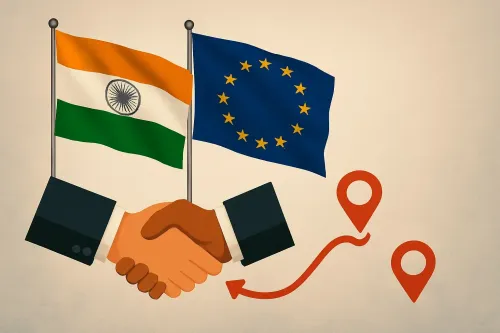
New Delhi, April 4 (NationPress) The current fragile economic landscape in Europe, influenced by geopolitical tensions, may lead to significant impacts on India’s trade dynamics and sectoral competitiveness, as highlighted by a recent report. The findings from EY suggest that India stands to benefit from enhanced trade relations with Europe, particularly in sectors like textiles.
Changes in tariff and trade policies from the United States, along with ongoing conflicts in West Asia, could pose challenges to Europe’s economy, thereby affecting global trade patterns and competition with nations such as India.
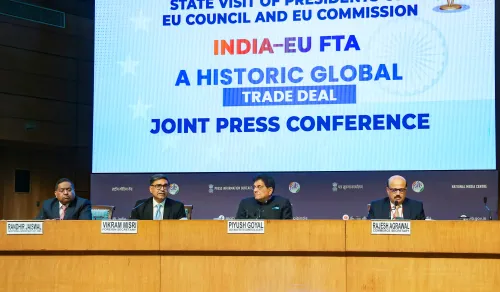
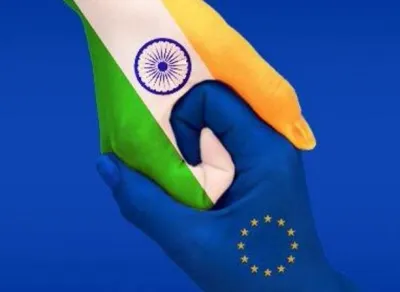
The report emphasizes that the newly established EU-India Free Trade Agreement (FTA) may produce varied sector-specific outcomes for European industries while intensifying competitive pressures in certain areas. It noted, "While the overall macroeconomic impact on Europe is minimal, the sectoral implications are significantly more pronounced," the report mentioned.
Particularly, the textile sector in Europe may experience heightened competition from India, while the minerals sector could gain from better accessibility to essential production inputs.
According to the advisory firm, US tariffs are projected to reduce EU's GDP growth by 0.5 percentage points in 2026, with the most adverse effects anticipated in Ireland and the Nordic countries. Nevertheless, it projected that the euro area economy will continue to expand, albeit at a slow rate, before gradually recovering.
The report forecasts that overall growth in the euro area is likely to decline to 1.3 percent in 2026 from 1.5 percent in 2025, but it should pick up to 1.4 percent in 2027 and 1.5 percent in 2028-29.
Furthermore, geopolitical tensions in the Middle East are expected to influence global energy prices, leading to a 0.3 percentage point increase in inflation in Europe by 2026 and a reduction in GDP by 0.2 percent.
The challenges posed by aging populations and labor shortages may weigh heavily on Europe’s long-term growth, especially in Central, Eastern, and Southern regions.
Investments in emerging technologies, such as artificial intelligence, could potentially enhance Europe’s productivity and economic outcomes in the next decade.
"AI has the potential to boost Western Europe's GDP by up to 4 percent by 2033," the report indicated, although it cautioned that Europe may fall behind the United States in AI investments.
Additionally, the report warned that a significant disruption, such as a blockade of the Strait of Hormuz, could lead to considerably larger economic repercussions.
aar/pk
Point of View
I find that the implications of the EU-India FTA are pivotal for India’s economic landscape. This trade agreement not only promises to bolster India's sectoral competitiveness but also serves as a strategic response to the shifting global economic dynamics. It reflects a nation-first approach that could reshape our trade relations.
NationPress
15 Oct 2026
Frequently Asked Questions
What is the significance of the EU-India FTA?
The EU-India FTA is significant as it aims to enhance trade relations between the two regions, potentially boosting India's competitiveness in various sectors, especially textiles.
How will geopolitical tensions affect global trade?
Geopolitical tensions, particularly in the Middle East, may disrupt trade flows, influence energy prices, and lead to inflationary pressures, impacting global trade dynamics.
What sectors might benefit from the FTA?
Sectors like textiles may see increased competition, while the minerals sector could benefit from improved access to essential production inputs due to the FTA.
What are the expected economic growth rates for Europe?
The report anticipates that euro area growth will slow to 1.3% in 2026 but may recover slightly to 1.4% in 2027 and 1.5% in 2028-29.
What role does artificial intelligence play in Europe's economy?
Investments in artificial intelligence could significantly boost Europe’s productivity, with the potential to increase GDP by up to 4% by 2033.