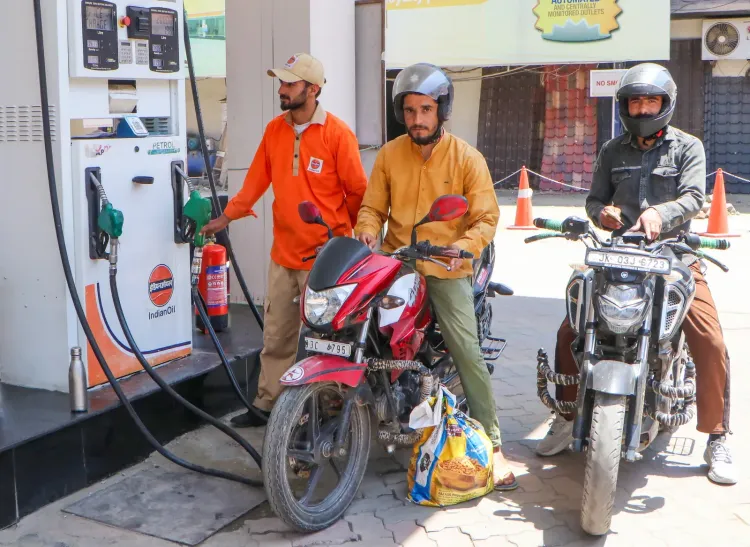
Fuel price hike of ₹3 a drop in ocean as oil firms bleed ₹1,000 crore daily
Synopsis
A ₹3 per litre fuel price hike sounds significant at the pump — but officials say it barely dents a ₹1,000 crore-a-day bleeding by Indian Oil, BPCL, and HPCL, with petrol under-recoveries at ₹26 and diesel at ₹82 per litre. The real story is how long the Centre can sustain this buffer as the Strait of Hormuz crisis keeps crude above $100 a barrel.
Key Takeaways
State-run oil companies are absorbing losses of nearly ₹1,000 crore every day to prevent steep retail fuel price increases.
Petrol under-recoveries stand at approximately ₹26 per litre ; diesel under-recoveries are as high as ₹82 per litre .
The ₹3 per litre hike in petrol and diesel prices covers only a small fraction of actual losses borne by Indian Oil , BPCL , and HPCL .
Global crude oil prices have crossed $100 a barrel , driven by the US-Iran conflict and disruption at the Strait of Hormuz .
India holds 60 days of crude stocks and refineries are at maximum capacity — no immediate supply shortage.
The government is simultaneously bearing a fertiliser subsidy burden of nearly ₹2.25 lakh crore to shield farmers.
The ₹3 per litre increase in petrol and diesel prices announced by the government is a fraction of the actual losses being absorbed by state-run oil companies, a senior official said on Friday, 15 May. With global crude oil prices crossing $100 a barrel, public sector oil marketing companies — along with the government — are collectively absorbing losses of nearly ₹1,000 crore every day to shield Indian consumers from the full force of the global oil shock.
The Scale of Under-Recovery
According to official sources, petrol under-recoveries are currently estimated at around ₹26 per litre, while diesel under-recoveries are as steep as ₹82 per litre. Against that backdrop, the ₹3 hike covers only a marginal portion of the financial burden now being borne by Indian Oil, BPCL, and HPCL — the three state-owned oil marketing companies operating at the front line of this subsidy squeeze.
Why the Government Is Holding Back
Officials said the Centre's policy stance is deliberate: it does not want Indian consumers to absorb the full impact of rising global crude prices through steep pump-price increases. A sharp hike, officials argued, would trigger a chain reaction across the economy — raising transportation costs, pushing up food prices, and squeezing household budgets at a sensitive moment for domestic demand.
Notably, this fuel subsidy effort is running alongside a fertiliser subsidy burden estimated at nearly ₹2.25 lakh crore, which the government is bearing separately to protect the agriculture sector from rising input costs. Together, the two form what official sources described as a deliberate buffer strategy against imported inflation.
The Geopolitical Trigger
Officials pointed to the escalating US-Iran conflict and the disruption of the Strait of Hormuz — through which 20 per cent of the world's energy exports transit under normal conditions — as the primary drivers of the current crude price surge. 'India has zero control over these geopolitical developments,' a source said, adding that the government is consciously trying to avoid transferring the entire external shock onto consumers.
India's annual crude oil import bill is estimated at ₹12–15 lakh crore, with every $10 increase in crude prices adding roughly $13–14 billion to the country's import burden. Government sources characterised the situation as a 'massive twin drain' driven by elevated oil and gold imports simultaneously.
Supply Position and Macroeconomic Context
Indian Oil officials said refineries are currently operating round the clock at maximum capacity, and the country holds 60 days of crude stocks — the maximum required — ensuring no near-term fuel shortage. Officials also noted that India's macroeconomic position is significantly stronger than during the 2012–13 oil crisis: the current account deficit stands below 1.5 per cent of GDP, compared with nearly 5 per cent during that earlier period, and inflation remains relatively contained.
Prime Minister Narendra Modi, sources said, has been pushing for lower fuel consumption patterns and reduced import dependence as a longer-term structural response, rather than relying on aggressive retail price hikes as the primary adjustment mechanism. How long the government can sustain daily losses of this magnitude without a larger correction will be the defining question in the weeks ahead.
Point of View
000 crore subsidy burn is a political choice, not an economic inevitability — and one that defers, rather than resolves, the adjustment pain. Under-recoveries of ₹82 per litre on diesel are unsustainable at scale; every day of delay compounds the eventual correction. What is missing from the official framing is a credible exit timeline: at what crude price level, or for how many weeks, does the Centre absorb losses before passing them on? Without that signal, the policy looks like crisis management dressed as consumer protection. India's stronger macro position is real, but it does not make ₹1,000 crore a day free.
NationPress
27 Sept 2026
Frequently Asked Questions
Why did the government raise petrol and diesel prices by only ₹3 per litre?
The ₹3 per litre hike is a partial adjustment designed to avoid passing the full burden of soaring global crude prices onto consumers. Officials said petrol under-recoveries are around ₹26 per litre and diesel under-recoveries are as high as ₹82 per litre, making the ₹3 increase a fraction of actual losses.
How much are oil marketing companies losing every day?
State-run oil marketing companies — Indian Oil, BPCL, and HPCL — along with the government are collectively absorbing losses of nearly ₹1,000 crore every day to keep retail fuel prices from rising sharply, according to official sources.
What is driving the surge in global crude oil prices?
Officials attributed the price surge primarily to the escalating US-Iran conflict and disruption at the Strait of Hormuz, through which 20 per cent of the world's energy exports transit. These geopolitical developments have pushed crude above $100 a barrel.
Is India at risk of a fuel shortage?
No immediate shortage is expected. Indian Oil officials said refineries are operating at maximum capacity round the clock, and the country currently holds 60 days of crude stocks — the maximum required by refineries.
How does India's current oil crisis compare with the 2012–13 episode?
Officials said India's macroeconomic position is significantly stronger now. The current account deficit is below 1.5 per cent of GDP, compared with nearly 5 per cent during the 2012–13 crisis, and inflation remains relatively contained despite global volatility.