Unraveling the Socio-Political Conflicts in Balochistan: A Report
Synopsis
Discover the troubling socio-political landscape of Balochistan, where smuggling and misgovernance intertwine, revealing a complex narrative that challenges the authority's claims. This report highlights the significant contradictions and the public's struggle for recognition.
Key Takeaways
Contradictions in Governance: The Balochistan government struggles with internal inconsistencies, particularly in its anti-smuggling narrative.
Public Sentiment: The local populace feels a profound sense of deprivation and mistrust towards their leaders.
Political Dynamics: Shafiq Mengal's controversial political ties illustrate the complexities of Balochistan's political landscape.
Socio-Economic Impact: Smuggling is both a livelihood and a challenge, compounding the region's socio-economic issues.
Need for Genuine Solutions: Addressing misgovernance is crucial for fostering public trust and effectively tackling corruption.
Quetta, April 12 (NationPress) An analysis by an independent think tank unveils the socio-political contradictions prevailing in Pakistan's Balochistan through two recent incidents.
Balochistan's Chief Minister, Mir Sarfraz Bugti, set the price of Iranian smuggled petrol at PKR 280 per litre, while Shafiq Mengal received a National Assembly ticket. This situation underscores a significant inconsistency: a government that boasts about its anti-smuggling efforts cannot concurrently endorse prices for smuggled fuel, highlighting a failure of basic reasoning, according to Imtiaz Gul, who leads the Centre for Research and Security Studies in Islamabad, in his opinion piece for The Express Tribune.
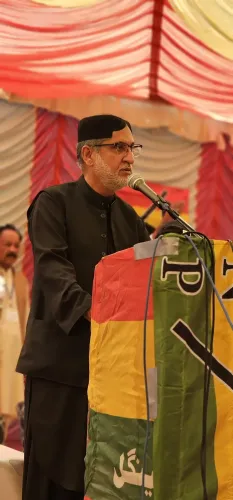
Gul notes, "The concept of the 'illegal spectrum' has become a frequent term for officials, yet in this instance, they inadvertently validate the very cross-border activities they claim to combat. The second event revolves around Shafiq Mengal, who was awarded a PPP ticket for the NA-256 Khuzdar by-election after aligning himself with President Asif Ali Zardari earlier in March. Mengal fails to garner much affection, trust, or empathy from the Baloch populace," he elaborated.
"Implicated by allegations—whether proven or not—of connections to armed factions, enforced disappearances, political flip-flopping, and involvement in several murders, including those of close relatives, he represents a highly divisive figure. These instances collectively expose the core challenges afflicting Balochistan: smuggling, terrorism, narcotics, misgovernance, corruption, insufficient governance capacity, political apathy, and a lack of public trust in leaders who many in Balochistan regard as 'selected' rather than truly elected," he continued.
These underlying issues also influence how authorities approach solutions, leading to varying interpretations of the ground realities.
Balochistan finds itself trapped between two conflicting narratives. The first is propagated by the authorities, who deliver optimistic PowerPoint presentations backed by government data, showcasing their commitment to combat the 'illegal spectrum', including terrorism, Gul asserts.
The second narrative emerges from the public, who experience feelings of deprivation, helplessness, and systemic exclusion. While official reports mention discontent and terrorist activity, they concentrate on challenges without adequately addressing solutions. Authorities believe they are effectively tackling smuggling and corruption, yet they seem to overlook that corruption is a consequence of misgovernance, which is inherently tied to the methods of candidate selection for elected positions.
Anti-smuggling initiatives portray a narrative of victimhood among families that rely on this trade for their livelihood, as pointed out in the opinion piece. Officials claim that only a handful of families in border regions have gained from smuggling, while these areas continue to experience socio-economic neglect and lack basic social-political infrastructure.
Point of View
It's crucial to recognize the complex interplay of smuggling, political affiliations, and public sentiment in Balochistan. The region's challenges demand a nuanced understanding and a commitment to addressing the root causes of discontent rather than superficial solutions.
NationPress
7 Oct 2026
Frequently Asked Questions
What recent events highlight the issues in Balochistan?
Recent decisions by the Balochistan government, including the pricing of Iranian smuggled petrol and the political ticket awarded to Shafiq Mengal, reveal the contradictions in their governance and the public's response.
Why is Shafiq Mengal a controversial figure?
Shafiq Mengal is viewed as polarizing due to allegations of connections to armed groups and involvement in criminal activities, which have led to a lack of trust among the Baloch public.
How do the authorities view the challenges in Balochistan?
Authorities present an optimistic narrative about combating the 'illegal spectrum', but public sentiment reflects a deep sense of deprivation and systemic rejection, highlighting a disconnect between official reports and ground realities.
What role does smuggling play in the socio-economic landscape of Balochistan?
Smuggling is seen as a livelihood for many families in Balochistan, yet it perpetuates socio-economic deprivation and is exacerbated by governmental misgovernance.
What is the public perception of political leaders in Balochistan?
Many in Balochistan perceive their political leaders as 'selected' rather than genuinely elected, leading to widespread discontent and a lack of trust in governance.