White House Backs US-Made Medicine Push, Tags Sec Kennedy
Synopsis
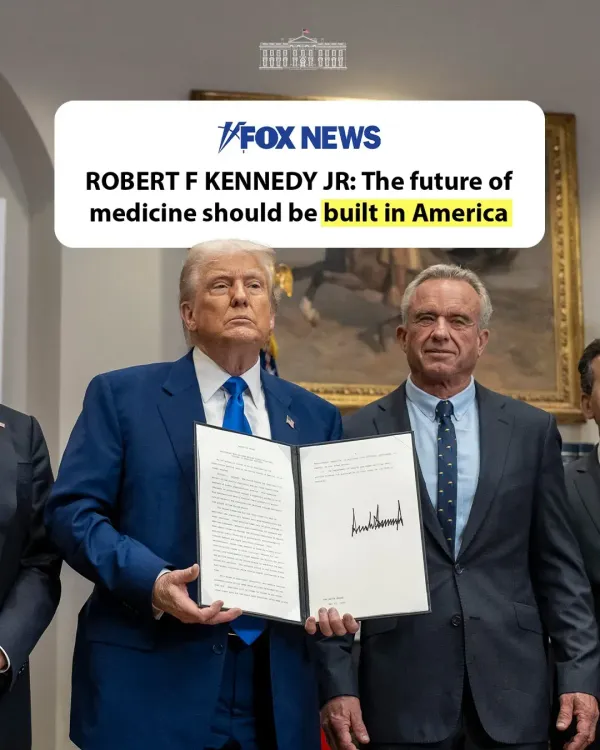
The White House declared 'the future of medicine should be built in America,' tagging Secretary Kennedy in a June 2026 post that reinforces executive focus on reshoring pharmaceutical manufacturing and reducing US dependence on foreign drug supply chains.
Key Takeaways
The White House posted on June 24, 2026 that 'the future of medicine should be built in America,' tagging @SecKennedy .
Kennedy Jr. holds a senior health policy role focused on chronic disease and regulatory reform.
Executive Order 13944 , signed in August 2020 , established the policy foundation for reducing reliance on foreign pharmaceutical sources.
The push aligns with broader US efforts to treat pharmaceutical supply chains as a national-security issue, similar to semiconductors and critical minerals.
Potential next steps include HHS manufacturing incentives, FDA guidance updates, and legislation on domestic-content thresholds for federally purchased drugs.
Both US pharmaceutical manufacturers and American patients are key stakeholders, with differing near-term implications for industry and consumer costs.
The White House on Tuesday, June 24, 2026, declared that the future of medicine should be built in America, tagging Secretary Kennedy in a post that signals continued executive focus on domestic pharmaceutical manufacturing. The statement, issued from the official communications account of the Executive Office of the President, amplifies a policy direction centred on reshoring medical production and reducing foreign supply-chain dependence.
Context
The post — 'The future of medicine should be built in America' — is brief but pointed. By tagging @SecKennedy, the White House directly associates the message with the health policy portfolio held by Robert F. Kennedy Jr., who was appointed to a senior health role focused on chronic disease and regulatory reform after aligning with the Trump campaign. The statement reflects an ongoing executive posture that treats domestic pharmaceutical production as both an economic and a national-security priority.
The framing echoes a long-standing concern in Washington DC about the vulnerability of American patients to disruptions in global drug supply chains — a concern that became acute during the COVID-19 pandemic, when shortages of active pharmaceutical ingredients highlighted the risks of heavy reliance on foreign manufacturers, particularly in Asia.
Policy Backdrop
The groundwork for this posture was laid at least as far back as August 2020, when Executive Order 13944 directed federal agencies to identify and reduce dependence on foreign sources for essential medicines and active pharmaceutical ingredients. That order established a template — domestic-content preferences, manufacturing incentives, and supply-chain audits — that subsequent administrations have built upon in varying forms.
The broader pattern spans multiple administrations and reflects a bipartisan recognition that pharmaceutical supply-chain resilience is a national-security issue, not merely a trade or health-care question. Biotechnology and advanced drug manufacturing have increasingly been treated alongside semiconductors and critical minerals as sectors where domestic capacity is strategically essential.
Stakeholders and Impact
US pharmaceutical manufacturers stand to benefit most directly from any policy push that follows this signal, whether through federal procurement preferences, tax incentives for on-shore facilities, or streamlined FDA approvals for domestically produced drugs. Industry groups have long lobbied for such measures, arguing that the cost differential with overseas production requires government support to bridge.
For American patients, the stated goal is greater reliability and security of drug supply. Critics, however, caution that reshoring without accompanying price controls or competition policy could raise costs for consumers in the near term, even if long-term supply security improves.
What's Next
Analysts and industry watchers will now look to the Department of Health and Human Services for concrete follow-through — potential announcements could include manufacturing incentive programmes, updated FDA guidance on domestic production facilities, or proposed legislation mandating domestic-content thresholds for federally purchased medicines. The tagging of Secretary Kennedy suggests his office is expected to be the operational centre of whatever policy action follows this public signal.
Whether this statement translates into binding executive action or remains an aspirational framing will be the defining question in the weeks ahead — and a key test of the administration's ability to move from rhetoric to regulatory reality on pharmaceutical manufacturing.
Point of View
The administration is staking out ground that is difficult for opponents to contest head-on. The move fits a broader pattern of using short, values-laden social media statements to set the agenda for forthcoming regulatory or legislative action. The real test will be whether concrete policy instruments follow, or whether the statement remains in the register of aspirational branding.
NationPress
23 Jun 2026
Frequently Asked Questions
What did the White House say about medicine manufacturing in America?
The White House stated that 'the future of medicine should be built in America,' tagging Secretary Kennedy in a June 2026 post focused on domestic pharmaceutical production.
Who is Secretary Kennedy and what is his role in US health policy?
Robert F. Kennedy Jr. was appointed to a senior US health policy position focused on chronic disease and regulatory reform after aligning with the Trump campaign. He is tagged by the White House as a key figure in the domestic medicine manufacturing push.
What is Executive Order 13944 and how does it relate to this?
Executive Order 13944 , signed in August 2020 , directed federal agencies to reduce reliance on foreign sources for essential medicines and active pharmaceutical ingredients, laying the policy foundation for the current administration's stance.
Why does the US want to manufacture medicine domestically?
The COVID-19 pandemic exposed dangerous dependence on foreign drug supply chains, prompting multiple administrations to treat pharmaceutical manufacturing as a national-security priority alongside semiconductors and critical minerals.
What policy actions could follow the White House's medicine manufacturing statement?
Potential next steps include HHS manufacturing incentive programmes, updated FDA guidance for domestic facilities, and legislation requiring domestic-content thresholds for federally purchased medicines.