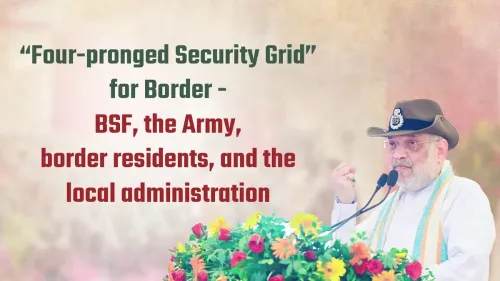
Amit Shah Chairs Land Border SPs Conference 2026
Synopsis
Union Home Minister Amit Shah chaired the Land Border Districts' SPs Conference 2026 in New Delhi on 9 July, announcing a shift to proactive border security through a four-pronged district-level grid integrating technology, forces, administration and citizens under the smart border initiative.
Key Takeaways
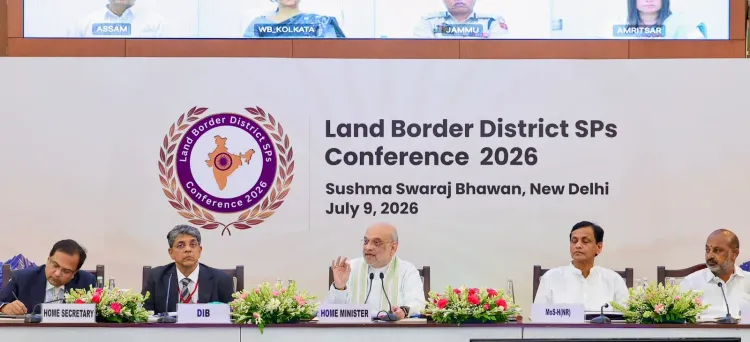
Amit Shah chaired the Land Border Districts' SPs Conference 2026 in New Delhi on 9 July 2026 .
The Modi government has repositioned India's border security from a reactive to a proactive model, per Shah.
A four-pronged security grid is being rolled out to the district level, integrating forces, administration, technology, and citizens.
The smart border initiative is the technological backbone of this architecture, aimed at real-time frontier monitoring.
The conference brought together Superintendents of Police from all land border districts to coordinate implementation.
India's border security framework builds on the Comprehensive Integrated Border Management System (CIBMS) piloted from 2016 .
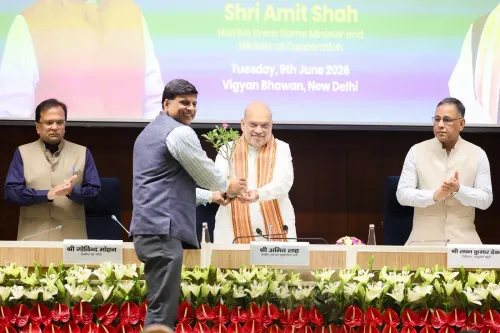
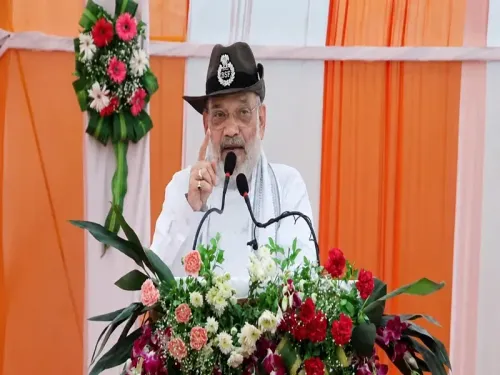
Union Home Minister Amit Shah on Thursday, 9 July 2026, chaired the Land Border Districts' Superintendents of Police (SPs) Conference 2026 in New Delhi, bringing together district-level police chiefs from India's land border regions to review and strengthen the country's frontier security apparatus.
Context
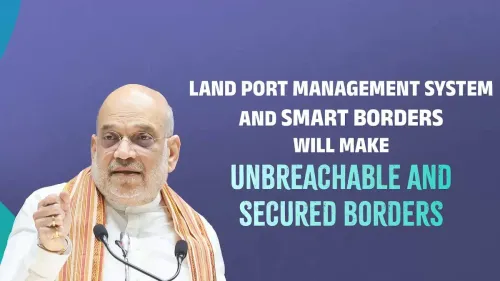
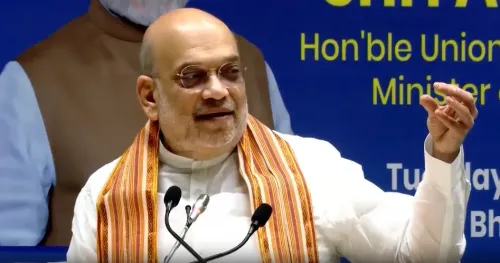
Addressing the conference, Amit Shah declared that the Modi government has fundamentally transformed India's border security posture — shifting it from a reactive model to a proactive one. He described an integrated framework combining the capabilities of security forces, district administration, modern technology, and local citizens into a unified security ecosystem.
Shah stated that a four-pronged security grid is being implemented down to the district level, anchored by the 'smart border' initiative, with the stated objective of securing 'every inch' of India's frontiers with what he called 'the world's most modern security ring.'
Policy Backdrop
India's approach to land border security has evolved considerably since 2014, with successive layers of technology, physical infrastructure, and administrative coordination added across frontiers with Pakistan, Bangladesh, Myanmar, and China. The Comprehensive Integrated Border Management System (CIBMS), piloted from 2016 onward, was an early step in this direction — combining physical barriers with electronic surveillance along the India-Pakistan border.
The 'smart border' concept referenced by Shah extends this logic, deploying sensors, surveillance systems, and integrated data grids for real-time monitoring. The emphasis on district-level coordination marks a deliberate decentralisation, integrating central paramilitary forces with state police machinery and civilian networks rather than relying solely on central agencies.
The Land Border Districts' SPs Conference itself serves as a key coordination mechanism, convening Superintendents of Police from districts that share international land borders — officers who are often the first administrative point of contact for cross-border incidents, infiltration attempts, and smuggling.
Stakeholders and Impact
The primary beneficiaries of this architecture are border district police forces, central security agencies such as the Border Security Force (BSF), Sashastra Seema Bal (SSB), and Indo-Tibetan Border Police (ITBP), as well as the millions of citizens living in India's border villages and districts. Integrating local citizens into the security grid — as referenced by Shah — reflects a broader 'Vibrant Villages' and border-area development philosophy that the government has pursued in recent years.
For state governments, the district-level grid approach implies closer coordination between state police and central forces, with SPs playing a more operationally significant role in border security decisions rather than acting purely in a supporting capacity.
What's Next
Attention will now turn to the rollout timelines for additional smart-fencing segments and any follow-up directives issued to state governments arising from the conference. The articulation of a four-pronged security grid framework suggests formal guidelines or standard operating procedures may be communicated to border district administrations in the coming weeks. India's land border security posture — particularly along the Bangladesh and Myanmar frontiers — remains under active operational focus, making the outcomes of this conference consequential for ground-level implementation.
Point of View
Force-centric model. By framing citizens as active components of the security grid, the government is extending its 'Vibrant Villages' philosophy into the operational security domain, blurring the line between development policy and strategic depth. The four-pronged grid language suggests a codified doctrine is being built, not merely an ad hoc upgrade. If implemented consistently, this could redefine the role of state police in India's border management architecture, with SPs becoming key nodes in what has historically been a central government-dominated space.
NationPress
10 Jul 2026
Frequently Asked Questions
What is the Land Border Districts' SPs Conference 2026?
The Land Border Districts' SPs Conference 2026 is a meeting of Superintendents of Police from India's land border districts, convened by the Union Home Ministry to review operational coordination, technology integration, and security strategy along the country's land frontiers.
What is the smart border initiative in India?
The smart border initiative is a technology-centric approach to border security that deploys sensors, surveillance systems, and integrated data grids for real-time monitoring of India's land frontiers, building on earlier systems like the Comprehensive Integrated Border Management System (CIBMS) piloted from 2016.
What did Amit Shah say at the border SPs conference?
Amit Shah stated that the Modi government has transformed India's border security from a reactive to a proactive apparatus by integrating security forces, administration, technology, and citizens, and announced a four-pronged security grid down to the district level under the smart border initiative.
What is the four-pronged security grid for India's borders?
As announced by Home Minister Amit Shah, the four-pronged security grid is a district-level border security framework integrating the capabilities of security forces, administration, technology, and citizens, aimed at achieving comprehensive coverage of India's land frontiers.
Which borders does India's land border security framework cover?
India's land border security architecture covers frontiers with Pakistan, Bangladesh, Myanmar, and China, with central forces like the BSF, SSB, and ITBP operating alongside state police and district administrations.