Assam Budget 2026: Four New Medical Colleges Planned

Synopsis
The Chief Minister's Office of Assam announced in the 2026 state budget that four new medical colleges will be set up in Goalpara, Hailakandi, Hojai and Bajali, bringing the total to 28. The move is part of Assam's 'One District, One Medical College' vision for equitable higher education.
Key Takeaways
Four new medical colleges are proposed in Goalpara , Hailakandi , Hojai , and Bajali under the Assam Budget 2026 .
The additions will bring Assam's total number of medical colleges to 28 , according to the government.
The expansion is part of the state's vision of 'One District, One University, One Medical College and One Engineering College' .
All four districts have historically had limited access to medical education infrastructure.
New colleges will require regulatory clearance from the National Medical Commission before becoming operational.
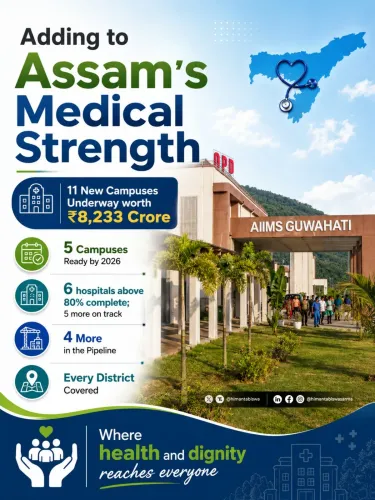
The announcement continues Assam's decade-long drive, which previously added colleges in Barpeta , Tezpur , and Diphu .
The Chief Minister's Office of Assam announced on Friday, 10 July 2026, that the Assam Budget 2026 proposes establishing four new medical colleges in Goalpara, Hailakandi, Hojai, and Bajali, which the government says will bring the state's total count of medical colleges to 28.
Context
The budget announcement frames the expansion under a broader vision the government has articulated as 'One District, One University, One Medical College and One Engineering College' — a formula aimed at ensuring quality higher education in every district of the state. The four districts named have historically faced limited access to medical training infrastructure, making them priority sites for the expansion.
Goalpara in western Assam and Hailakandi in the south have long been underserved in terms of tertiary health education. Hojai and Bajali similarly represent districts where residents have had to travel significant distances for medical college access.
Policy Backdrop
Assam has been on a sustained drive to expand medical education capacity since 2016, establishing or upgrading colleges in Barpeta, Tezpur, and Diphu through state funding and central government schemes. The current push continues that trajectory, now deepened by post-pandemic recognition of the Northeast's doctor shortage.
Chief Minister Himanta Biswa Sarma, who has helmed the state since May 2021, has consistently positioned district-level institution-building as a pillar of his government's human-capital agenda. The 'one district, one institution' model mirrors approaches adopted in several other Indian states seeking geographically balanced higher education coverage.
At the national level, India faces a well-documented shortage of doctors relative to its population, and the central government has encouraged states to scale up medical college capacity. New institutions, however, require clearances from the National Medical Commission (NMC), the statutory body that sets and enforces standards for medical education across the country.
Stakeholders and Impact
The most direct beneficiaries are medical aspirants from districts that currently lack local options, who often bear the cost and disruption of relocating to Guwahati or outside the state for MBBS seats. Residents of Goalpara, Hailakandi, Hojai, and Bajali stand to gain improved access to locally trained doctors over the medium term.
District administrations, local contractors, and faculty recruitment pipelines will all be drawn into the implementation process. The expansion also has downstream implications for nursing, paramedical, and allied health training ecosystems that typically develop around medical college campuses.
What's Next
The proposal's translation into operational colleges depends on several sequential steps: formal budget approval by the Assam Legislative Assembly, land acquisition and construction, faculty hiring, and — critically — regulatory clearance from the National Medical Commission. NMC approvals have historically been a bottleneck for new state medical colleges across India.
Phased timelines for each of the four sites have not yet been disclosed. The pace at which Assam navigates NMC requirements and recruits qualified faculty will determine when students can actually enrol at these institutions.
Point of View
One Medical College' framing is a politically legible commitment that lets the Himanta Biswa Sarma government demonstrate geographic equity — a recurring pressure point in a state with sharp regional disparities. Announcing four colleges in a single budget signals ambition, but the real test will be NMC approvals and faculty pipelines, both of which have stalled similar announcements in other states. The Northeast's chronic doctor shortage gives this expansion genuine policy urgency beyond optics. If executed, it would mark one of the most significant single-budget expansions of medical education capacity in Assam's history.
NationPress
8 Oct 2026
Frequently Asked Questions
Which districts will get new medical colleges in Assam Budget 2026?
The Assam Budget 2026 proposes new medical colleges in Goalpara , Hailakandi , Hojai , and Bajali .
How many medical colleges will Assam have after the new ones are built?
According to the government's announcement, Assam will have 28 medical colleges once the four new institutions are established.
What is Assam's 'One District, One Medical College' vision?
It is a policy goal articulated in the Assam Budget 2026 to ensure every district in the state has at least one university, one medical college, and one engineering college, improving access to quality higher education across the state.
Who approves new medical colleges in India?
The National Medical Commission (NMC) is the statutory body responsible for approving and regulating new medical colleges across India, and its clearance is mandatory before any new institution can admit students.
Has Assam expanded medical colleges before?
Yes. Between 2016 and 2023 , Assam established or upgraded medical colleges in Barpeta , Tezpur , and Diphu , through state funds and central government schemes.