CM Himanta backs Assam law protecting women from polygamy

Synopsis
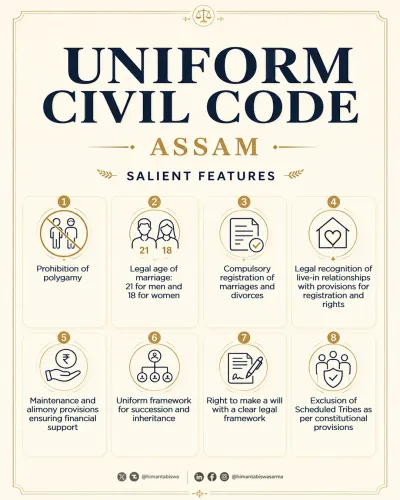
Assam Chief Minister Himanta Biswa Sarma on 27 May 2026 backed a new state law criminalising polygamy and interfaith marriage fraud, framing it as a secular, progressive reform that guarantees Assam women full rights in inheritance, divorce and desertion — part of a broader BJP-led push for uniform personal laws across India.
Key Takeaways
CM Himanta Biswa Sarma on 27 May 2026 publicly endorsed a new Assam law targeting polygamy and 'Love Jihad', calling it 'the most secular, uniform and progressive law.' The law proposes to make polygamy and interfaith marriage fraud punishable offences under Assam statute.
Women are promised full rights in inheritance, divorce and desertion cases, closing gaps in existing personal law frameworks.
Uttarakhand enacted India's first state-level Uniform Civil Code in 2024 , providing a legislative precedent for Assam's effort.
Possible constitutional challenges before the Gauhati High Court or Supreme Court are anticipated, particularly over 'Love Jihad' provisions.
As NEDA convenor, Sarma's endorsement could prompt other northeastern states to consider similar legislation.
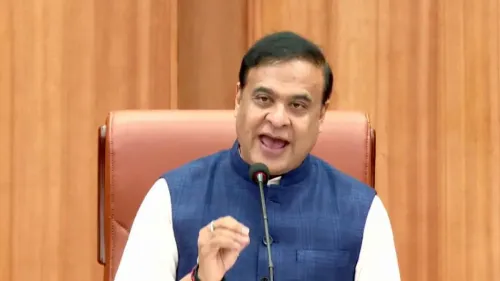
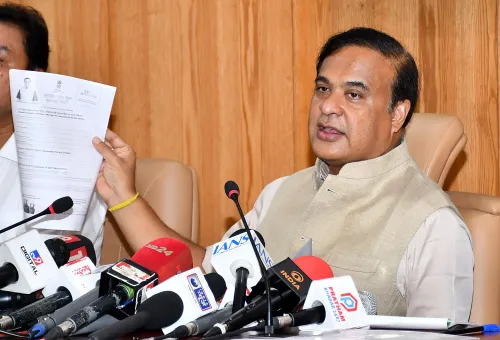
Assam Chief Minister Himanta Biswa Sarma on Wednesday, 27 May 2026 publicly endorsed a new law targeting polygamy and interfaith marriage fraud, calling it the most secular, uniform and progressive legislation that will especially benefit the state's women by guaranteeing them rights in inheritance, divorce and desertion cases.
Context
Responding to a post on X, CM Sarma described the law as one that will 'especially benefit Assam's #NariShakti by protecting them from polygamy and Love Jihad, making these punishable offences and also ensuring women have full rights in case of inheritance, divorce and desertion.' The statement signals that the legislation has either been tabled or is in an advanced stage of finalisation in the Assam assembly.
The Chief Minister's framing positions the law simultaneously as a secular reform — in that it applies uniform rules regardless of religion — and as a gender-justice measure aimed at closing legal gaps that have historically left women, particularly in Muslim-majority pockets of the state, without adequate recourse.
Policy Backdrop
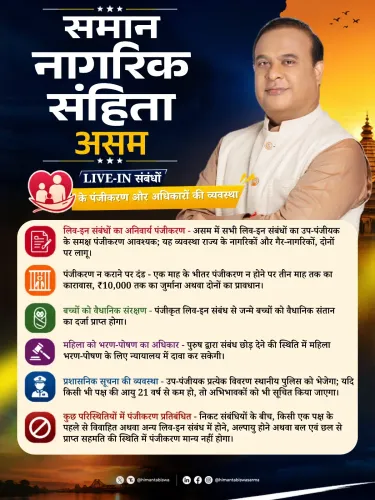
The move draws on Article 44 of the Indian Constitution, a Directive Principle that calls on the state to secure a Uniform Civil Code (UCC) governing marriage, divorce, inheritance and succession for all citizens. Uttarakhand became the first Indian state to enact such a code in 2024, covering marriage, divorce, inheritance and live-in relationships, setting a legislative template others have watched closely.
Assam signalled its own intent as far back as late 2023, when the state government announced plans to ban polygamy and strengthen women's property rights. The BJP, which governs both at the Centre and in Assam, has framed such reforms as advancing gender equality and national integration — a consistent plank in its multi-state legislative push since 2023.
The reference to 'Love Jihad' as a punishable offence is notable. Several BJP-ruled states have enacted laws regulating religious conversions in the context of marriage, though the constitutional validity of such provisions has been contested in various high courts. The precise scope of the Assam statute's definition and enforcement mechanism will be critical to how courts assess it.
Stakeholders and Impact
The law's most direct beneficiaries, as articulated by CM Sarma, are Assam's women — particularly those in communities where polygamy has been practised under personal law and where inheritance rights for women have been weakly enforced. Advocates for women's rights have long argued that codified, religion-neutral rules on divorce and property division are essential for genuine economic security.
Critics, however, contend that legislation targeting polygamy and interfaith marriages disproportionately affects Muslim communities and risks being used as an instrument of discrimination rather than liberation. Civil liberties groups are expected to scrutinise the 'Love Jihad' provisions closely, and constitutional challenges before the Gauhati High Court or the Supreme Court of India remain a distinct possibility.
What's Next
The immediate question is whether the Assam assembly will pass the law in its current session and when enforcement will begin. CM Sarma, as convenor of the North-East Democratic Alliance (NEDA), also wields influence over several other northeastern states; observers will watch whether NEDA-aligned governments in the region move to adopt similar statutes.
Longer term, the Assam law will add to the body of state-level UCC-adjacent legislation that could either accelerate or complicate the Centre's own deliberations on a national Uniform Civil Code — a debate that is certain to intensify ahead of future electoral cycles.
Point of View
State-by-state strategy to build a de facto Uniform Civil Code from the periphery inward, using Assam — with its politically salient Muslim demography — as a showcase. By anchoring the law in the language of women's rights and secularism, the party seeks to neutralise the charge that such legislation is communally motivated. Yet the 'Love Jihad' provision is a flashpoint: it conflates personal-law reform with religious policing in ways that courts have previously found constitutionally problematic. The Assam law's fate in the judiciary may ultimately shape how far the Centre is willing to go on a national UCC before the next general election.
NationPress
11 Oct 2026
Frequently Asked Questions
What does the new Assam law on polygamy do?
The proposed Assam law makes polygamy a punishable offence and seeks to guarantee women equal rights in inheritance, divorce and desertion cases, applying uniform rules regardless of religion.
What is 'Love Jihad' and why is it in the Assam law?
'Love Jihad' is a term used by some political groups to describe alleged cases of interfaith marriage fraud; the Assam law proposes to make such conduct a punishable offence, though the constitutional validity of such provisions is contested.
Has any Indian state already enacted a Uniform Civil Code?
Yes. Uttarakhand became the first Indian state to enact a Uniform Civil Code in 2024 , covering marriage, divorce, inheritance and live-in relationships.
Why is CM Himanta Biswa Sarma pushing this law in Assam?
CM Sarma has consistently advocated reform of personal laws to expand women's rights and curb polygamy; he frames the law as a secular and progressive measure aligned with the BJP's broader push for uniform civil laws across India.
Can the Assam anti-polygamy law be challenged in court?
Yes. Constitutional challenges before the Gauhati High Court or the Supreme Court of India are widely anticipated, particularly over provisions relating to interfaith marriages and the definition of punishable conduct.