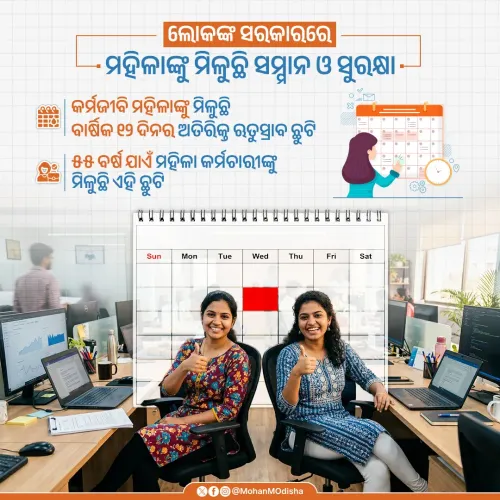
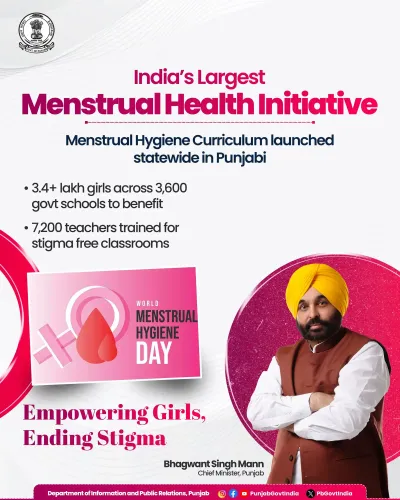
CM Majhi marks Menstrual Hygiene Day, pledges dignity for Odisha women
Synopsis
On World Menstrual Hygiene Day, Odisha Chief Minister Mohan Charan Majhi reaffirmed his government's commitment to menstrual health awareness, stigma reduction, and better sanitation for women and girls, framing the issue as central to equality and empowerment.
Key Takeaways
CM Mohan Charan Majhi posted on 28 May 2026 — World Menstrual Hygiene Day — reaffirming Odisha's commitment to menstrual health and sanitation.
The chief minister described menstrual hygiene access as 'a matter of equality, education and empowerment', not merely a health issue.
Odisha's efforts are supported by the National Health Mission (NHM) and the Menstrual Hygiene Scheme launched nationally in 2011 .
The Swachh Bharat Mission (2014) incorporated menstrual hygiene management into school and community sanitation guidelines.
ASHA workers remain the primary delivery channel for sanitary napkin distribution and awareness programmes in rural Odisha.
Budget allocations and NHM implementation reports in the coming fiscal year will indicate whether the commitment leads to expanded programme coverage.
Odisha Chief Minister Mohan Charan Majhi on 28 May 2026 — World Menstrual Hygiene Day — reaffirmed his government's commitment to menstrual health awareness, stigma reduction, and improved sanitation and healthcare facilities for women and girls across the state. The chief minister framed access to menstrual hygiene as inseparable from equality, education, and empowerment.
Context
World Menstrual Hygiene Day is observed every year on 28 May as a global platform to normalise conversations around menstrual health and push for better infrastructure and policy. CM Majhi used the occasion to state that Odisha is actively working to 'create awareness, break stigma and ensure better sanitation and healthcare facilities across the state.' The message was directed at both the public and policymakers, framing menstrual hygiene as a governance priority rather than a purely medical subject.
Policy Backdrop
India's institutional framework for menstrual hygiene dates to the Menstrual Hygiene Scheme of 2011, launched by the Ministry of Health and Family Welfare, which channels subsidised sanitary napkins to rural adolescent girls through ASHA workers. The Swachh Bharat Mission, introduced in 2014, further embedded menstrual hygiene management into school and community sanitation infrastructure. Both initiatives are funded and monitored under the National Health Mission (NHM), which has been operational since 2013 and provides states like Odisha with grants for adolescent health and sanitation components.
State governments have increasingly used international observance days to publicly restate their alignment with these central frameworks, linking welfare delivery to broader gender equity outcomes such as girls' school retention rates and women's workforce participation.
Stakeholders and Impact
The primary beneficiaries of menstrual hygiene programmes in Odisha are adolescent girls and rural women, particularly those in districts with limited access to healthcare infrastructure. Research consistently links adequate menstrual hygiene facilities in schools to reduced absenteeism among girl students, making this a concern that cuts across health, education, and gender policy departments.
Community health workers — especially ASHAs — remain the frontline delivery mechanism for both product distribution and awareness campaigns in rural Odisha. Their reach and effectiveness directly determine how well state-level commitments translate into outcomes for women and girls at the grassroots.
What's Next
Odisha's budget allocations and NHM programme implementation reports for the coming fiscal year will be a key indicator of whether the chief minister's stated commitment translates into enhanced funding or expanded programme coverage. Advocates and civil society groups are likely to track disbursements under the Menstrual Hygiene Scheme and Swachh Bharat Mission components at the district level. A stronger signal would come if the state government announces specific targets — such as the number of schools to receive sanitation upgrades or the volume of sanitary napkins to be distributed — in the months ahead.
Point of View
Moving the issue from a technical health concern to a gender-rights narrative that resonates with a broader electorate. For a BJP-led government in Odisha that came to power in 2024, visible engagement on women's welfare issues carries electoral significance in a state where women constitute a decisive voting bloc. The real test will be whether this rhetorical commitment is followed by measurable increases in programme spending and district-level delivery in the months ahead.
NationPress
11 Oct 2026
Frequently Asked Questions
What did Odisha CM Mohan Majhi say on World Menstrual Hygiene Day 2026?
CM Mohan Charan Majhi reaffirmed Odisha's commitment to menstrual health awareness, breaking stigma, and improving sanitation and healthcare facilities for women and girls, calling it a matter of equality, education and empowerment.
When is World Menstrual Hygiene Day observed?
World Menstrual Hygiene Day is observed every year on 28 May as a global platform to promote menstrual health awareness and reduce stigma.
What central schemes support menstrual hygiene in Odisha?
The National Health Mission (NHM) and the Menstrual Hygiene Scheme — launched in 2011 by the Ministry of Health and Family Welfare — provide funding and infrastructure support, while the Swachh Bharat Mission (2014) incorporated menstrual hygiene into school and community sanitation guidelines.
How are menstrual hygiene products distributed in rural Odisha?
ASHA (Accredited Social Health Activist) workers are the primary frontline channel for distributing subsidised sanitary napkins and conducting awareness campaigns in rural areas of Odisha.
Why is menstrual hygiene linked to girls' education in India?
Adequate menstrual hygiene facilities in schools are consistently linked to lower absenteeism among girl students; without proper sanitation infrastructure, many girls miss school during menstruation, affecting their educational outcomes.