CM Mohan Yadav Hails 11 Years of Digital India
Synopsis
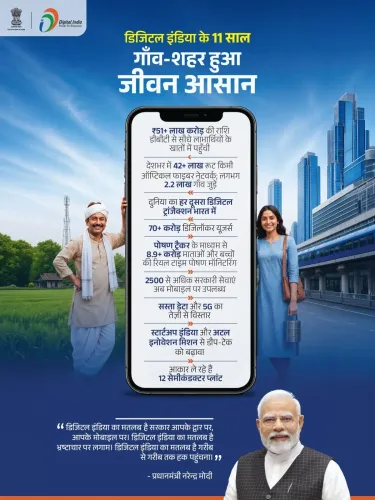
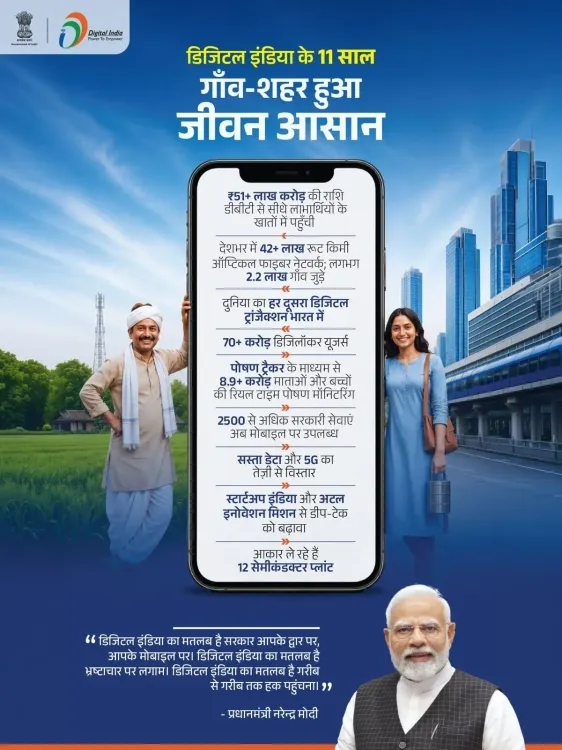
On the eleventh anniversary of Digital India, Madhya Pradesh Chief Minister Dr. Mohan Yadav praised PM Modi's leadership, highlighting 81% UPI transaction share, 2.18 lakh BharatNet-connected panchayats, 45,000-plus GPUs for the IndiaAI Mission, and 23.36 lakh jobs created by 2.23 lakh startups.
Key Takeaways
Digital India completed 11 years on 1 July 2026 , launched originally on 1 July 2015 by PM Narendra Modi .
UPI now accounts for 81 per cent of digital payments in India, according to the post.
2.18 lakh gram panchayats have been connected to broadband through the BharatNet project.
The IndiaAI Mission has deployed more than 45,000 GPUs to build national AI compute capacity.
2.23 lakh startups have generated 23.36 lakh jobs , per figures cited by CM Yadav.
CM Yadav linked all achievements to the long-term Viksit Bharat 2047 vision for a developed India.
Madhya Pradesh Chief Minister Dr. Mohan Yadav on Wednesday, 1 July 2026 marked the eleventh anniversary of the Digital India programme by crediting Prime Minister Narendra Modi's leadership with transforming digital access across the country, citing sweeping gains in payments, rural connectivity, artificial intelligence infrastructure, and startup-driven employment.
Context
Digital India was formally launched on 1 July 2015 by Prime Minister Narendra Modi with the stated aim of delivering digital infrastructure as a core utility to every citizen. The programme consolidated several earlier e-governance efforts into a single, mission-mode framework covering broadband connectivity, digital literacy, and online service delivery. Its eleventh anniversary on 1 July 2026 has prompted senior BJP leaders, including state chief ministers, to publicly enumerate its outcomes.
Dr. Yadav's post, written in Hindi, described the occasion as 'अविस्मरणीय यात्रा' — an 'unforgettable journey' — and positioned the programme's achievements as stepping stones toward Viksit Bharat 2047, the government's vision to make India a developed nation by the centenary of its independence.
Policy Backdrop
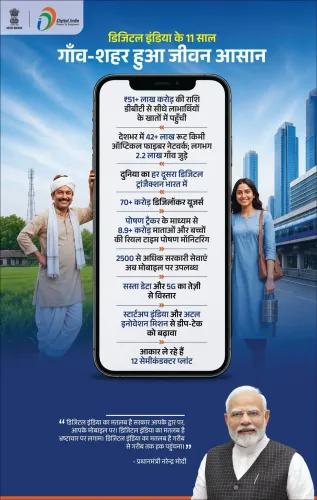
The post highlights four headline metrics from the past eleven years. On payments, it states that UPI now accounts for 81 per cent of all digital transactions in India. The Unified Payments Interface, introduced in August 2016 by the National Payments Corporation of India, has grown into one of the world's largest real-time retail payment systems and has been cited repeatedly by the central government as a model for financial inclusion.
On rural connectivity, the post notes that 2.18 lakh gram panchayats have been linked through BharatNet, the optical-fibre broadband project that was integrated into the Digital India framework. For artificial intelligence, it credits the IndiaAI Mission with deploying more than 45,000 GPUs to build national compute capacity. On entrepreneurship, it states that 2.23 lakh startups have collectively created 23.36 lakh jobs, a figure it links to the enabling environment created since 2015, including the Startup India initiative announced in January 2016.
Stakeholders and Impact
The constituencies most directly affected by the Digital India programme span urban payment users, rural households newly connected to broadband, early-stage entrepreneurs, and government service recipients. BharatNet's rural coverage has particular relevance for Madhya Pradesh, a large state with significant rural and tribal populations that have historically faced connectivity gaps. Improved gram panchayat connectivity underpins the delivery of welfare schemes, agricultural market access, and telemedicine.
The startup and employment figures cited by Dr. Yadav reflect a national count rather than a Madhya Pradesh-specific tally, but the chief minister framed them as a collective national achievement in which the state shares. He concluded his post by expressing gratitude on behalf of the people of Madhya Pradesh to Prime Minister Modi — 'हृदय से आभार', meaning 'heartfelt gratitude'.
What's Next
Attention will now turn to whether Madhya Pradesh publishes state-specific implementation data — such as the number of gram panchayats connected within the state, local startup registrations, or district-level UPI adoption rates — to complement the national figures cited in the chief minister's post. Analysts watching the IndiaAI Mission will also track announcements on the next phase of GPU deployment and research partnerships in upcoming Union Budget sessions or parliamentary proceedings.
The anniversary also sets up a political communication cycle ahead of potential state-level digital governance reviews, as the BJP-led government in Bhopal seeks to align Madhya Pradesh's development narrative with the broader Viksit Bharat 2047 framework championed by the central leadership.
Point of View
The post ties Madhya Pradesh's identity to a decade-long national vision, making the state a stakeholder in outcomes it did not independently produce. The aggregation of four distinct metrics — payments, rural broadband, AI compute, and startup employment — signals that the BJP is now presenting Digital India not as a single scheme but as a civilisational upgrade, a framing that is harder for opponents to contest on narrow policy grounds. Whether Madhya Pradesh can produce granular state-level data to substantiate this narrative will determine how credible the claim looks to local voters.
NationPress
1 Jul 2026
Frequently Asked Questions
When was Digital India launched and by whom?
Digital India was launched on 1 July 2015 by Prime Minister Narendra Modi to transform India into a digitally empowered society through infrastructure, services, and digital literacy.
What is the UPI share in India's digital payments as per CM Mohan Yadav's post?
According to the post by CM Dr. Mohan Yadav , UPI accounts for 81 per cent of all digital payments in India as of the eleventh anniversary of Digital India .
How many gram panchayats are connected under BharatNet?
The post states that 2.18 lakh gram panchayats across India have been connected to broadband through the BharatNet project under the Digital India programme.
What is the IndiaAI Mission and how many GPUs has it deployed?
The IndiaAI Mission is a government initiative to build national artificial intelligence compute capacity. CM Yadav's post cites a deployment of more than 45,000 GPUs to power this mission.
How many jobs have Indian startups created under Digital India?
According to the post, 2.23 lakh startups have created 23.36 lakh jobs in India, with the enabling environment attributed to the Digital India and Startup India frameworks.