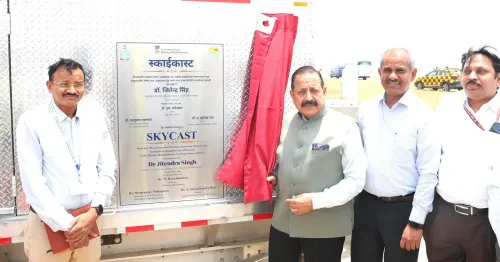
Dr. Jitendra Singh flags SkyCast for aviation weather safety
Synopsis
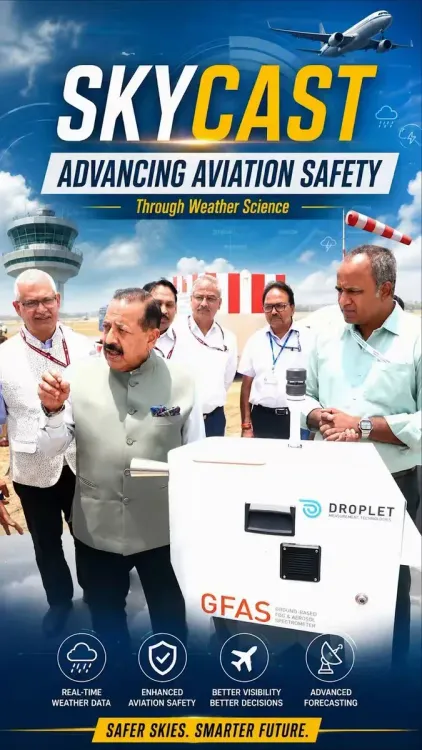
Union Science and Technology Minister Dr. Jitendra Singh spotlighted SkyCast, a real-time aviation weather intelligence system built by IITM Pune and IMD under Mission Mausam, promising smarter turbulence alerts and runway visibility data for pilots, airlines and air traffic control across India.
Key Takeaways
SkyCast is a real-time aviation weather system developed jointly by IITM Pune and IMD under the Ministry of Earth Sciences .
The system provides turbulence alerts and precise runway visibility forecasts to pilots, airlines, and ATC .
It is a flagship output of Mission Mausam , the central government's initiative to modernise weather and climate services.
IITM Pune , established in 1962 , and IMD , founded in 1875 , are the two institutional pillars behind the project.
Integration with AAI and DGCA safety protocols remains the key next step for full operational deployment.
The initiative builds on earlier programmes including the Monsoon Mission (2012) and IMD's Phase-II modernisation .
Union Science and Technology Minister Dr. Jitendra Singh on Wednesday, 24 June 2026, highlighted SkyCast, an advanced aviation weather intelligence system developed jointly by the Indian Institute of Tropical Meteorology (IITM), Pune and the India Meteorological Department (IMD) under the Ministry of Earth Sciences (MoES), calling it a transformative tool for real-time aviation safety.
Context
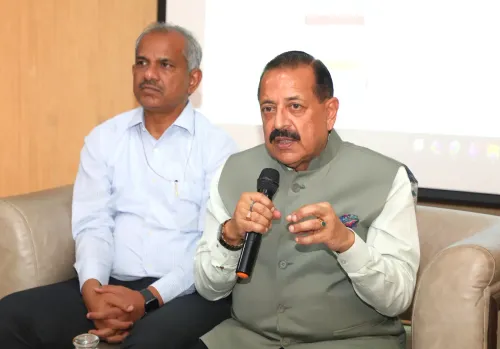
In a post on X, the Minister described SkyCast as delivering 'smarter forecasts' and 'safer skies' by providing turbulence alerts and precise runway visibility data to pilots, airlines, and air traffic control (ATC). The system is being promoted as a flagship output of Mission Mausam, the central government initiative to strengthen weather and climate services through advanced modelling and real-time applications. Dr. Singh shared a video demonstrating the system's capabilities in action.
SkyCast represents a convergence of research and operational meteorology, with IITM Pune — a premier MoES institute established in 1962 — contributing its tropical meteorology expertise alongside IMD, India's national weather forecasting service founded in 1875.
Policy Backdrop
Aviation weather services have been a growing priority within India's meteorological modernisation agenda. IMD's Phase-II modernisation programme, launched in 2012, added Doppler weather radars and nowcasting systems specifically aimed at aviation and severe weather alerts. The earlier Monsoon Mission, also initiated in 2012, laid the groundwork for high-resolution dynamical forecasting models that now underpin systems like SkyCast.
Mission Mausam extends this lineage by focusing on nowcasting and sector-specific applications, with aviation identified as a key beneficiary. The approach mirrors a global trend of national meteorological agencies partnering with research institutions to deliver AI-enhanced, real-time weather products to end-users in safety-critical sectors.
Stakeholders and Impact
The primary beneficiaries of SkyCast are pilots, airlines, and air traffic controllers who require accurate, timely weather intelligence to make go or no-go decisions, reroute flights, and manage runway operations. Turbulence and poor visibility are among the leading weather-related causes of aviation incidents globally, making actionable real-time forecasting a direct safety intervention.
Broader stakeholders include MoES, which oversees both IITM and IMD, and aviation regulators such as the Airports Authority of India (AAI) and the Directorate General of Civil Aviation (DGCA), whose safety protocols would need to integrate SkyCast outputs for the system to achieve full operational impact. India's rapidly expanding civil aviation sector — with passenger traffic growing steadily across both metro and regional airports — adds urgency to improved meteorological support.
What's Next
Attention will now focus on the formal roll-out milestones of Mission Mausam and the extent to which SkyCast is integrated into AAI and DGCA safety frameworks. Parliamentary scrutiny of MoES budget utilisation for aviation meteorology is also expected to intensify as the programme matures. The Minister's public communication signals an intent to build political and public visibility around the initiative, suggesting further announcements on deployment scope and outcomes are likely in the near term.
Point of View
Sector-specific face — aviation being a domain where weather failures carry immediate human cost and media salience. By anchoring the announcement in a joint IITM-IMD product, the government underscores the value of its research-to-operations pipeline, a model it has been building since the Monsoon Mission era. The real test, however, lies in formal adoption by aviation regulators; ministerial visibility alone does not translate to cockpit utility. Watchers of India's science diplomacy will also note that aviation meteorology is increasingly a soft-power arena, where national capability is benchmarked against global peers.
NationPress
24 Jun 2026
Frequently Asked Questions
What is SkyCast and who developed it?
SkyCast is a real-time aviation weather intelligence system developed jointly by the Indian Institute of Tropical Meteorology (IITM) in Pune and the India Meteorological Department (IMD) under the Ministry of Earth Sciences. It provides turbulence alerts and runway visibility forecasts to pilots, airlines, and air traffic controllers.
What is Mission Mausam?
Mission Mausam is a central government initiative under the Ministry of Earth Sciences aimed at strengthening India's weather and climate services through advanced modelling, nowcasting, and sector-specific applications such as aviation meteorology.
How does SkyCast improve aviation safety?
SkyCast delivers accurate, actionable weather intelligence in real time, including turbulence alerts and precise runway visibility data, enabling pilots, airlines, and air traffic control to make better-informed decisions and reduce weather-related aviation risks.
What is IITM Pune's role in Indian weather research?
The Indian Institute of Tropical Meteorology (IITM), Pune, established in 1962, is a premier Ministry of Earth Sciences institute specialising in tropical meteorology and climate research. It has been central to initiatives like the Monsoon Mission and now SkyCast.
Will SkyCast be used at Indian airports?
Integration of SkyCast with the Airports Authority of India (AAI) and the Directorate General of Civil Aviation (DGCA) safety protocols is the key next step. The Minister's announcement signals intent, but formal regulatory adoption will determine its operational reach across Indian airports.