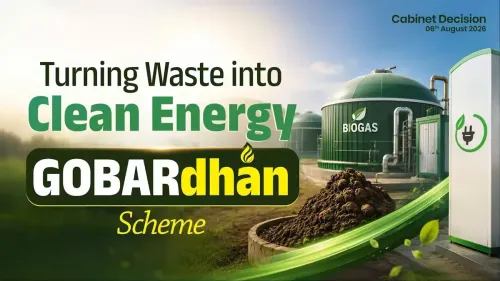
Giriraj Singh backs GAIL's CBG plant in Bengaluru
Synopsis
Union Textiles Minister Giriraj Singh spotlighted a GAIL-operated CBG plant in Bengaluru that promises to convert 300 tonnes of wet municipal waste daily into compressed biogas and organic fertiliser, advancing the SATAT scheme and India's energy self-reliance goals.
Key Takeaways
GAIL is setting up a Compressed Biogas (CBG) plant in Bengaluru with a stated capacity to process 300 tonnes of wet waste per day .
The plant will produce both clean fuel (CBG) and organic fertiliser (bio-slurry) as twin outputs from municipal solid waste.
The project aligns with the SATAT scheme , launched in October 2018 , which targeted 5,000 CBG plants across India by 2025 .
It also advances the Swachh Bharat Mission (Urban) 's mandate for scientific processing of municipal solid waste.
Union Textiles Minister Giriraj Singh framed the plant as a step toward energy self-reliance and better urban resource utilisation.
Actual commissioning timelines and verified operational status of the Bengaluru plant have not been officially confirmed.
Wet garbage going in, clean fuel and organic fertiliser coming out — that is the promise of a Compressed Biogas (CBG) plant being set up by GAIL in Bengaluru, and Union Textiles Minister Giriraj Singh used his platform on 12 November 2026 to flag the project as a milestone in India's urban waste management story.
Posting in Hindi, Singh wrote: 'गीले कचरे से स्वच्छ ईंधन और जैविक खाद का उत्पादन शहरी कचरा प्रबंधन को नई दिशा दे रहा है' — 'Producing clean fuel and organic fertiliser from wet waste is giving urban waste management a new direction.' He added that the plant, with a stated processing capacity of 300 tonnes of waste per day, would advance the central government's clean-energy goals and contribute to energy self-reliance.
GAIL's bet on biogas in India's tech capital
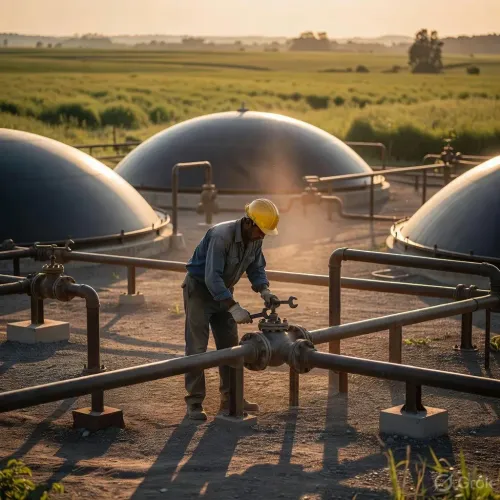
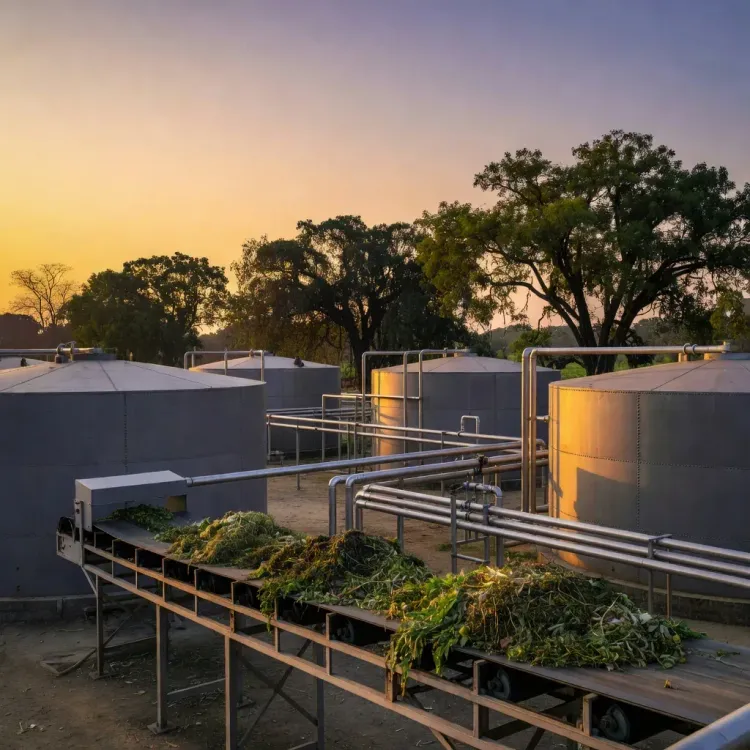
Bengaluru generates thousands of tonnes of municipal solid waste every day, making it one of India's most acute urban waste challenges. A CBG plant converts the organic or 'wet' fraction of that waste — kitchen scraps, food market refuse, garden trimmings — into compressed biogas chemically similar to CNG, alongside nutrient-rich bio-slurry that can serve as organic fertiliser. The dual output is the project's headline pitch: one city's garbage problem becomes a fuel supply and an agricultural input at the same time.
GAIL, the state-owned natural gas infrastructure giant operating under the Ministry of Petroleum and Natural Gas, is the executing agency. Its involvement signals that the central government is treating CBG not as a fringe experiment but as a mainstream addition to the domestic fuel supply chain — reducing dependence on imported natural gas while ticking climate and sanitation boxes simultaneously.
SATAT's long road from 2018 targets to city-scale plants
The policy scaffolding behind this plant goes back to October 2018, when the Ministry of Petroleum and Natural Gas launched the SATAT (Sustainable Alternative Towards Affordable Transportation) scheme with an ambitious target: 5,000 CBG plants across India by 2025. The scheme aimed to source biogas from agricultural residue, cattle dung, and urban municipal waste, then compress and market it as an alternative transport fuel. Progress against that target has been uneven, and commissioning timelines for announced plants — including this Bengaluru facility — remain a key metric to watch.
The Bengaluru project also sits within the Swachh Bharat Mission (Urban), launched in 2014, which mandated scientific processing of municipal solid waste including segregation of wet and dry streams. CBG plants are, in effect, the downstream reward for upstream segregation — they only work efficiently if wet waste arrives cleanly separated, making community and municipal compliance a critical variable.
Who gains beyond the fuel meter
The beneficiaries extend well beyond city commuters filling CNG tanks. Organic farmers stand to receive subsidised bio-slurry fertiliser as a byproduct of biogas production — a potentially significant input cost reduction at a time when chemical fertiliser prices remain volatile. Urban local bodies gain a potential revenue stream and a scientifically validated landfill-diversion mechanism. For India's broader energy security calculus, every unit of domestically produced biogas is one fewer unit of imported liquefied natural gas.
Minister Singh's post does not announce a commissioning date, and the plant's exact operational status cannot be independently verified from public records at this stage. What the post does confirm is that the project has senior political attention — and that the government is positioning Bengaluru's waste crisis as a test case for scaling the waste-to-fuel model nationally.
India's landfills are overflowing; its gas import bill is a persistent drain on foreign exchange. If a 300-tonne-a-day plant in Bengaluru can prove the model works at city scale, the template becomes the story — and 5,000 plants suddenly looks less like an aspirational target and more like a roadmap.
Point of View
The government is signalling that urban sanitation is no longer a standalone municipal issue but a node in India's broader energy security architecture. The SATAT scheme's 2025 deadline for 5,000 plants has effectively passed without full realisation, so high-profile plant announcements in metro cities serve a dual purpose: demonstrating momentum and rebuilding credibility around the target. The real test will be whether commissioning follows political messaging at the pace the climate and import-bill pressures demand.
NationPress
12 Nov 2026
Frequently Asked Questions
What is the GAIL CBG plant in Bengaluru?
It is a Compressed Biogas plant being set up by GAIL in Bengaluru that is designed to convert wet municipal solid waste into compressed biogas for use as fuel and bio-slurry for use as organic fertiliser.
What is the SATAT scheme and how does this plant relate to it?
SATAT (Sustainable Alternative Towards Affordable Transportation) is a government initiative launched in October 2018 to establish 5,000 CBG plants across India using organic waste. The Bengaluru GAIL plant is part of this broader push to commercialise biogas as a domestic transport fuel.
How much waste will the Bengaluru CBG plant process?
Union Textiles Minister Giriraj Singh stated the plant has a capacity to process 300 tonnes of wet waste per day, though the operational status and exact commissioning timeline have not been independently verified.
What is compressed biogas (CBG) and how is it made?
CBG is produced by anaerobically decomposing organic or wet waste — such as kitchen scraps and food market refuse — to generate biogas, which is then compressed to a quality similar to CNG and used as a vehicle fuel or for other energy purposes.
Who benefits from India's CBG and waste-to-energy plants?
Urban local bodies benefit from reduced landfill pressure, consumers gain access to domestically produced fuel, and farmers benefit from bio-slurry fertiliser byproducts. Nationally, CBG production helps reduce India's dependence on imported natural gas.