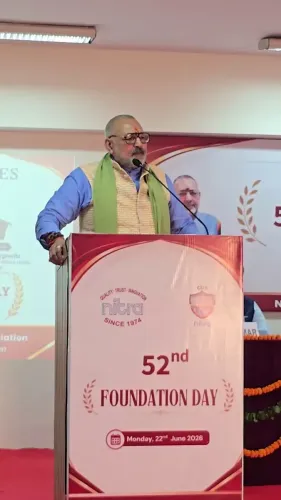
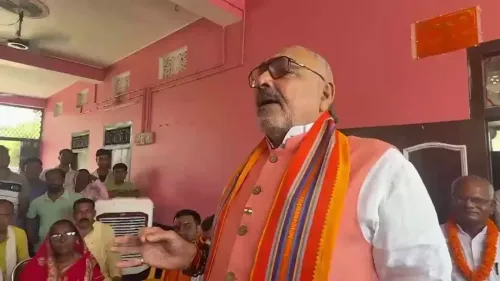
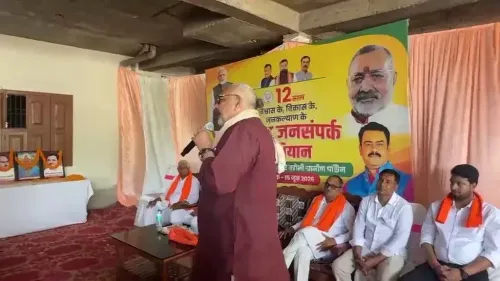
Giriraj Singh hails disability pension reforms under Modi govt

Synopsis
Union Textiles Minister Giriraj Singh highlighted three key disability pension reforms under PM Modi: eligibility threshold cut from 80% to 40%, age condition removed, and assistance amount raised by 25% — expanding social security access for millions of disabled Indians.
Key Takeaways
The disability pension eligibility threshold has been reduced from 80% to 40% , significantly broadening the beneficiary pool.
The age condition for disability pension eligibility has been removed entirely , eliminating an arbitrary exclusion criterion.
The monthly assistance amount under the disability pension scheme has been increased by 25% .
The reforms fall under the Indira Gandhi National Disability Pension Scheme , part of the National Social Assistance Programme.
Minister Giriraj Singh framed the changes as part of the BJP government's commitment to an inclusive and self-reliant India.
The Rights of Persons with Disabilities Act, 2016 had earlier expanded the legal definition of disability, and these pension revisions now better align financial eligibility with that framework.
A pension system that once shut out millions of disabled Indians — demanding an 80% disability threshold just to qualify — has now been overhauled, and Union Textiles Minister Giriraj Singh wants the country to take note. On Tuesday, October 27, 2026, the senior BJP leader posted on X to highlight three significant changes to disability pension policy under Prime Minister Narendra Modi: the eligibility threshold slashed from 80% to 40%, the age condition removed entirely, and the assistance amount raised by 25%.
In his post, Minister Singh described these as 'महत्वपूर्ण कदम' ('important steps') toward providing relief to persons with disabilities and their families. He framed the reforms as part of the BJP government's larger pledge — to ensure the dignity and participation of every individual in building an 'inclusive and self-reliant India' (समावेशी और आत्मनिर्भर भारत).
Why the 80% threshold was always the wrong bar
The old rule was blunt and exclusionary by design. An 80% disability requirement meant only the most severely disabled Indians could access pension support — leaving out a vast population living with significant but less extreme disabilities who still face enormous barriers to employment and economic participation. Halving that threshold to 40% is not a marginal adjustment; it is a structural shift in who the state considers worthy of support.
The removal of an age condition widens the net further, addressing a long-standing criticism that the scheme's eligibility rules created arbitrary exclusions unconnected to actual need. Together, these two changes represent a recognition that disability-linked poverty does not follow neat bureaucratic categories.
The pension scheme and its place in India's social security architecture
The reforms apply within the framework of the Indira Gandhi National Disability Pension Scheme, a central component of the National Social Assistance Programme (NSAP) — India's primary federal platform for delivering cash transfers to vulnerable groups including the elderly, widows, and persons with disabilities. The NSAP was restructured and expanded after 2014 as the Modi government intensified focus on direct benefit delivery to marginalised sections.
The Rights of Persons with Disabilities Act, 2016 had already broadened the legal definition of disability and mandated greater state responsibility. These pension revisions now align financial eligibility more closely with that expanded legal framework — a coherence between law and welfare delivery that advocates had long demanded.
A 25% raise: what it signals
The 25% hike in assistance amounts may appear modest in isolation, but it signals an acknowledgment that pension values had eroded in real terms over time. For families whose primary earner has a disability, even a partial monthly pension can mean the difference between accessing healthcare and foregoing it. The revision, combined with the lower eligibility threshold, means both more Indians qualify and those who do receive meaningfully more.
The scale of the change — in terms of new beneficiaries added and budgetary outlay — will come into sharper focus when the government releases revised implementation guidelines and beneficiary data. That number will be the real measure of the reform's reach.
Decades of exclusion do not reverse overnight. But when the threshold drops, the age bar lifts, and the cheque grows — the architecture of exclusion starts to crack.
Point of View
' potentially adding a large new cohort of beneficiaries. Politically, the announcement fits the BJP's recurring welfare-visibility strategy ahead of electoral cycles, but the substantive merits of expanding coverage are real and separate from the messaging. The test, as always, will be in implementation: whether revised beneficiary lists are updated, payments flow without bureaucratic friction, and the 25% hike keeps pace with inflation over time.
NationPress
27 Oct 2026
Frequently Asked Questions
What is the new disability percentage required to get a government pension in India?
The disability threshold for pension eligibility has been reduced to 40% , down from the previous requirement of 80%, making the scheme accessible to a much wider population of persons with disabilities.
What is the Indira Gandhi National Disability Pension Scheme?
The Indira Gandhi National Disability Pension Scheme is a central government programme under the National Social Assistance Programme that provides monthly cash transfers to persons with disabilities who meet eligibility criteria.
Has the disability pension amount been increased in 2026?
Yes, the assistance amount under the disability pension scheme has been increased by 25% as part of recent reforms highlighted by Union Minister Giriraj Singh.
What is the Rights of Persons with Disabilities Act 2016?
The Rights of Persons with Disabilities Act, 2016 broadened India's legal definition of disability from 7 to 21 categories and mandated greater state responsibility for inclusion, accessibility, and welfare — forming the legal backbone for subsequent pension and welfare reforms.
Who is Giriraj Singh and which ministry does he head?
Giriraj Singh is a senior BJP leader and Lok Sabha MP from Begusarai, Bihar, currently serving as India's Union Minister of Textiles in the Modi government.