Jal Shakti Minister Paatil hails Varanasi ropeway as India's first
Synopsis
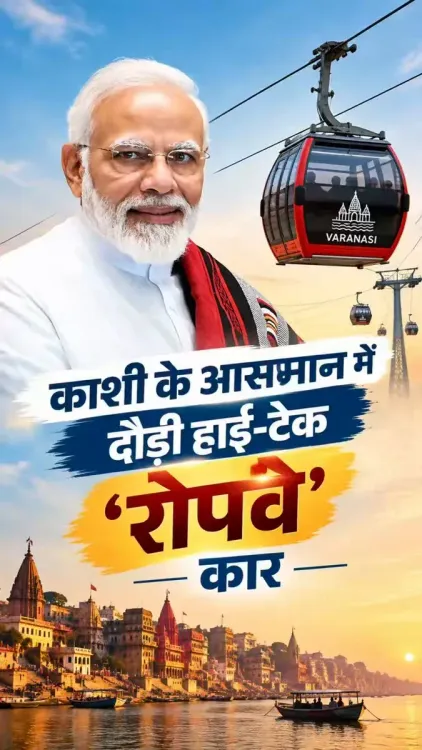
Union Jal Shakti Minister C. R. Paatil has highlighted India's first public-transport ropeway in Varanasi, linking Cantt Station to Godaulia using Swiss technology and cutting what were hours of gridlock to just 15 minutes under PM Modi's smart-mobility push.
Key Takeaways
India's first public-transport ropeway connects Cantt Station to Godaulia in Varanasi .
The corridor uses Switzerland-sourced technology and cuts journeys to 15 minutes , down from hours of traffic.
The project is part of the Parvatmala National Ropeways Development Programme announced in Union Budget 2022 .
Varanasi is PM Narendra Modi's Lok Sabha constituency and a flagship city under the PM Gati Shakti National Master Plan.
Godaulia is the nearest major junction to Dashashwamedh Ghat — the city's most visited pilgrimage point — making the link strategically significant for tourism and daily commuters.
A successful Varanasi model is expected to influence ropeway expansion to other heritage and pilgrimage cities across India.
Imagine floating above the ancient, traffic-choked lanes of Varanasi in minutes — not hours. That is now the lived reality for commuters on India's first public-transport ropeway, stretching from Cantt Station to Godaulia, and Union Jal Shakti Minister C. R. Paatil wants the country to know it on Wednesday, 30 September 2026.
Paatil's post — addressed directly to Prime Minister Narendra Modi — captures the ambition of the project in a single rhetorical question: 'क्या आपने कभी सोचा था' ('Did you ever imagine') that Banaras's notorious congestion could be beaten by gliding through the sky? The aerial corridor, he declares, is slashing journeys that once swallowed hours of gridlock down to a crisp 15 minutes.
Swiss technology above a 3,000-year-old city
The ropeway is built using Switzerland-sourced world-class technology, according to Paatil's post — a deliberate juxtaposition of one of the world's oldest continuously inhabited cities and some of its most modern transit engineering. Varanasi's medieval street grid, dense pilgrimage crowds, and layers of heritage structures make conventional road-widening almost impossible. An aerial solution sidesteps the problem entirely, leaving the fabric of the old city untouched below.
The project fits neatly into the Parvatmala National Ropeways Development Programme, announced in the Union Budget 2022, which was designed to promote ropeway connectivity in difficult terrains and high-footfall tourist locations. Varanasi — PM Modi's own Lok Sabha constituency — has been a flagship canvas for that policy, receiving sustained central investment in ghats, roads, and now aerial transit under the PM Gati Shakti National Master Plan.
Why Godaulia — and why it matters
Godaulia is the nerve centre of Varanasi's pilgrimage economy: the closest major junction to the Dashashwamedh Ghat, the city's most visited and televised ghats, and a daily flashpoint for pedestrian and vehicle conflict. Linking it directly to Cantt Station, the city's principal railway terminus, means pilgrims and tourists can step off a train and reach the ghats without ever fighting through ground-level traffic. For Varanasi's commuters, it is a structural fix to a daily ordeal.
Ropeways are increasingly positioned by central policy planners as a low-footprint alternative to road expansion in densely built heritage cores — zero demolition, no new land acquisition, and a smaller carbon footprint than surface transit. The Varanasi corridor, as India's first operational urban public-transport ropeway, becomes the proof-of-concept that other congested historic cities will now watch closely.
The template other cities are eyeing
The real stakes in Paatil's post are not purely local. A working model in Varanasi opens the door for replication in similarly gridlocked heritage cities — Mathura, Haridwar, Amritsar, Puri — anywhere that combines high religious footfall with streets too narrow or sacred to tear up. Ridership data from the Cantt–Godaulia corridor will determine how quickly the Parvatmala programme scales urban ropeways beyond their original mountain-terrain mandate.
For now, a city that has watched pilgrims wade through traffic jams for generations has a new skyline feature — and a 15-minute answer to a very old problem.
Point of View
Minister Paatil reinforces the BJP's 'development in Modi's constituency' narrative ahead of any state or national electoral cycle. The real policy question now is whether ridership data will be transparent and strong enough to justify accelerating the Parvatmala programme's urban arm beyond its original mountain mandate. If it does, the Cantt–Godaulia corridor could trigger a wave of similar projects in Haridwar, Mathura, and Amritsar — cities that face identical constraints of dense heritage fabric and surging pilgrimage footfall.
NationPress
30 Sept 2026
Frequently Asked Questions
What is the Varanasi ropeway and where does it run?
It is India's first public-transport urban ropeway, running from Cantt Station to Godaulia in Varanasi, Uttar Pradesh, and is designed to ease the city's chronic traffic congestion for commuters and pilgrims.
How long does the Varanasi ropeway journey take?
According to Minister C. R. Paatil's post, the ropeway covers the Cantt–Godaulia route in approximately 15 minutes , replacing journeys that could previously take hours due to gridlock.
What technology is used in the Varanasi ropeway?
The ropeway uses Switzerland-sourced technology , described as world-class by Minister Paatil in his post; however, detailed specifications and technology-transfer arrangements have not been independently confirmed.
What is the Parvatmala National Ropeways Development Programme?
Parvatmala is a Union Budget 2022 initiative to develop ropeway connectivity across India, originally targeting difficult mountain terrain and tourist locations, with the Varanasi project representing its first urban public-transport application.
Will other Indian cities get ropeways like Varanasi?
Policy planners are positioning the Varanasi ropeway as a proof-of-concept; ridership data from this corridor is expected to determine whether the Parvatmala programme expands to other heritage and pilgrimage cities such as Haridwar, Mathura, and Amritsar.