CM Hemant Soren's Jharkhand exits aspirational education grade
Synopsis
Jharkhand has exited the 'Aspirational' band in the Performance Grading Index 2024-25 with a 29-point improvement, the Chief Minister's Office announced on 31 May 2026, stating no district in the state remains in the lowest PGI category — a milestone attributed to ground-level education reforms under CM Hemant Soren.
Key Takeaways
The Chief Minister's Office of Jharkhand announced on 31 May 2026 that no district in the state remains in the PGI 'Aspirational' category.
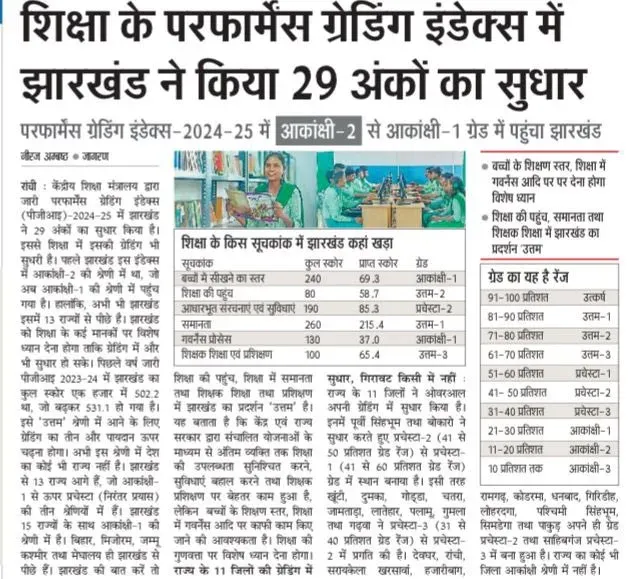
Jharkhand recorded a 29-point improvement in the Performance Grading Index (PGI) 2024-25 , earning the 'Aspirational-1' grade .
The PGI is an annual Ministry of Education tool introduced in 2017-18 to benchmark states on school education indicators.
Several Jharkhand districts had previously been covered under the NITI Aayog Aspirational Districts Programme (2018) , with education as a core theme.
The improvement aligns with a national pattern of PGI gains driven by teacher recruitment, infrastructure upgrades, and NEP 2020 implementation.
Sustaining and improving on this grade in the next PGI cycle will be the key test for the state's education administration.
The Chief Minister's Office of Jharkhand announced on Sunday, 31 May 2026 that not a single district in the state remains in the 'Aspirational' category of the Performance Grading Index (PGI) 2024-25, crediting the development to ground-level education reforms under Chief Minister Hemant Soren's vision. The state has recorded a 29-point improvement in PGI 2024-25, earning the 'Aspirational-1' grade.
Context
The CMO's post, written in Hindi, reads: 'Mukhyamantri Shri Hemant Soren ke vision ke anurup, rajya ka koi bhi jila ab 'Aakankshi' shreni mein nahin hai' — ('In line with Chief Minister Hemant Soren's vision, not a single district of the state is now in the Aspirational category') — marking what officials describe as a turning point in the state's education trajectory. The post directly links this outcome to measurable improvements at the grassroots level in the education sector.
The Performance Grading Index is an annual benchmarking tool introduced by the Union Ministry of Education in 2017-18 to assess states and Union Territories across parameters including access, equity, infrastructure, governance, and learning outcomes. States are graded on a scale from 'Aspirational' at the lower end to higher performance bands, with the index designed to incentivise targeted reforms.
Policy Backdrop
Jharkhand, an eastern Indian state with a large Scheduled Tribe population, has historically seen several of its districts feature in the lower rungs of national education performance rankings. The state's districts had previously been categorised under the 'Aspirational' band — the lowest tier in the PGI framework — reflecting gaps in school infrastructure, teacher availability, and foundational learning outcomes.
The NITI Aayog Aspirational Districts Programme, launched in 2018, had identified several Jharkhand districts for intensive development support, with education as one of six core themes. Progress on school-level indicators has since been tracked both under that programme and through the Ministry of Education's PGI cycle. The state's reported 29-point jump in PGI 2024-25 places it in the 'Aspirational-1' grade — one step above the baseline — consistent with a national pattern of gradual gains in historically lagging regions.
Across India, multiple states have posted PGI score improvements in recent cycles, driven by teacher recruitment drives, classroom infrastructure upgrades, and implementation of the National Education Policy (NEP) 2020. Jharkhand's exit from the lowest PGI category fits this broader trend of targeted interventions aimed at meeting foundational literacy and numeracy goals.
Stakeholders and Impact
The most direct beneficiaries of this shift are school students across Jharkhand's districts, particularly in tribal and rural belts where access and quality gaps have historically been sharpest. Teachers and district education officials are the primary implementers whose on-ground work the CMO's post highlights as the engine of this change.
For the state government, exiting the 'Aspirational' PGI band carries administrative significance: it signals to the Union government and development agencies that Jharkhand's school system is no longer among the weakest performers nationally, potentially influencing future grant allocations and scheme eligibility tied to performance metrics.
What's Next
The next test will be the subsequent PGI cycle, where Jharkhand will need to sustain and build on its 29-point gain to move further up the grading ladder from 'Aspirational-1' toward higher performance bands. Any regression would attract scrutiny given the public nature of this announcement.
Watchers of Jharkhand's education budget for 2026-27 will look for fresh scheme expansions or teacher recruitment announcements that could cement these gains. If the state continues on this trajectory, it could serve as a model for other eastern and central Indian states with similar demographic and infrastructure challenges.
Point of View
The JMM government is building a governance narrative around measurable social-sector delivery ahead of future electoral cycles. The exit from the 'Aspirational' band is a genuine administrative milestone, but the move from 'Aspirational-1' to higher PGI grades will require sustained investment rather than a single cycle's momentum. More broadly, this fits a pattern among state governments of using Union government benchmarking tools — PGI, NITI rankings, ease-of-doing-business indices — as legitimising frames for incumbent performance claims. The real test will be whether district-level learning outcome data, which PGI increasingly weights, corroborates the grade-level progress.
NationPress
14 Oct 2026
Frequently Asked Questions
What is the Performance Grading Index (PGI) in India?
The Performance Grading Index is an annual tool introduced by the Union Ministry of Education in 2017-18 to grade states and Union Territories on school education parameters including access, equity, infrastructure, governance, and learning outcomes. States are ranked from 'Aspirational' at the lower end to higher performance bands to drive targeted reforms.
What grade did Jharkhand get in PGI 2024-25?
Jharkhand achieved the 'Aspirational-1' grade in PGI 2024-25, recording a 29-point improvement over its previous score, according to an announcement by the Chief Minister's Office on 31 May 2026.
What does it mean that no Jharkhand district is in the 'Aspirational' category?
It means that every district in Jharkhand has moved above the lowest PGI performance band, indicating measurable progress across school education indicators such as infrastructure, teacher availability, and learning outcomes at the district level.
What is the Aspirational Districts Programme and how does it relate to Jharkhand?
The NITI Aayog Aspirational Districts Programme, launched in 2018, identified underdeveloped districts — including several in Jharkhand — for intensive support across six development themes including education. Progress under this programme has run alongside the Ministry of Education's PGI assessments.
Who is Hemant Soren and what is his role in Jharkhand's education push?
Hemant Soren is the Chief Minister of Jharkhand from the Jharkhand Mukti Morcha (JMM) party, serving since 2019 with a focus on tribal welfare and social sector improvements. The CMO's announcement credits his 'vision' as the guiding force behind the state's education reforms that led to the PGI improvement.