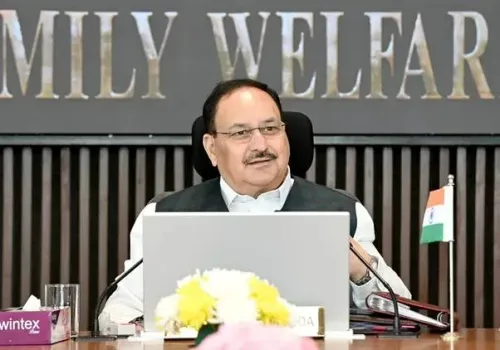
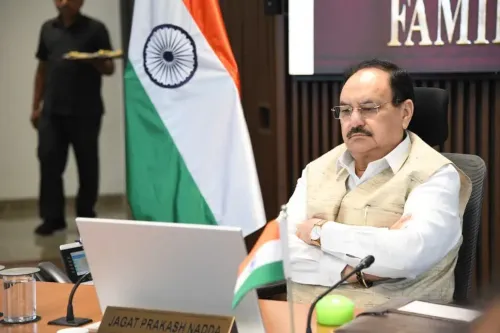
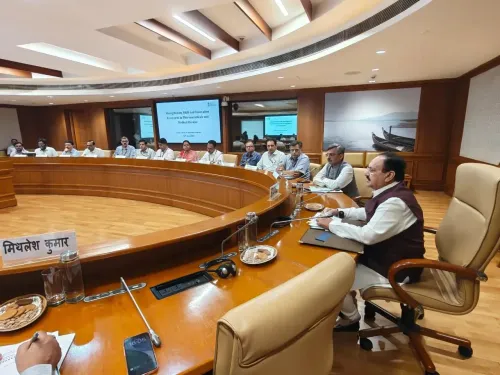
Nadda chairs 32nd PC&PNDT Board meet on sex selection curbs

Synopsis
Union Health Minister J. P. Nadda chaired the 32nd Central Supervisory Board meeting on 19 November 2026 to review enforcement of the PC&PNDT Act, calling for stricter monitoring, technology use and state-level coordination to end gender-biased sex selection in India.
Key Takeaways
Nadda chaired the 32nd meeting of the Central Supervisory Board under the PC&PNDT Act on 19 November 2026 .
The minister stressed four priorities: stringent enforcement, effective monitoring, responsible use of technology, and sustained public awareness.
The PC&PNDT Act was originally enacted in 1994 and amended in 2003 to tighten regulation of prenatal diagnostic techniques.
The Beti Bachao Beti Padhao scheme, launched in 2015 , pairs legal enforcement with community awareness to combat skewed child sex ratios.
Coordinated action with all States and Union Territories was identified as the key implementation lever going forward.
State-level action-taken reports and any new ministry directives on digital monitoring are the immediate watch-points after the meeting.
A law that turned thirty-two years old this year got its most senior review yet on Thursday, 19 November 2026 — Union Health Minister J. P. Nadda chaired the 32nd meeting of the Central Supervisory Board to assess how India is enforcing the Pre-Conception and Pre-Natal Diagnostic Techniques (PC&PNDT) Act and tightening the fight against gender-biased sex selection.
What the 32nd Central Supervisory Board meeting put on the table
The Central Supervisory Board is the statutory apex body created under the PC&PNDT Act to oversee national implementation, and its convening under the Health Minister's direct chairmanship signals political priority at the highest level. Nadda emphasised four pillars during the session: stringent enforcement of the law, effective monitoring of diagnostic facilities, responsible use of technology, and sustained public awareness — all to be driven through coordinated action with States and Union Territories.
The push for technology-led monitoring is significant. Ultrasound clinics and genetic laboratories across India are required to register under the Act, and digital tracking of their machines and usage logs has become a frontline tool for detecting illegal sex-determination services. Getting every state health department to enforce this uniformly remains the central challenge.
Three decades of the PC&PNDT Act — and why enforcement still matters
Parliament enacted the PC&PNDT Act in 1994, then strengthened it with amendments in 2003 after early enforcement proved patchy. The law bans the disclosure of a foetus's sex following pre-natal diagnosis and prohibits sex selection at the pre-conception stage. Violations can attract imprisonment and clinic de-registration.
Yet child sex-ratio numbers have underscored how much ground remains to cover. The Beti Bachao Beti Padhao scheme, launched in 2015 under Prime Minister Narendra Modi, tried to marry legal enforcement with community-level awareness campaigns — recognising that law alone cannot shift deeply entrenched preferences. The scheme concentrated its initial push on districts with the most skewed sex ratios, blending inspections with school enrolment drives and media outreach.
That twin-track approach — prosecute and persuade — is precisely what Nadda reiterated at the 32nd Board meeting, invoking Modi's stated vision of 'protecting, educating and empowering every daughter.'
States now in the spotlight
The real work lands in state capitals and district health offices. Central Supervisory Board meetings typically generate action-taken directives that flow down to state appropriate authorities, who are then expected to file compliance reports. Implementation has historically been uneven — high-income states with strong health bureaucracies often show better registration and inspection records than states with thinner administrative capacity.
Nadda's explicit call for 'coordinated efforts with States and UTs' points to exactly this accountability gap. The watch-point after Thursday's session is what state-level action reports surface and whether the Ministry notifies any tightening of rules around digital monitoring or inter-state enforcement coordination.
Every girl child, Nadda declared, 'deserves equal dignity, opportunities and the freedom to realise her full potential.' The 32nd Board meeting is a renewed federal signal that the promise written into a 1994 law is still very much a live mandate — and that the centre will keep watching the states to make sure it stays that way.
Point of View
Not merely administrative, instrument. By explicitly linking enforcement to the Prime Minister's 'Beti Bachao' vision, the Ministry frames legal compliance as an extension of a flagship social programme, lending it higher political protection from state-level foot-dragging. The emphasis on technology-led monitoring suggests the Centre is moving toward data-driven, real-time oversight of ultrasound facilities rather than relying on periodic inspections alone. If state action reports following this meeting are made public, they could become a rare, granular accountability benchmark for one of India's oldest gender-justice laws.
NationPress
19 Nov 2026
Frequently Asked Questions
What is the PC&PNDT Act in India?
The Pre-Conception and Pre-Natal Diagnostic Techniques (PC&PNDT) Act, enacted in 1994 and amended in 2003 , prohibits sex selection before or after conception and regulates the use of prenatal diagnostic techniques to prevent their misuse for sex determination. Violations can result in imprisonment and cancellation of clinic registration.
What is the Central Supervisory Board under PC&PNDT Act?
The Central Supervisory Board is the statutory apex body constituted under the PC&PNDT Act. It is responsible for reviewing national implementation of the law, advising the government on enforcement policies and issuing directions to state appropriate authorities.
What is the Beti Bachao Beti Padhao scheme?
Beti Bachao Beti Padhao is a central government scheme launched in 2015 under Prime Minister Narendra Modi. It combines enforcement of the PC&PNDT Act with awareness campaigns to improve the child sex ratio and promote girls' education, initially targeting districts with the most skewed ratios.
What did J. P. Nadda say at the 32nd CSB meeting?
J. P. Nadda emphasised stringent enforcement of the PC&PNDT Act, effective monitoring of diagnostic facilities, responsible use of technology for detection, and sustained public awareness through coordinated efforts with all States and Union Territories.
Why is gender-biased sex selection a problem in India?
Gender-biased sex selection has led to a skewed child sex ratio in several Indian states, with significantly fewer girls being born relative to boys. This reflects deep-rooted son preference and has long-term social consequences including demographic imbalances, making it a public-health and human-rights priority for successive governments.