Gujarat startup Satleo's TAPAS-1 thermal camera to ride SpaceX Falcon 9 on Oct 1
Synopsis
A three-year-old Ahmedabad startup is about to put India's first privately built thermal infrared camera into orbit on a SpaceX Falcon 9 — a payload that can act as a real-time thermometer for the Earth. With ₹60 crore raised, USD 52 million in Letters of Intent (60% from abroad), and eight more satellites planned by 2029, Satleo's launch is one of the sharpest signals yet that India's private spacetech sector is moving from ambition to hardware.
Key Takeaways
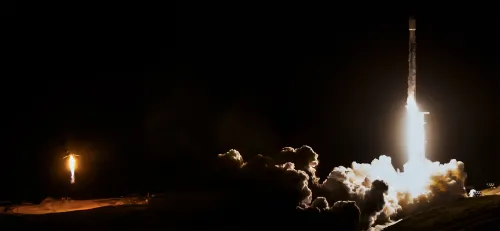
Satleo's TAPAS-1 — India's first thermal infrared camera by a private company — is set to launch on SpaceX Falcon 9 on 1 October from the United States .
The 3 kg payload will orbit at 500 km altitude and remain operational for three years .
Applications span agriculture , forest-fire detection , urban heat management , water stress monitoring , and climate research .
Satleo has raised ₹60 crore and secured Letters of Intent worth approximately USD 52 million , with 60% from international clients.
The company plans to launch eight more satellites of the same type by 2029 and has a team of over 40 professionals .
The launch aligns with Gujarat Spacetech Policy 2025-30 , which offers incentives for startups, launch cost support, and testing subsidies.
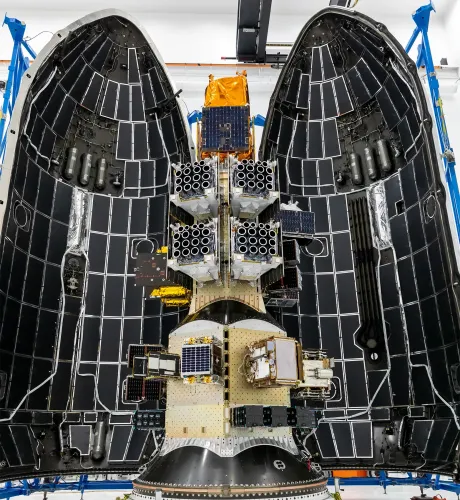
Ahmedabad-based spacetech startup Satleo is set to launch TAPAS-1 — described as India's first thermal infrared camera developed by a private company — aboard SpaceX's Falcon 9 rocket from the United States on 1 October. The payload, weighing 3 kg, will be deployed on a satellite in an orbit approximately 500 km above Earth, where it will detect heat patterns invisible to conventional satellite cameras.
What TAPAS-1 Does
The camera is engineered to capture thermal infrared radiation from Earth's surface, generating images that map temperature and heat variations across landscapes. Unlike standard optical cameras, it can see through the invisible thermal spectrum — a capability with wide-ranging real-world applications.
According to the company, the data has potential uses in agriculture, urban heat management, water stress monitoring, industrial and disaster monitoring, forest-fire detection, and climate research. The thermal data can further be processed using artificial intelligence to yield more granular insights for each domain.
What the Founders Said
Satleo CEO Shravan Singh highlighted the camera's utility for municipal governance: 'This data can be used to monitor forest fires. Besides, temperature variations across different areas of a city can be tracked in real time. Different areas of a city have different temperatures. This can help municipal corporations undertake the necessary planning to address heat stress,' he said.
Chief Strategy Officer Urmil Bakhai framed the technology in broader terms: 'This technology will function as a thermometer for the Earth. It can provide highly important data for the agricultural sector. Through this, planning required for crops can be undertaken in a more modern and accurate manner... Most importantly, there is no need to create any large-scale additional infrastructure for this purpose. This data will be available directly from the satellite,' Bakhai said.
The Team and Technology Behind Satleo
Satleo was founded in Ahmedabad in 2023 by Singh, Dr Ranendu Ghosh, and Bakhai. Singh brings over 16 years of experience in satellite-related innovations, while Ghosh spent 27 years at the Indian Space Research Organisation (ISRO), working on satellite payload technologies covering agriculture, hydrology, and soil science. Bakhai has more than 22 years of experience in corporate sales and leadership.
TAPAS-1 was developed entirely at Satleo's laboratory in Gujarat and is expected to remain operational in orbit for three years. The startup currently employs a team of more than 40 professionals and plans to launch eight additional satellites of the same type by 2029.
Funding and Commercial Pipeline
Satleo has so far raised ₹60 crore in funding. On the commercial front, the company has reportedly secured Letters of Intent worth approximately USD 52 million, with around 60 per cent of those commitments originating from companies outside India — a signal of early international traction.
The startup had earlier conducted a pilot project with the Ahmedabad Municipal Corporation, mapping temperature variations across different parts of the city. Following the commercial launch of TAPAS-1, Satleo plans to supply thermal imaging data to organisations across multiple sectors.
Gujarat's Spacetech Ambitions
The launch arrives amid a broader push by the Gujarat state government to cultivate a dedicated spacetech ecosystem. Under the Gujarat Spacetech Policy 2025-30, the state has announced incentives for startups and private investors, including assistance with launch costs, support for intellectual property rights, and subsidies for testing facilities. The policy is explicitly aimed at positioning Gujarat as a manufacturing and innovation hub for space technology.
Notably, TAPAS-1 marks the entry of a Gujarat-based startup into specialised satellite hardware and thermal imaging — a segment previously dominated by national agencies. With eight more satellites planned and international Letters of Intent already in hand, how Satleo scales its data business post-launch will be the real test of whether India's private spacetech sector can move from milestone to market.
Point of View
But the harder question is what comes after orbit insertion. Thermal infrared data is only as valuable as the analytics pipeline and the paying customers behind it — and with 60% of Letters of Intent coming from abroad, the company is effectively betting that global agri-tech and climate-services firms will pay for Indian satellite data before domestic institutions scale up procurement. The Gujarat Spacetech Policy provides a useful backstop, but state incentives rarely substitute for recurring commercial revenue. If Satleo can convert those Letters of Intent into signed contracts and demonstrate data quality post-launch, it will have built a replicable template for India's private space hardware sector. If not, TAPAS-1 risks becoming a technically successful but commercially premature venture — a pattern that has tripped up several first-generation spacetech startups globally.
NationPress
30 Sept 2026
Frequently Asked Questions
What is Satleo's TAPAS-1 and why is it significant?
TAPAS-1 is a 3 kg thermal infrared camera developed by Ahmedabad-based startup Satleo, described as India's first such camera built by a private company. It is significant because it can detect heat patterns on Earth that conventional satellite cameras cannot, with applications in agriculture, urban planning, forest-fire detection, and climate research.
When and how is TAPAS-1 being launched?
TAPAS-1 is scheduled to launch on 1 October aboard SpaceX's Falcon 9 rocket from the United States. It will be deployed on a satellite in an orbit approximately 500 km above Earth and is expected to remain operational for three years.
Who founded Satleo and what is their background?
Satleo was founded in Ahmedabad in 2023 by CEO Shravan Singh, Dr Ranendu Ghosh, and Chief Strategy Officer Urmil Bakhai. Singh has over 16 years of experience in satellite innovations, Ghosh spent 27 years at ISRO on satellite payload technologies, and Bakhai brings more than 22 years in corporate sales and leadership.
How much funding has Satleo raised and what is its commercial pipeline?
Satleo has raised ₹60 crore in funding to date. The company has also reportedly secured Letters of Intent worth approximately USD 52 million, with around 60% of those commitments from international clients, indicating early global commercial traction.
What are Satleo's plans after the TAPAS-1 launch?
Following the commercial launch, Satleo plans to supply thermal imaging data to organisations across agriculture, urban management, and other sectors. The company also aims to launch eight more satellites of the same type by 2029 and currently employs a team of over 40 professionals.