Are Violence and Crimes Against Minorities Being Whitewashed in Bangladesh?

Synopsis
In Bangladesh, a disturbing trend reveals police diluting charges against those committing violence against minorities, especially Hindus. This article explores how this systemic issue is reminiscent of tactics observed in Pakistan, as violence escalates and elections loom, posing significant implications for the region's political landscape.
Key Takeaways
Police are minimizing charges against violent offenders.
Jamaat-e-Islami is allegedly following ISI tactics.
Violence against minorities is being framed as personal disputes.
Social media is being used to incite mob violence.
Upcoming elections are heavily influenced by ongoing violence.
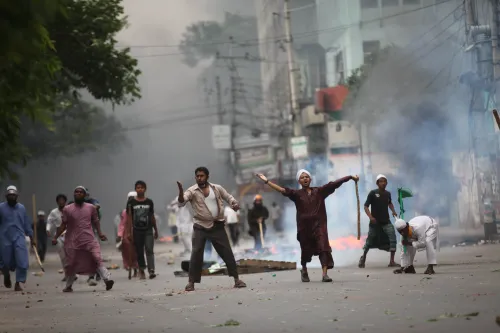
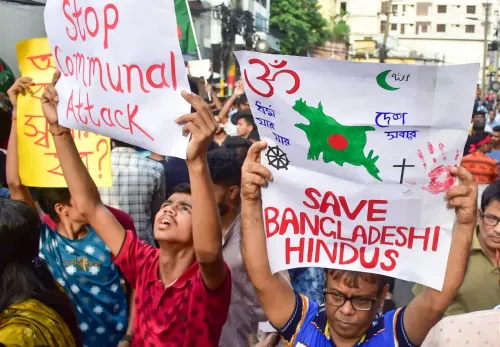
New Delhi, Dec 31 (NationPress) A troubling trend has emerged in Bangladesh, where law enforcement is increasingly minimizing charges against those who commit acts of violence against minority groups, especially the Hindus. These incidents are often misrepresented as mere accidents or private disputes.
According to intelligence reports, the Jamaat-e-Islami is executing a strategy akin to that of the ISI.
The overarching goal appears to be the systematic eradication of minority communities throughout the nation.
Whenever a minority individual is murdered, authorities typically frame it as a personal vendetta.
There have also been cases where Hindus are mischaracterized as foreign agents or outsiders.
For instance, the assassination of anti-India student leader, Osman Hadi, was portrayed as a targeted attack by Indian operatives.
One official noted that the intent is to cultivate an anti-India sentiment among Bangladeshis, mirroring the situation in Pakistan. While violence against minorities is not new in Bangladesh, the current tactics suggest that the Jamaat is following the ISI playbook.
Another alarming discovery by Indian intelligence is that extremists are being urged to view the murder of minorities as a duty. This mirrors longstanding practices in Pakistan.
The objective seems to be the identification and violent targeting of a specific community, fostering radical mobilization. Current events in Bangladesh reflect a disturbing replication of decades-long patterns witnessed in Pakistan.
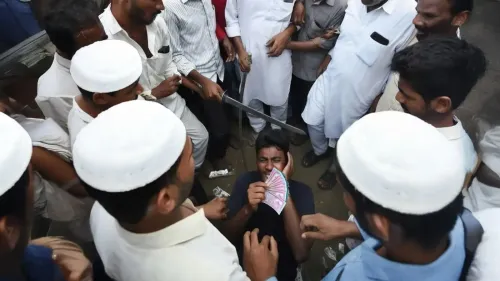
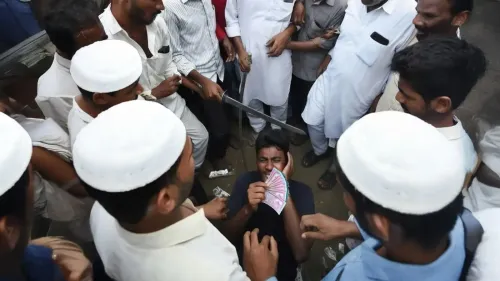
Jamaat-affiliated groups are also highly active on social media. Each time a minority member is killed, they attempt to invoke blasphemy allegations. These fabricated claims propagate rapidly, inciting mob violence and leading to further atrocities. This is a clear instance of organized violence, and Indian agencies warn that such occurrences are unlikely to cease soon.
The Jamaat and ISI are exploiting religious sentiments to mask their violent campaigns against minorities.
An official explained that these mobs frequently evade accountability. Charges filed against them are often weak and disconnected from the actual violence.
Despite widespread condemnation of this institutionalized violence, Bangladesh consistently refutes these allegations.
The filing of such trivial cases for grave offenses offers the government an opportunity to dismiss serious accusations.
An intelligence official remarked that while minorities are being targeted, there is also a concerted effort to foster an anti-India mindset among Bangladeshis.
This strategy would facilitate ISI operations in Bangladesh with greater public backing, according to the official.
Amidst these issues, there is also a strategy to disrupt or postpone elections.
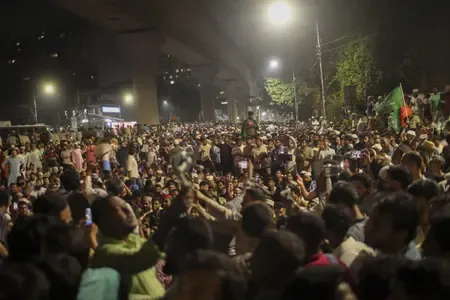
The ISI and Jamaat have vowed that there will not be a single day in Bangladesh without incidents of violence, aiming to pressure the Election Commission into delaying elections due to the ongoing chaos.
Moreover, the intent is to manipulate the electoral results. Such frequent violence creates an atmosphere of fear and instability.
The strategy appears designed to deter a significant number of voters from participating, thus tilting the outcome in favor of the Jamaat.
Indian agencies predict that the situation in Bangladesh will deteriorate further as elections approach. It is crucial for India to monitor any potential spillover effects from Bangladesh.
Point of View
It is imperative to bring attention to the plight of minorities in Bangladesh. The alarming trend of diluting charges against perpetrators of violence not only undermines justice but also threatens the very fabric of society. We must advocate for transparency and protection for all communities, ensuring that no voice is silenced.
NationPress
21 Sept 2026
Frequently Asked Questions
What is the main issue highlighted in the article?
The article discusses the trend of police diluting charges against perpetrators of violence against minorities, particularly Hindus, in Bangladesh.
How does this issue relate to political dynamics in Bangladesh?
The violence is viewed as a tactic to manipulate electoral outcomes and foster an anti-India sentiment among the populace.
What role does the Jamaat-e-Islami play in this situation?
The Jamaat-e-Islami is believed to be orchestrating these acts of violence, utilizing strategies similar to those employed by the ISI.
What is the expected impact on the upcoming elections?
The ongoing violence aims to create fear and instability, potentially influencing voter turnout and election results in favor of Jamaat.
What actions are being taken by Indian intelligence agencies?
Indian agencies are closely monitoring the situation in Bangladesh, warning that the violence could escalate as elections approach.