Chhattisgarh CMO launches 'Solar for All' to power every roof
Synopsis
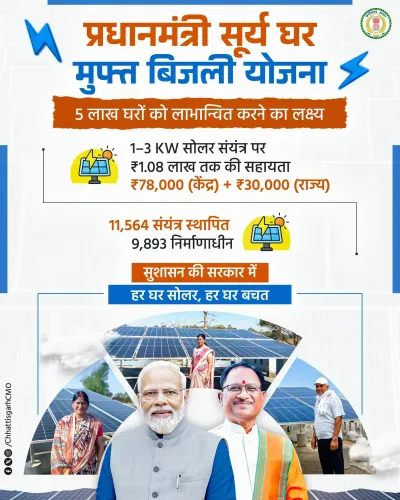
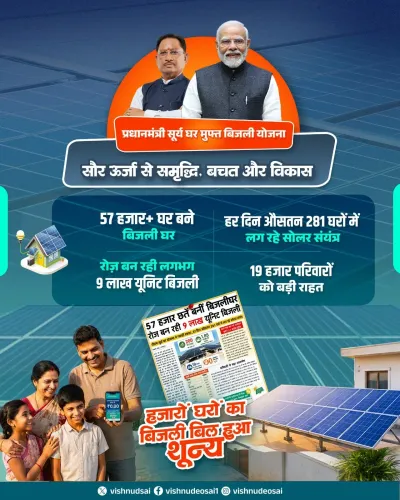
The Chhattisgarh Chief Minister's Office on 24 July 2026 announced the 'Solar for All' campaign, aiming to bring rooftop solar energy under PM Surya Ghar Muft Bijli Yojana to urban, rural, forest and multi-storey households across Bastar, Korba and Raipur districts.
Key Takeaways
The Chhattisgarh CMO announced the 'Solar for All' campaign on 24 July 2026 , targeting rooftop solar access across cities, villages, forest areas and multi-storey buildings.
The campaign is anchored to the central government's PM Surya Ghar Muft Bijli Yojana , launched in February 2024 , which targets one crore household solar installations nationally.
Districts specifically named include Bastar , Korba , and Raipur , representing tribal, industrial, and urban geographies respectively.
Chief Minister Vishnu Deo Sai , in office since December 2023 , is the political face of the initiative.
The campaign explicitly includes vananchal (forest-area) residents and apartment dwellers — two groups often excluded from standard rooftop solar rollouts.
India's target of 500 GW non-fossil fuel capacity by 2030 underpins the urgency of state-level solar campaigns like this one.
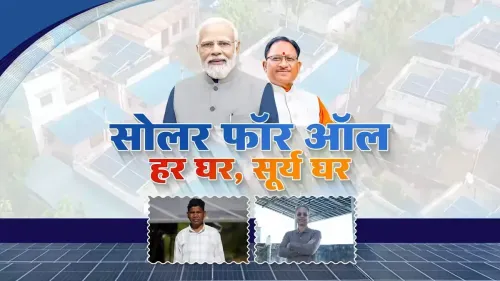
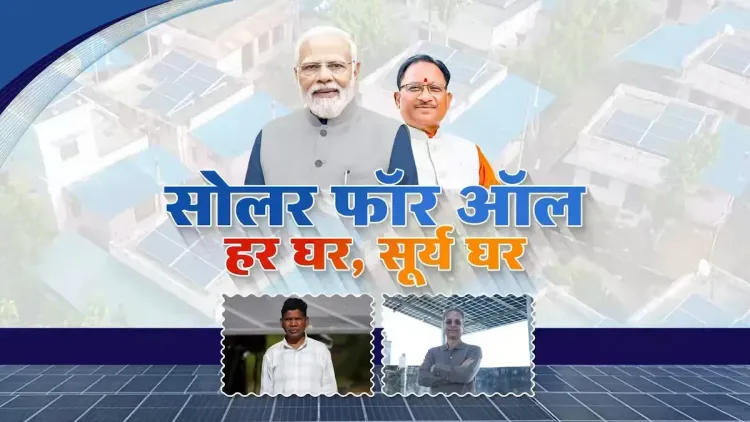
The Chief Minister's Office of Chhattisgarh on Friday, 24 July 2026, announced the 'Solar for All' (Solar Fॉr ऑल) campaign, pledging to extend rooftop solar energy benefits to cities, villages, forest regions, and multi-storey residential buildings across the state under the PM Surya Ghar Muft Bijli Yojana.
Context
The post, shared from the official CMO handle and tagging Chief Minister Vishnu Deo Sai alongside district accounts for Bastar, Korba, and Raipur, declared: 'Har chhat banegi urja ka srot, har parivar banega atmanirbhar' — 'Every roof will become a source of energy, every family will become self-reliant.' The message signals a state-level push to localise the central government's flagship rooftop solar scheme and reach segments of the population — particularly tribal and forest-dwelling communities — that standard urban-focused rollouts often miss.Policy Backdrop
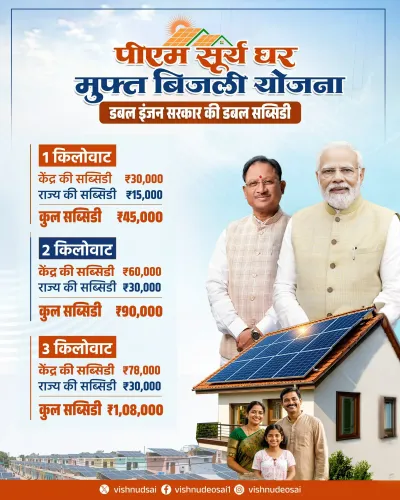
The PM Surya Ghar Muft Bijli Yojana, launched by the central government in February 2024, targets installation of rooftop solar panels on one crore households nationwide, providing beneficiaries up to 300 units of free electricity per month through subsidised installations. Chhattisgarh, a central Indian state with large tribal and forested hinterlands — including the Bastar division — presents a distinct implementation challenge: conventional grid-extension models have historically struggled to reach dispersed, remote settlements. The 'Solar for All' campaign appears designed to address this gap by explicitly naming vananchal (forest areas) and multi-storey housing alongside urban and rural zones as target geographies. India's broader renewable energy ambition — 500 GW of non-fossil fuel capacity by 2030 — gives states like Chhattisgarh a strong incentive to accelerate household solar uptake, and the National Solar Mission, first launched in 2010 and revised in 2015, laid the policy foundation on which these state-level extensions now build.Stakeholders and Impact
The campaign's stated reach spans four distinct beneficiary groups: urban households, rural families, residents of vananchal (forest-adjacent communities), and occupants of multi-storey apartment buildings — the last of which has historically been a regulatory grey zone for rooftop solar due to shared-roof ownership issues. Districts tagged in the post — Bastar, Korba, and Raipur — represent a deliberate geographic spread: Raipur is the state capital and its largest urban centre; Korba is a major coal and power hub where a solar transition carries symbolic weight; and Bastar is among India's most heavily forested and tribal districts, where energy access gaps remain acute. For households in these areas, successful enrolment under the scheme would mean subsidised installation costs and a significant reduction in monthly electricity bills.What's Next
Attention will now turn to district-level installation targets, subsidy disbursement timelines, and the administrative mechanism for enrolling multi-storey and forest-area households — categories that require adapted implementation frameworks beyond the standard rooftop solar model. CM Vishnu Deo Sai's government, in office since December 2023, has positioned good governance and welfare delivery as its defining mandate; the pace of connections under the 'Solar for All' campaign will be an early measurable test of that promise. State budget allocations and periodic performance disclosures from the tagged districts will be closely watched as indicators of whether the campaign's ambitions translate into verified household connections.Point of View
The BJP-led Chhattisgarh government is projecting inclusive governance optics at a moment when its development credentials matter electorally. The explicit inclusion of multi-storey housing and forest communities suggests the state is trying to close coverage gaps that have dogged PM Surya Ghar's national rollout. Whether the campaign produces verified household connections or remains aspirational will depend on the administrative machinery in districts where last-mile delivery has historically been weakest. Watched against India's 2030 clean energy targets, Chhattisgarh's localised push is part of a broader competitive dynamic among states to demonstrate solar absorption capacity and unlock central subsidy flows.
NationPress
24 Jul 2026
Frequently Asked Questions
What is the 'Solar for All' campaign in Chhattisgarh?
The 'Solar for All' campaign is a Chhattisgarh state initiative announced on 24 July 2026 to extend rooftop solar energy benefits — under the central PM Surya Ghar Muft Bijli Yojana — to urban, rural, forest-area and multi-storey residential households across the state.
What is PM Surya Ghar Muft Bijli Yojana?
PM Surya Ghar Muft Bijli Yojana is a central government scheme launched in February 2024 that subsidises rooftop solar panel installation for households, providing beneficiaries up to 300 units of free electricity per month. The scheme targets one crore households nationwide.
Which districts in Chhattisgarh are targeted under Solar for All?
The Chhattisgarh CMO's post specifically tagged Bastar, Korba, and Raipur districts, covering tribal forest regions, a major power-sector hub, and the state capital respectively.
Who is the Chief Minister of Chhattisgarh in 2026?
Vishnu Deo Sai is the Chief Minister of Chhattisgarh, heading a BJP-led government that took office in December 2023.
How does Chhattisgarh's Solar for All campaign help tribal and forest communities?
The campaign explicitly names vananchal (forest areas) as a target geography, aiming to bring subsidised rooftop solar to tribal and forest-dwelling households that are often beyond the reach of conventional grid-extension or urban-focused solar programmes.