CM Himanta Defends UCC Assam as Secular, Pro-Integration Law
Synopsis
Assam Chief Minister Himanta Biswa Sarma has defended the proposed UCC Assam as a secular law that promotes national integration by replacing religion-based personal laws, while assuring it will not disturb religious or indigenous traditional practices.
Key Takeaways
CM Himanta Biswa Sarma described #UCCAssam as a 'secular law' that overrides personal laws to ensure national integration.
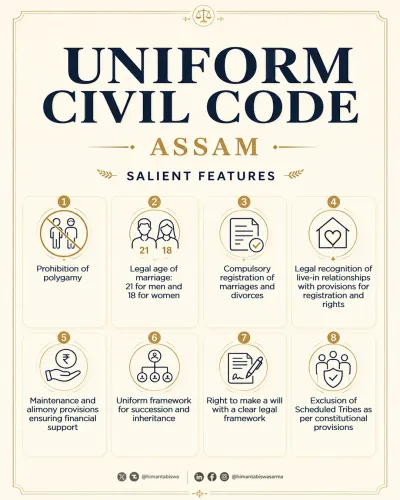
He explicitly assured that the code will not interfere with the religious practices of any community or the traditional practices of Assam 's indigenous peoples.
Article 44 of the Indian Constitution mandates the State to endeavour to secure a Uniform Civil Code for all citizens.
Uttarakhand became India's first state to enact a UCC in 2024 , setting a precedent for BJP -ruled states.
A formal UCC bill in the Assam Legislative Assembly and potential constitutional challenges before the Gauhati High Court are the next key milestones to watch.
Assam 's complex tribal landscape — with communities protected under the Sixth Schedule — makes the scope of indigenous exemptions a critical legal question.
Assam Chief Minister Himanta Biswa Sarma on Wednesday, 27 May 2026 defended the proposed Uniform Civil Code for Assam (#UCCAssam), describing it as a secular legislation that will foster national integration by replacing religion-based personal laws with a single common framework — while explicitly assuring that it will not disturb the religious or traditional practices of any community, including the state's indigenous peoples.
Context
Responding to a query on the social media platform X, CM Sarma stated that the #UCCAssam 'is a secular law which overrides personal laws and will ensure national integration by removing disparate loyalties to law which have contracting ideologies.' He further clarified that the code 'doesn't interfere with the religious practices of any community or traditional practices of our indigenous.' The remarks come as the Assam government has been actively deliberating the introduction of a state-level Uniform Civil Code, following the trail blazed by Uttarakhand in 2024.
The twin assurances — secular character on one hand, and protection of indigenous customs on the other — reflect a careful political calibration in a state where tribal and ethnic identities are constitutionally protected and politically significant. Assam is home to dozens of Scheduled Tribes and indigenous communities whose customary laws govern matters of marriage, inheritance, and land.
Policy Backdrop
Article 44 of the Indian Constitution (1950) places a Uniform Civil Code among the Directive Principles of State Policy, directing the State to 'endeavour to secure for the citizens a uniform civil code throughout the territory of India.' For decades, the provision remained aspirational, with successive governments citing social sensitivity as a reason for inaction.
The debate was reignited by the Shah Bano case in the 1980s and has periodically resurfaced through Law Commission consultations. Uttarakhand became the first state to enact a UCC in 2024, after the BJP made it a key manifesto commitment in both the 2014 and 2019 general elections. BJP-ruled states have since framed UCC measures as instruments of legal uniformity and national cohesion rather than as assaults on minority identity.
In the Northeast, the political calculus is more complex. Many tribal communities in Assam enjoy protections under the Sixth Schedule of the Constitution, which grants Autonomous District Councils the power to legislate on customary law. Any UCC framework for the state would need to navigate — or explicitly carve out — these constitutional safeguards, which is precisely the assurance CM Sarma appears to be offering.
Stakeholders and Impact
The proposed #UCCAssam has drawn attention from at least three broad constituencies. Religious minorities, including Assam's significant Muslim population, have historically viewed UCC proposals with concern, fearing the erosion of personal law protections in matters such as marriage, divorce, and inheritance. CM Sarma's framing of the code as 'secular' — rather than as a majoritarian measure — appears aimed directly at this audience.
Indigenous and tribal communities represent a second, equally important stakeholder group. The Chief Minister's explicit reference to 'traditional practices of our indigenous' signals an intent to build in exemptions or carve-outs, a model that Uttarakhand's UCC also partially adopted for Scheduled Tribes. Civil society organisations and legal scholars are likely to scrutinise the precise scope of any such exemptions once a formal bill is tabled.
What's Next
The immediate watch-point is the tabling of a formal UCC bill in the Assam Legislative Assembly. Once introduced, the legislation would face scrutiny on whether its provisions genuinely protect indigenous customary law and whether the 'secular' characterisation withstands constitutional challenge. Any enacted law could face petitions before the Gauhati High Court or, ultimately, the Supreme Court of India.
If Assam proceeds, it would become the second BJP-governed state to operationalise a UCC, potentially accelerating similar moves in other Northeast states within CM Sarma's NEDA alliance. The debate around #UCCAssam is, in effect, a regional preview of a national conversation that shows no sign of receding.
Point of View
Designed to pre-empt the most potent political objection to the legislation. The simultaneous assurance on indigenous customs reflects the Northeast's distinct constitutional landscape, where Sixth Schedule protections make a blanket UCC legally and politically hazardous. Together, the two planks position Assam's UCC not as a replication of the national BJP template but as a regionally adapted variant — one that may serve as a blueprint for other NEDA-aligned states. Whether the eventual bill's text matches the Chief Minister's assurances will determine both its legal durability and its political reception.
NationPress
11 Oct 2026
Frequently Asked Questions
What is UCC Assam and what does it propose?
UCC Assam refers to the proposed Uniform Civil Code for the state of Assam, which aims to replace religion-based personal laws governing marriage, divorce, and inheritance with a single secular framework applicable to all citizens, while reportedly protecting indigenous and tribal customary practices.
Will UCC Assam affect tribal and indigenous communities?
CM Himanta Biswa Sarma has stated that the UCC Assam will not interfere with the traditional practices of indigenous communities. However, the precise legal carve-outs will only become clear once a formal bill is tabled in the Assam Legislative Assembly.
Is a Uniform Civil Code constitutional in India?
Yes. Article 44 of the Indian Constitution lists a Uniform Civil Code as a Directive Principle of State Policy, meaning the State is directed to endeavour to secure it. States such as Uttarakhand have already enacted UCC legislation, establishing a legal precedent.
Which state first enacted a Uniform Civil Code in India?
Uttarakhand became the first Indian state to enact a Uniform Civil Code in 2024, following BJP manifesto commitments made in the 2014 and 2019 general elections.
What happens after Assam tables a UCC bill?
Once tabled in the Assam Legislative Assembly, the bill would be debated and, if passed, could face constitutional challenges before the Gauhati High Court or the Supreme Court of India, particularly on questions of tribal exemptions and minority personal law protections.