Giriraj Singh Hails PLI Scheme: ₹2.4 Lakh Crore Investment, 14 Lakh Jobs
Synopsis
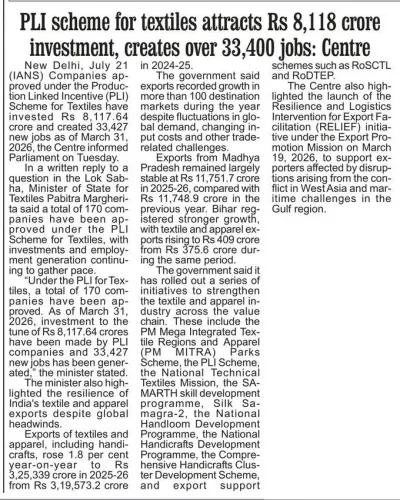
Union Textiles Minister Giriraj Singh on 22 July 2026 cited PLI scheme data showing ₹2.4 lakh crore in investment attracted and over 14 lakh jobs created till March 2026, calling it a major policy success under the Atmanirbhar Bharat framework.
Key Takeaways
Union Textiles Minister Giriraj Singh posted on 22 July 2026 highlighting PLI scheme outcomes.
The scheme has reportedly attracted ₹2.4 lakh crore in investment across covered sectors.
Over 14 lakh jobs have been created under the PLI framework up to March 2026 , per figures cited by the minister.
The PLI scheme was expanded in 2021 to 13 sectors , including textiles (man-made fibre and technical textiles).
The Ministry of Textiles and DPIIT are expected to release detailed performance reports that will independently verify these figures.
The announcement fits India's post-2020 industrial policy shift under the Atmanirbhar Bharat and Make in India frameworks.
Union Textiles Minister Giriraj Singh on Wednesday, 22 July 2026 highlighted the performance of the Production Linked Incentive (PLI) scheme, citing figures of ₹2.4 lakh crore in investment attracted and over 14 lakh jobs created up to March 2026, calling it a major success of the central government's industrial policy.
Context
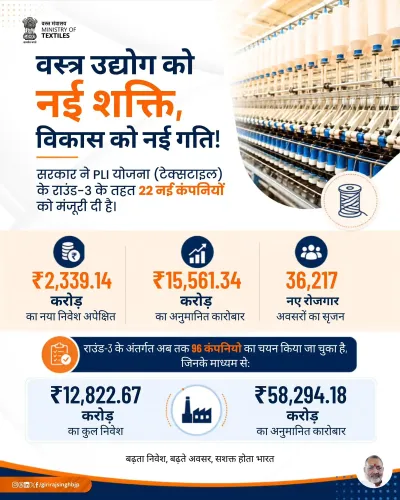
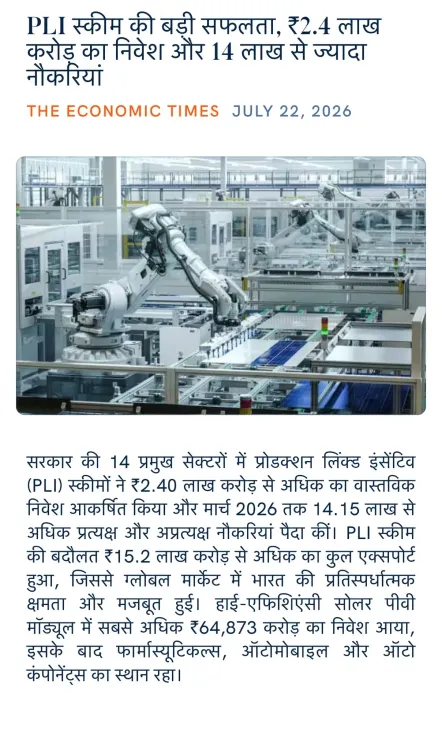
Posting on X via the NaMo App, Singh wrote: 'PLI स्कीम की बड़ी सफलता, ₹2.4 लाख करोड़ का निवेश और 14 लाख से ज्यादा नौकरियां' — translated as 'Big success of the PLI scheme: ₹2.4 lakh crore in investment and more than 14 lakh jobs.' The post was accompanied by an image and a link to a detailed economic policy report on the scheme's cumulative performance across sectors.
The PLI scheme was first introduced in the Union Budget 2020-21 for the electronics sector and was subsequently expanded in 2021 to cover 13 sectors, including textiles — specifically man-made fibre apparel and technical textiles. The Ministry of Textiles is among the nodal ministries responsible for implementing the scheme in its designated product categories.
Policy Backdrop
The PLI framework offers financial incentives tied to incremental production and sales, positioning itself as a successor to earlier Make in India efforts under the broader Atmanirbhar Bharat initiative. The scheme is designed to raise domestic value addition, reduce import dependence, and scale up employment in both labour-intensive and technology-intensive industries.
Successive Union Budgets and economic surveys from 2022 onward have included periodic reviews and additional allocations for PLI across sectors. The Department for Promotion of Industry and Internal Trade (DPIIT) and individual ministries have periodically published performance updates tracking committed investment, actual disbursements, and direct employment generated.
Stakeholders and Impact
The primary beneficiaries of the PLI scheme include textile manufacturers, large-scale manufacturing investors, and the broader Indian workforce in the organised manufacturing sector. If the cited figures of ₹2.4 lakh crore in investment and 14 lakh-plus jobs are borne out by official audits, they would represent one of the largest employment outcomes attributed to a single industrial incentive programme in recent Indian economic history.
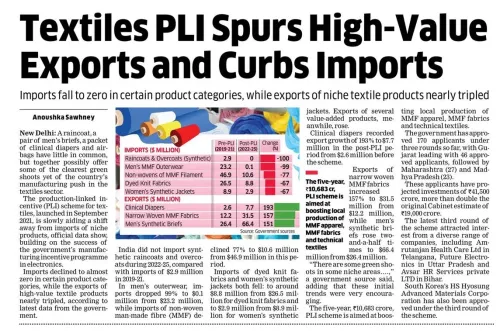
For the textiles sector specifically, PLI coverage of man-made fibre products and technical textiles has been seen as a strategic push to diversify India's manufacturing base beyond conventional cotton-based exports and into higher-value segments that compete with producers in China, Vietnam, and Bangladesh.
What's Next
Attention will now turn to the next quarterly or annual PLI performance report from DPIIT or the Ministry of Textiles, which would provide independently compiled data on fund disbursements alongside the investment and employment figures cited by the minister. Parliamentary questions during the ongoing or upcoming session are also expected to probe the granular breakdown of job creation across individual PLI sectors.
As the government approaches the next budget cycle, the PLI scheme's aggregate performance metrics are likely to feature prominently in official economic assessments, with ministers across portfolios expected to cite sector-specific outcomes to make the case for continued or enhanced outlay under the programme.
Point of View
The messaging targets two distinct audiences — investors and voters — simultaneously. The post also fits a wider pattern of BJP ministers using the NaMo App ecosystem to reinforce Atmanirbhar Bharat credentials ahead of legislative sessions where opposition scrutiny of scheme disbursements is expected to intensify. Independent verification of the ₹2.4 lakh crore and 14 lakh jobs figures through DPIIT audit reports will be the real test of how durable this narrative proves.
NationPress
22 Jul 2026
Frequently Asked Questions
What is the PLI scheme and which sectors does it cover?
The Production Linked Incentive (PLI) scheme offers financial incentives tied to incremental production and sales in designated sectors. It was launched in 2020-21 for electronics and expanded in 2021 to 13 sectors, including textiles (man-made fibre apparel and technical textiles), pharmaceuticals, food processing, and others.
How much investment has the PLI scheme attracted according to Giriraj Singh?
Union Textiles Minister Giriraj Singh cited a figure of ₹2.4 lakh crore in investment attracted under the PLI scheme up to March 2026. These figures are pending independent verification through official DPIIT or Ministry of Textiles performance reports.
How many jobs has the PLI scheme created in India?
According to figures cited by Giriraj Singh on 22 July 2026, the PLI scheme has created over 14 lakh jobs across covered sectors up to March 2026. Official audit reports from DPIIT are expected to provide a sector-by-sector breakdown.
What is the PLI scheme's role in the textiles sector?
The PLI scheme covers man-made fibre apparel and technical textiles in the textiles sector, with the Ministry of Textiles as the nodal body. It aims to raise domestic value addition and help Indian manufacturers compete with producers in China, Vietnam, and Bangladesh.
What is Atmanirbhar Bharat and how does PLI relate to it?
Atmanirbhar Bharat, or 'Self-Reliant India,' is the central government's overarching economic framework announced in 2020 to boost domestic manufacturing and reduce import dependence. The PLI scheme is one of its flagship instruments, designed to attract investment and generate employment in strategic sectors.