Women Leaders Applaud Women's Reservation Bill as a Landmark Move for Empowerment
Synopsis
The Women's Reservation Bill is hailed as a pivotal step towards enhancing women's representation in legislative bodies. Leaders across the political spectrum emphasize the importance of merit-based opportunities while celebrating this significant advancement in women's empowerment.
Key Takeaways
The Women's Reservation Bill reserves 33% of legislative seats for women.
Support from various political leaders highlights its importance.
The need for merit-based opportunities is emphasized alongside the Bill.
Implementation timelines have been a point of concern for activists.
The initiative is viewed as a significant step towards gender equality.
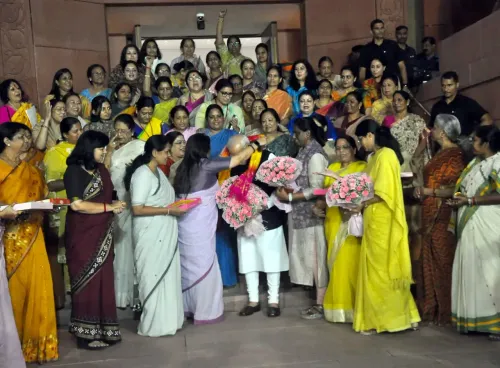
New Delhi, April 5 (NationPress) The Women’s Reservation Bill has captured the attention of both political and social spheres, with many notable figures heralding it as a crucial advancement for enhancing women’s representation in legislative assemblies. However, there are calls for ensuring merit-based openings and prompt execution of the provisions.
Spiritual figure Jaya Kishori praised the initiative, viewing it as a positive stride forward. She stated, “This is a very good thing. Women will gain a significant opportunity, which is encouraging. However, it should be allocated to those who are genuinely capable and deserving of these positions. All in all, it’s a beneficial initiative to elevate women and provide them with rightful opportunities.”
BJP MP Aparajita Sarangi echoed this sentiment, recognizing the central government’s ongoing commitment under Prime Minister Narendra Modi to promote women’s empowerment, safety, and dignity. She remarked, “The Modi government has consistently worked towards uplifting women, ensuring their development, safety, and dignity.”
She underscored the importance of the Nari Shakti Vandan Adhiniyam, which guarantees a 33 percent reservation for women in the Lok Sabha and state legislative assemblies. “As a woman, I am incredibly pleased. In 2023, Parliament passed the Nari Shakti Vandan Adhiniyam, reserving 33% of seats for women in the Lok Sabha and state assemblies. This is a tremendous accomplishment. The special session of Parliament on April 16, 17, and 18 signifies three essential points: First, the provisions of the Nari Shakti Vandan Adhiniyam, including the 33% reservation, will be put into action,” she added.
Shamina Shafiq, a former member of the National Commission for Women and a Congress leader, highlighted the long-standing demand for women’s reservation. She noted that calls for women’s representation have been increasingly resonating nationwide. “The Women’s Reservation Bill has been on hold for many years, and the demand for women’s representation has been growing louder across the country. Social activists, female politicians, and women from diverse backgrounds have stressed that adequate reservation is necessary for ensuring that women’s voices are acknowledged in the legislature,” she mentioned.
She further referred to recent advancements, noting that Prime Minister Modi's announcement of special sessions and the introduction of the bill has been widely welcomed as a commendable action.
In a similar vein, BJP worker Rupali stated that the party, under PM Modi’s guidance, has consistently prioritized women’s empowerment. “Under Modi’s leadership, the BJP has always valued and provided opportunities for women. I have also benefited from such opportunities, and now the discussion around 33 percent reservation is a very encouraging step,” she expressed.
Social activist Yogita Bhayana pointed out that, while the initiative is welcomed, it has come after an extensive delay. She noted that although the bill had previously been passed, its implementation timeline has postponed its actual effects. “This should have been enacted much sooner. Although the bill was approved several years ago, it is anticipated to take effect in 2029. Nonetheless, with the recent announcement, serious action will commence immediately. It is a very positive move, and we should express gratitude to those who initiated it,” she commented.
At the community level, women in Sitapur expressed hope regarding the anticipated rise in political involvement. BJP Mahila Morcha member Sheetal Agrawal mentioned that the allocation of 33 percent reservation would significantly empower women, whose representation has historically been much lower than that of men.
Meanwhile, in Amethi, Rita Singh, National President of Rita Singh Jan Kalyan, backed the initiative while stressing that further efforts are needed. “What Prime Minister Narendra Modi is advocating is entirely accurate. Women have received reservations, yet there are still areas requiring more attention for women,” she stated.
Point of View
It is essential to recognize the significance of the Women's Reservation Bill. This legislation is a pivotal development in the ongoing journey towards gender equality in India. While it has garnered widespread support, it is crucial to ensure that meritocracy and timely implementation accompany this initiative to truly empower women.
NationPress
15 Oct 2026
Frequently Asked Questions
What is the Women's Reservation Bill?
The Women's Reservation Bill aims to reserve 33% of seats for women in the Lok Sabha and state legislative assemblies to enhance their representation in governance.
Why is the Women's Reservation Bill significant?
It is significant as it addresses the long-standing demand for women's representation in legislative bodies, promoting gender equality in political participation.
Who are some key supporters of the Bill?
Key supporters include BJP MP Aparajita Sarangi, former National Commission for Women member Shamina Shafiq, and various women's rights activists.
What does the Nari Shakti Vandan Adhiniyam entail?
It is the legislation under which the 33% reservation for women in the Lok Sabha and state assemblies is provided.
When is the implementation of the Bill expected?
While the Bill has been passed, its implementation is anticipated to begin in 2029.